

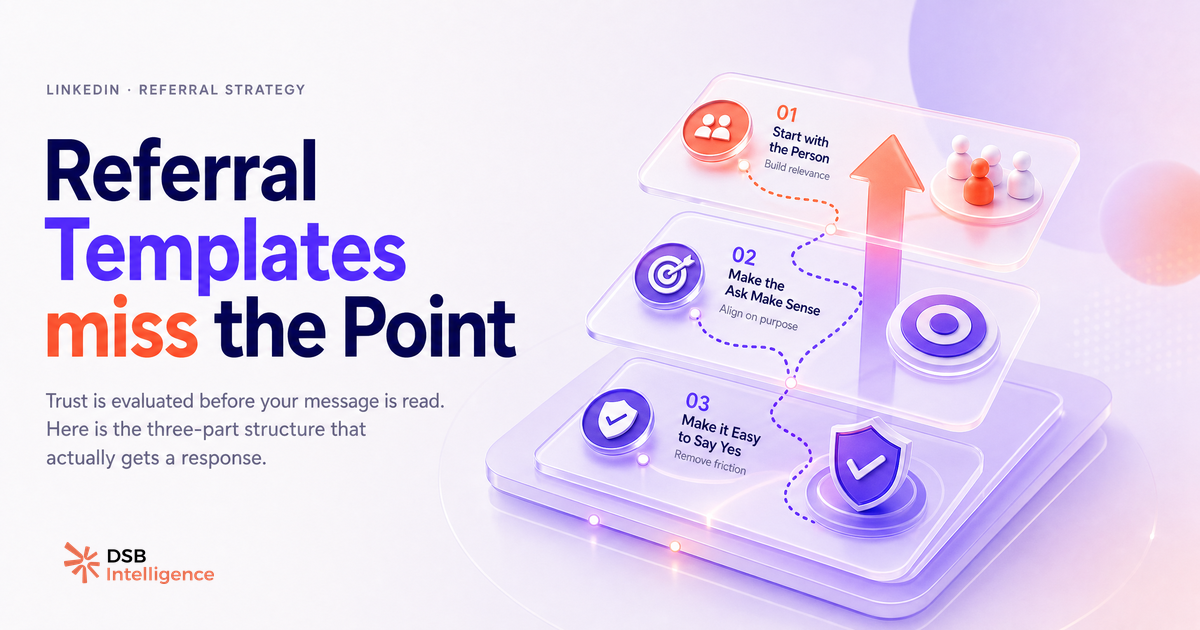
The template is not the problem. The relationship is.
Most people searching for a LinkedIn referral template are solving the wrong bottleneck. They spend 45 minutes polishing the wording of a message sent to someone who has no reason to act on their behalf. The reply rate stays at zero. The template gets blamed.
Why do most LinkedIn referral templates fail before the first word?
They fail because the ask precedes the relationship. A referral is a social voucher: the person giving it stakes a small piece of their reputation on you. No amount of clever framing changes that calculus.
The pattern is consistent. Someone finds a job posting or a target account, searches their first-degree connections for a name that fits, and fires off a message. The connection is 18 months old, the last interaction was a generic "congrats on the new role" notification, and the message opens with "I hope this finds you well."
That is not a warm introduction request. That is a cold outreach with a familiar face attached.
The fix is not a better opening line. It is asking the right person at the right moment. Everything else is secondary.
What does a referral message actually need to do (and it is not about the format)?
A referral message needs to lower the cost of saying yes. That is its only job.
Your contact has to picture themselves forwarding your message, adding a line of endorsement, and feeling comfortable with both. If they cannot do that in 10 seconds, they will not reply. Not because they dislike you — because the friction is too high.
Three things raise that friction:
A vague ask forces the contact to do all the work. "Could you put me in touch with someone at Acme?" means they have to figure out who, draft the intro, and decide how to frame you. That is a lot of invisible labor.
No context makes the ask feel transactional. If there is no shared signal anchoring the message — a conversation you had, a post they commented on, a problem you both know exists — the request reads as opportunistic.
No exit ramp creates social pressure. If declining feels awkward, many contacts will simply not reply rather than say no. Silence is easier than a polite refusal.
A good linkedin referral message removes all three friction points before the contact even finishes reading.
What is the 3-part structure that gets replies: context, ask, exit ramp?
This structure works because it mirrors how people actually process a favor request. It is not a formula — it is a sequence that matches the contact's mental checklist.
Part 1: Context. Open with a shared signal, not a pleasantry. "Saw your comment on [Name]'s post about enterprise sales cycles last week" is a context line. "Hope you're doing well" is not. The context line tells the contact: you are paying attention, this is not a mass message, and there is a real reason you are reaching out now.
Part 2: The specific ask. Name the person or the role. "I'd love a warm intro to [Name], your VP of Partnerships" is a specific ask. "Could you connect me with someone at your company" is not. Specificity makes the ask easy to act on and signals that you have done your homework.
Part 3: The exit ramp. Give the contact a frictionless way to decline. "If the timing is off or it feels awkward, no worries at all — just thought it was worth asking" does two things: it signals that you respect the relationship more than the outcome, and it paradoxically makes people more likely to say yes.
The whole message should fit in 5-7 sentences. If it is longer, you are over-explaining. Over-explanation signals low confidence in the ask.
For a deeper look at the mechanics of referral requests on LinkedIn, the article How to Ask for a Referral on LinkedIn (That Works) covers the pre-ask preparation in more detail.
How does the Recommendations Engine flag which contacts are warm enough to ask?
Knowing who to ask is a data problem. Most people solve it with gut feel, which means they either ask too early (cold contact, awkward silence) or too late (the opportunity has passed).
The signals that actually predict referral readiness are interaction recency and depth. A contact who commented on your post last week, replied to a DM two weeks ago, and engaged with your content three times in the past month is warm. A first-degree connection you have not exchanged a word with in six months is not, regardless of how strong the original relationship felt.
DSB Intelligence's Recommendations Engine surfaces exactly this: it identifies contacts whose recent interaction pattern suggests they are primed for a direct ask, so you are not guessing at warmth from memory. It flags the signal early, before the window closes.
This matters because timing is not just a nice-to-have. Sending a b2b referral outreach message within a few days of a meaningful touchpoint feels natural. Sending it three weeks later, when the interaction has faded from both sides, feels calculated.
If you are thinking about how your content strategy affects the quality of these interactions in the first place, How to Publish Articles on LinkedIn (and Why Most B2B Creators Quit Too Soon) is worth reading alongside this. And for a format that consistently generates the kind of dwell time that builds familiarity, Comment faire un carrousel LinkedIn qui retient l'attention covers the mechanics.
For context on what LinkedIn Premium actually changes (and does not change) in outreach, LinkedIn Sales Navigator vs Premium : le verdict gives a clear-eyed comparison.
What should you do when the referral goes cold after the first reply?
The first reply is not a conversion. It is the beginning of a short negotiation.
A contact who says "sure, let me think about who to connect you with" and then goes quiet is not hostile. They are busy, and your ask has slipped down their priority list. The mistake is to interpret silence as rejection and either give up or send a follow-up that repeats the original ask verbatim.
One follow-up is appropriate. The rule is that it must add value, not just add pressure.
A value-adding follow-up looks like this: you send a piece of context that makes the introduction easier for them. A short note about why you want to reach the specific person. A relevant article that frames the problem you are trying to solve. An update that gives them something new to say when they make the intro.
"Just following up on my message" adds nothing. It signals that you are tracking their non-response, which creates pressure without giving them a reason to act.
If the second message also goes unanswered, let it go. A contact who does not respond to two well-crafted messages is telling you something about the relationship. Pushing further damages it.
For more context on how LinkedIn data and scraping tools fit into outreach workflows, Bright Data LinkedIn Scraper : ce qu'il fait vraiment is a useful reference on what is technically possible and where the limits are.
Et maintenant ?
- Audit your last 10 referral messages: did each one have a context line, a specific ask, and an exit ramp? If not, rewrite the next one before you send it.
- Before your next ask, check the interaction history with that contact: last message, last comment, last engagement. If there is nothing in the past 30 days, warm the relationship first.
- For any referral that went cold after the first reply, draft one follow-up that adds a concrete piece of context — not a reminder.
- If identifying warm contacts at scale is the bottleneck, try DSB Intelligence free and let the Recommendations Engine surface the right moment to ask.