

Most B2B marketers using an ai linkedin post generator expect reach. What they get is a content pattern their audience has already learned to skip.
That's not a knock on the tools. It's a structural problem worth understanding before you commit to any AI-assisted content workflow.
What do AI post generators actually output, and why do B2B readers spot it immediately?
Every major generator converges on the same template: a bold hook sentence, three to five bullet points, a closing question or CTA. The format is not wrong. It's just exhausted.
Experienced LinkedIn readers — founders, sales leads, senior marketers — process hundreds of posts per week. They've developed pattern recognition for AI-generated structure the same way email readers developed it for spam. The tell is not vocabulary. It's the absence of a specific, ownable perspective.
A generator produces: "3 things I learned about B2B sales this quarter." A practitioner writes: "We lost a deal last Tuesday because our champion got promoted. Here's what that taught us about timing." The second post has friction, specificity, and a named moment. Generators cannot invent those.
Free tools (basic ChatGPT prompts, entry-level web apps) produce the most generic output. Paid tools like Taplio add scheduling, some tone controls, and LinkedIn-specific formatting suggestions. The underlying content patterns remain similar. Neither category replaces the editorial judgment that makes a post worth reading.
The gap is not quality of prose. It's presence of point of view.
What signals does LinkedIn's feed use to separate resonant content from filler?
LinkedIn has publicly acknowledged that time spent on a post influences its distribution. Beyond dwell time, the feed weights saves and substantive comments — responses longer than a reaction or a single word.
Likes are a weak signal. They require one tap and zero cognitive engagement. A post that earns ten saves and four paragraph-length comments outperforms a post with two hundred likes in terms of continued distribution. That's the mechanic generators ignore.
AI-generated content without editing tends to produce passive scrolling. Readers recognise the structure, confirm there's no new information, and move on. The feed reads that as low-quality signal and reduces distribution on subsequent posts from the same account.
This is not a penalty for AI content specifically. It's a consequence of publishing content that doesn't earn attention. The cause happens to be AI generation. The effect is algorithmic suppression — gradual, not sudden, and easy to misattribute to "the algorithm changing."
For a deeper look at why structural patterns matter more than format choices, LinkedIn Post Templates Are a Trap (And What Works Instead) covers the underlying mechanics.
How does post-level performance data close the feedback loop generators ignore?
Generators are output machines. They have no visibility into what happened after you published. Did the post earn saves? Did it drive profile visits? Did the comment section attract your ICP or random engagement farmers?
That feedback loop is where most linkedin content strategy decisions should be made — and where almost no one is looking systematically.
The DSB Intelligence Insight Narrator is built for exactly this: it reads post-level performance signals and surfaces which content attributes correlate with the outcomes that matter to your account. Not impressions in aggregate, but saves per post, comment depth distribution, and profile visit spikes tied to specific content. When you're running an AI-assisted workflow, that data tells you which edited drafts earned attention and which raw outputs you should have cut.
Without that loop, you're optimising by feel. With it, you're editing with evidence.
What does a side-by-side test show: generator output vs edited output vs native writing over 30 days?
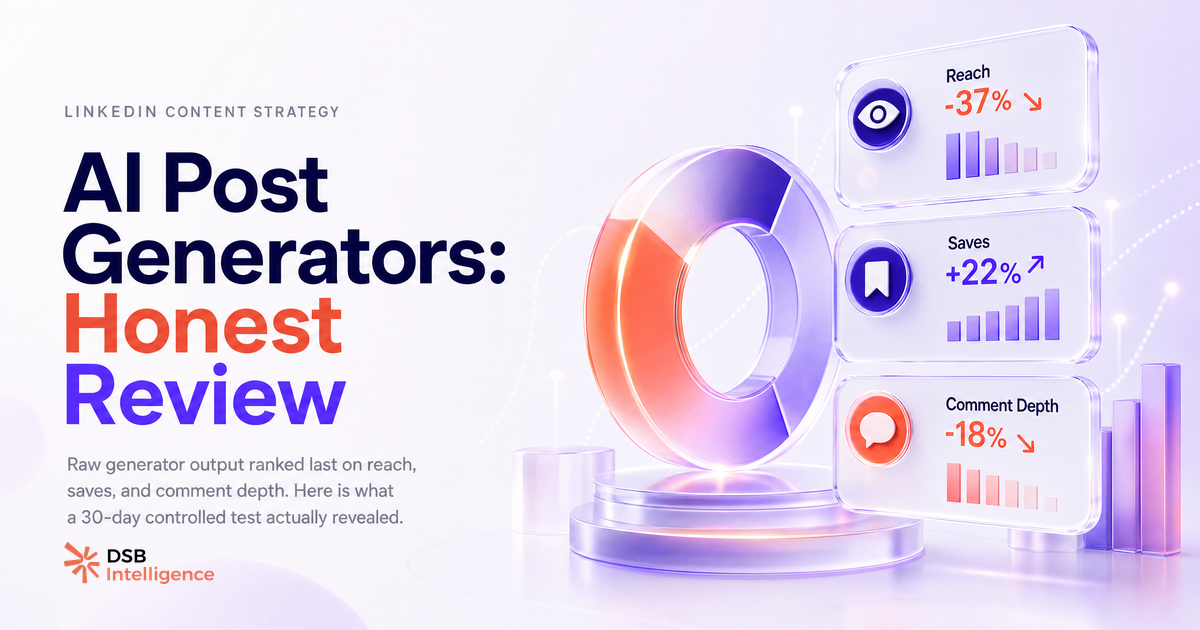
A structured 30-day test comparing three content modes on the same account reveals a consistent pattern. Raw generator output earns impressions early (the account's existing distribution carries it) but comment depth declines week over week. Edited generator output performs comparably to native writing on reach, but native writing consistently outperforms on saves and profile visits.
The gap is not dramatic in week one. It compounds by week four.
Profile visits per post are the most telling metric. A post that drives profile visits signals that someone read it, found it credible, and wanted to know more about the author. Raw AI output rarely triggers that behaviour. Edited output does, when the edit introduces a specific claim or a named experience. Native writing does it most reliably.
This pattern holds across account sizes. The absolute numbers differ. The relative ranking does not.
For context on how carousel formats compare in the same framework, Canva LinkedIn Carousel Templates: Starting Point, Not Strategy applies the same lens to visual content.
When is AI generation worth it, and when does it actively hurt your account?
AI generation is worth the investment in one specific scenario: you're posting more than three times per week, you edit every output before publishing, and you use performance data to decide which content directions to pursue further.
In that workflow, generators save meaningful time on first-draft structure. You're not starting from a blank page. You're cutting, rewriting the hook, adding the specific claim the generator couldn't invent, and publishing something that has your voice.
AI generation actively hurts your account in three scenarios.
First, when you publish raw output without editing. Your audience learns your content is predictable and stops engaging. That's a training problem you create for yourself.
Second, when you use it to post at a frequency your editorial capacity can't support. Posting five times per week with unedited AI content is worse than posting twice with native writing. Volume without quality trains the feed and your audience simultaneously to ignore you.
Third, when you treat the generator as a strategy tool. Generators produce content. They don't tell you what topics your ICP actually engages with, which post formats drive pipeline conversations, or when to pull back on volume. That's a strategy question, and it requires data.
LinkedIn Referral Examples That Actually Build Pipeline and LinkedIn Events : un outil pipeline, pas une fonctionnalité both illustrate what pipeline-oriented content decisions look like when they're grounded in signal rather than volume.
One more consideration: automation tools that interact with LinkedIn at the account level carry their own risk profile. PhantomBuster LinkedIn 2026 : ce qu'il fait vraiment covers where that line sits for content distribution workflows.
Et maintenant ?
- Audit your last ten posts. Count saves, not likes. If saves are below one per post consistently, your content is not earning intent — regardless of whether it was AI-generated or not.
- If you're using an ai linkedin post generator, add one specific, named, dated claim to every draft before publishing. That single edit separates your output from every other account using the same tool.
- Track profile visits per post for four weeks. That metric tells you which posts made someone curious enough to investigate the author. Optimise toward it.
- Ready to close the feedback loop with post-level data? Try DSB Intelligence free and see which of your posts actually moved the metrics that matter.