

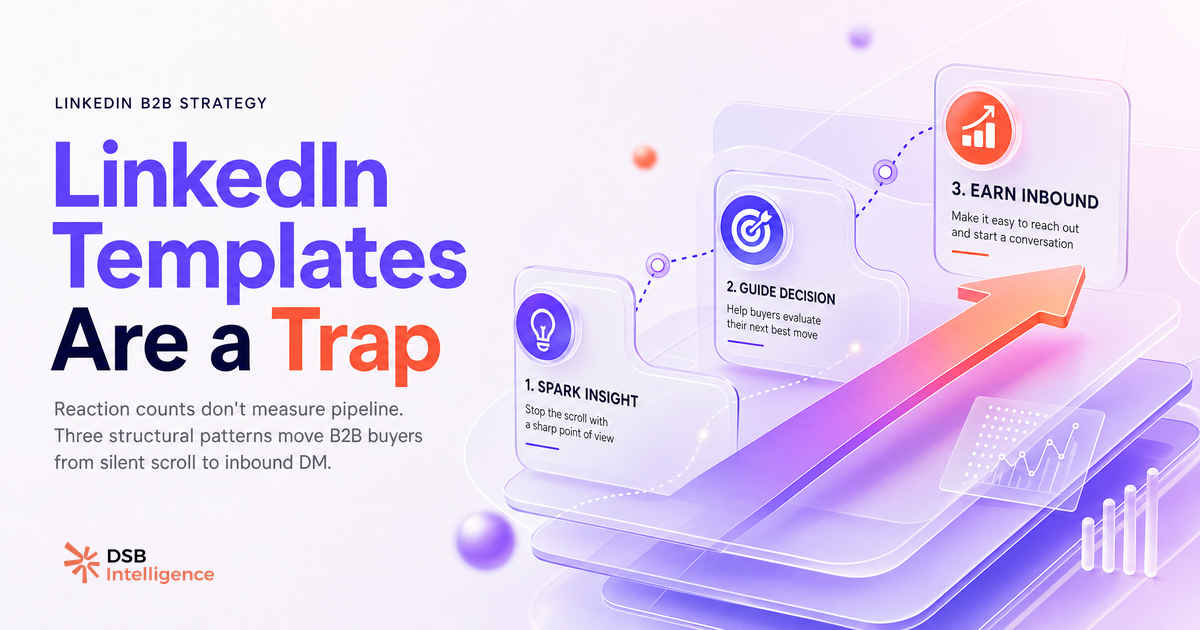
Copying a top creator's hook-list-question format is not a content strategy. It is a shortcut that produces engagement theater — reactions from people who will never buy from you.
The B2B buyers you actually want to reach behave differently. They read without reacting, visit your profile, and DM you three days later. No template gallery is built around that behavior.
Why do most LinkedIn post templates optimize for likes, not leads?
The template problem starts with what gets measured. Most LinkedIn post templates circulating in creator communities were reverse-engineered from posts with high reaction counts. Reactions are visible, countable, and satisfying to track. Pipeline is not.
The result is a format monoculture: a punchy first line (the "hook"), a numbered or bulleted body, and a closing question designed to pull comments. That structure works for the algorithm's surface signals. It does not work for B2B buyers in evaluation mode.
Buyers evaluating a vendor do not react to posts. They read, pause, visit the profile, and either connect or disappear. The reaction count on a post that generated three inbound DMs is often lower than the reaction count on a post that generated zero. Optimizing for the wrong metric is not a minor calibration error — it sends your content strategy in the opposite direction from revenue.
There is a second problem: saturation. When every account in a niche uses the same hook-list-question format, the format itself becomes invisible. Readers pattern-match it instantly and scroll past before processing the content. A template that worked in 2022 because it stood out now blends into the background precisely because it worked.
As a reference point, Canva LinkedIn Carousel Templates Are a Start, Not a Strategy covers the same dynamic for visual formats: the tool is not the strategy, and borrowing a popular structure without understanding why it worked is how accounts plateau.
What are the three structural patterns that move B2B buyers from scroll to DM?
Three patterns consistently convert passive readers into active conversations. Each works at a different stage of buyer awareness, which is why applying all three in rotation matters more than picking a favorite.
The Contrarian Reframe challenges a belief your buyer currently holds and replaces it with a more useful frame. It works best when your audience is in early awareness — they know they have a problem but have not yet formed a strong opinion about the solution. The structure: name the dominant belief, explain precisely why it is wrong or incomplete, and offer the replacement frame in one sentence. No list. No question at the end. The post ends when the argument ends.
The Diagnostic Frame names a problem the reader is living right now, with enough specificity that they feel seen rather than targeted. It works best in the middle of the buying cycle, when a buyer is actively comparing options. The structure: describe the symptom (not the problem category, the specific symptom), explain the underlying cause, and make the implication explicit. A buyer who recognizes their situation in your post has already started a conversation with you in their head.
The Proof Sequence shows a before/after with enough concrete detail to be credible. It works best for buyers close to a decision. The structure: state the starting condition with a specific number or observable state, describe the single change made, state the outcome with the same specificity. Vague proof sequences ("we helped a client grow their pipeline") are indistinguishable from marketing copy. Specific ones ("a 12-person SaaS team shifted from weekly batch posting to pattern-matched timing and saw inbound DMs double over one quarter") are readable as evidence.
LinkedIn Video Posts: Reach vs. Format Myths is worth reading alongside this — the same pattern logic applies to video, and the reach dynamics are different enough to warrant a separate treatment.
How does DSB Intelligence's Recommendations Engine detect which pattern fits your audience right now?
Choosing the right pattern requires knowing where your audience is in the buying cycle, and that is not something you can read from reaction counts alone.
The signal that matters is downstream behavior: profile visits, connection requests, and DMs in the 48 hours after a post. A Contrarian Reframe that generates 40 reactions and 12 profile visits is performing differently than one that generates 80 reactions and 2 profile visits. The first is moving buyers; the second is entertaining peers.
DSB Intelligence's Recommendations Engine flags exactly this gap. It surfaces which post structures are driving downstream signals versus which are generating surface engagement, and it surfaces that distinction early enough to adjust before a content quarter is wasted on the wrong pattern. The recommendation is not "post more" or "try video" — it is pattern-specific and grounded in what your specific audience is responding to right now.
This matters because pattern fatigue is real and account-specific. Your audience's tolerance for the Diagnostic Frame depends on how often you have used it, how your competitors are using it, and what else is competing for attention in their feed that week.
What does a concrete before/after look like on a SaaS founder account?
The clearest way to see the pattern difference is in a direct comparison. Consider a SaaS founder posting consistently — three times a week, solid reactions, growing follower count — but generating almost no inbound DMs.
The existing content followed the hook-list-question template faithfully. Posts opened with a provocative statement, delivered five numbered insights, and closed with "What's your take?" Reaction counts averaged in the double digits. Profile visits after each post were minimal. DMs were rare.
The shift: replace the hook-list-question format with the Diagnostic Frame for two posts per week, keeping one Contrarian Reframe. The Diagnostic Frame posts described specific symptoms of the problem the founder's product solves — not the category problem, the Tuesday-morning symptom a buyer feels when the problem is active.
Within the first month, inbound DMs increased. More importantly, the quality changed: instead of "great post," the messages opened with "this is exactly what we're dealing with." That is the signal that a post has moved a buyer, not just pleased a peer.
The posting frequency did not change. The template did. LinkedIn Referral Templates Miss the Point documents a similar dynamic in the context of outreach — the structure of the message matters more than its polish.
For founders building carousel content alongside text posts, How to Make a Carousel on LinkedIn (and Not Kill Its Reach) covers how to apply the same structural logic to slide-based formats without sacrificing organic reach.
When does no template work, and what do you do instead?
Template fatigue hits every niche eventually. When your audience has seen every variant of every pattern — including the three above — borrowed structure stops working regardless of execution quality.
The signal is specific: reaction counts hold steady or grow, but downstream behavior (profile visits, DMs, connection requests) drops toward zero. The audience is still engaging with the format, but the content is no longer moving them.
At that point, the answer is not a new template. It is original structure built around a genuine insight your audience has not encountered. Write the one thing you know that your buyer does not. Strip every formatting convention — no hook, no list, no closing question. Post it as plainly as possible.
Plain prose built around a real insight performs differently than polished templates when an audience is saturated. It reads as a different kind of content, which is the point. The goal is not to be seen as a good poster. It is to be seen as someone worth talking to.
LinkedIn for Live Events: What B2B Teams Miss covers a related angle: the moments when standard content strategy breaks down and a different approach is required.
Now what?
- Audit your last ten posts for downstream signals, not reaction counts. Count profile visits and DMs in the 48 hours after each post. Identify which post structure drove the most downstream activity.
- Map your current content to the three patterns. If you are using only one, introduce a second. If you are using none, start with the Diagnostic Frame — it is the most transferable across B2B niches.
- Run one plain-prose post with no formatting conventions. No hook, no list, no closing question. Measure downstream behavior against your templated posts.
- If you want the pattern-matching done automatically, start a free trial of DSB Intelligence — the Recommendations Engine tracks which structures are driving real buyer signals on your specific account, so you stop guessing which format to run next.