

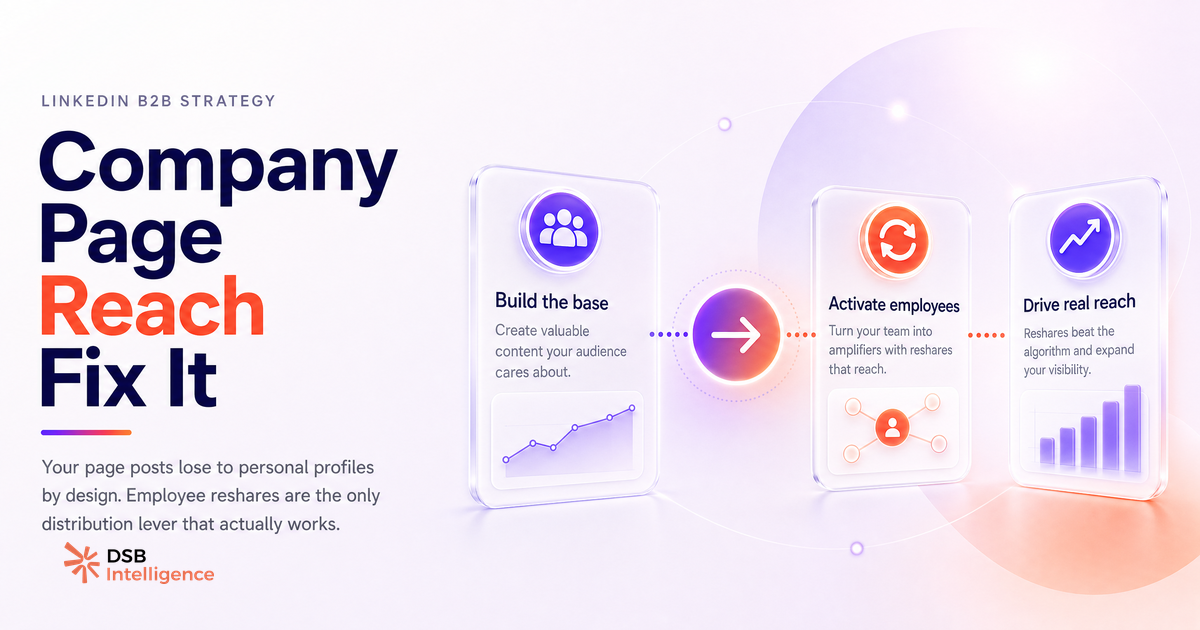
Ta company page LinkedIn publie dans un espace structurellement contraint. Ce n'est pas un problème de contenu, c'est un problème de câblage.
La vérité inconfortable : les pages reçoivent une fraction du reach des profils personnels
Le feed LinkedIn fonctionne sur un principe de réseau de premier degré. Quand un profil personnel publie, le contenu est distribué à ses connexions directes. Quand une page publie, il n'y a pas de connexions : il y a des abonnés, un segment beaucoup plus passif.
Un abonné de page ne reçoit pas le post dans son feed de la même façon qu'une connexion reçoit un post personnel. Le signal d'engagement initial est plus faible, ce qui limite la distribution algorithmique suivante. C'est un effet cumulatif : moins de reach initial, moins d'engagement, moins de reach ensuite.
On pense que les pages publient dans un espace structurellement contraint. La taille de ta base d'abonnés ne compense pas ce handicap de départ.
La bonne nouvelle : ce n'est pas un problème de contenu. C'est un problème de câblage.
Ce qui détermine vraiment la visibilité d'une company page (ce n'est pas la fréquence)
Publier cinq fois par semaine sur une page sans amplification externe ne change rien. Le volume de posts n'est pas le levier.
Ce qui détermine la portée réelle d'une page, c'est la vitesse et la densité des signaux d'engagement dans les premières heures après publication. Un post qui reçoit trois commentaires de membres de l'équipe dans la première heure se comporte différemment d'un post laissé seul.
Le format compte aussi, mais moins qu'on ne le croit. Les contenus qui retiennent l'attention (carrousels, vidéos courtes) génèrent un dwell time plus long, ce qui est un signal positif pour l'algorithme. Consulte Comment poster une vidéo LinkedIn qui génère de la portée pour les détails pratiques sur ce format.
Mais même le meilleur format ne compense pas l'absence d'amplification initiale. Le contenu a besoin d'une impulsion humaine pour décoller. C'est là qu'intervient l'équipe.
Pour comprendre ce que tes métriques de page disent vraiment, LinkedIn Impressions : combien c'est vraiment bon ? donne un cadre de lecture concret.
Comment connecter les profils personnels de ton équipe à la page, sans forcer personne
L'employee advocacy a mauvaise réputation parce qu'il est souvent mal implémenté : obligation de partager, scripts imposés, reporting individuel. Résultat : résistance passive et contenus qui sonnent faux.
Le bon modèle est plus simple. Il réduit le coût d'action, il n'impose pas d'obligation.
Concrètement : un message Slack ou un email hebdomadaire qui signale les deux ou trois posts de la semaine à fort potentiel. Pas "partage ça", mais "voici ce qu'on a publié cette semaine, si tu veux réagir". La différence est réelle : les gens qui partagent volontairement le font avec leur propre voix, ce qui génère plus d'engagement que le partage mécanique.
Deux ou trois amplificateurs réguliers dans l'équipe suffisent pour changer la trajectoire d'une page. Ce n'est pas une question de masse, c'est une question de timing et de régularité.
La clé : identifier qui dans l'équipe a déjà une audience LinkedIn active. Ce sont eux les amplificateurs naturels. Un post partagé par un profil avec 5 000 connexions actives a un impact sans commune mesure avec le même post partagé par un profil dormant.
Comment le Recommendations Engine de DSB Intelligence détecte une distribution cassée
Le problème avec les métriques natives de la page LinkedIn : elles ne distinguent pas le reach organique direct du reach amplifié par les profils personnels. Tu vois des impressions, tu ne sais pas d'où elles viennent.
Le Recommendations Engine de DSB Intelligence flag ce signal précisément : quand le reach d'une page chute significativement sur sept jours glissants sans baisse de fréquence de publication, il identifie la cause probable (perte d'amplificateurs actifs, chute du taux d'engagement initial) et propose des actions correctives ciblées. Ce n'est pas un dashboard de plus : c'est une lecture causale, pas descriptive.
Pour aller plus loin sur ce que les dashboards standard ne mesurent pas, LinkedIn Profile Views : vanity metric ou signal d'achat ? et LinkedIn Conversion API vs pixel : ce qui casse vraiment donnent le cadre complet.
Le playbook de reset sur quatre semaines pour une page stagnante
Une page stagnante ne se relance pas avec du contenu différent. Elle se relance avec un câblage différent. Voici la séquence :
-
Semaine 1 : audit des amplificateurs. Identifie les trois à cinq membres de l'équipe avec le plus de connexions actives sur LinkedIn. Ce sont tes relais prioritaires. Mets en place le système de notification interne (Slack ou email).
-
Semaine 2 : activation du câblage. Publie deux posts sur la page, notifie les relais identifiés dans les deux heures suivant la publication. Mesure le reach de ces deux posts versus la moyenne des quatre semaines précédentes.
-
Semaine 3 : ajustement du format. Sur la base des résultats de la semaine 2, identifie quel format a généré le meilleur ratio reach/engagement. Concentre-toi dessus. Pas besoin de diversifier à ce stade.
-
Semaine 4 : mesure et décision. Compare le reach moyen des quatre semaines de reset avec le mois précédent. Si la courbe remonte, continue. Si elle stagne, le problème est ailleurs : qualité du contenu ou taille insuffisante de l'audience amplificatrice.
Pour aller plus loin sur l'analyse vidéo dans ce contexte, Download LinkedIn Video : ce que ça révèle sur ta stratégie B2B complète utilement ce playbook.
Et maintenant ?
- Identifie tes trois amplificateurs prioritaires cette semaine. Regarde qui dans ton équipe a une audience LinkedIn active, pas qui a le plus grand titre.
- Mets en place un canal de notification interne minimal (un message Slack suffit) avant ta prochaine publication.
- Mesure le reach de tes deux prochains posts avec et sans amplification. C'est le seul test qui compte.
- Si tu veux une lecture causale de tes métriques de page sans faire le travail manuellement, essaie DSB Intelligence gratuitement.