

The urge to download LinkedIn videos is one of those small behaviors that reveals a much larger problem.
It's not a workflow issue. It's a strategy issue dressed up as a technical one.
Why do B2B teams search for a LinkedIn video downloader in the first place?
The answer is almost always one of two things: they lost their own source file, or they found a competitor's video that performed well and want to study — or copy — the format.
Both are understandable. Neither is a plan.
Losing source files is a symptom of treating LinkedIn as a broadcast channel rather than a content system. Teams publish, move on, and only look back when something worked and they want to reuse it. By then, the original file is buried in someone's Downloads folder or gone entirely.
Copying a competitor's format is a more nuanced problem. The instinct is right — observing what works in your category is legitimate competitive intelligence. But downloading a video to "repurpose" it without understanding why it performed is cargo-cult content. You're copying the surface, not the signal.
What does video on LinkedIn actually reward?
LinkedIn's feed is not YouTube. The context is different, the intent is different, and the distribution mechanics are different.
Most LinkedIn users scroll with audio off. A video that opens with a talking head and no captions loses the majority of its potential audience in the first two seconds. The hook has to work visually — a text overlay, a striking visual, or a counter-intuitive first frame.
Native uploads consistently outperform linked YouTube videos. This isn't a secret: LinkedIn's feed deprioritizes content that takes users off-platform. If your team is sharing YouTube links and wondering why reach is flat, that's the answer.
Length matters, but not in the way most teams assume. Shorter isn't always better — it's tighter that wins. A 90-second video with one clear idea and a strong close outperforms a 45-second video that meanders. The metric that reveals this is view-through rate, not raw view count.
View-through rate — the share of viewers who watch past the halfway point — is the closest proxy LinkedIn's native analytics offer for genuine attention. Raw views include one-second autoplay impressions. They're not the same thing, and treating them as equivalent is how teams end up celebrating numbers that don't move pipeline.
Why does LinkedIn video repurposing fail most B2B teams?
Repurposing is a sound principle. Producing original video is expensive in time and attention; extracting more value from what already performed well is rational.
The failure mode is repurposing without a feedback loop. Teams take a video that got "a lot of views," clip it, repost it, and measure nothing. They don't know if the original performed because of the hook, the length, the topic, the day of publication, or the audience segment that happened to engage first.
Without that attribution, repurposing is guesswork. You're not scaling what works — you're scaling what you think worked, which is a different thing entirely.
The teams that do this well treat every video post as a data point. They track which formats generate reach, which generate comments from target-persona accounts, and which drive profile visits in the 48 hours after publication. Profile visits and connection requests in that window are a leading indicator — they signal that someone watched, got curious, and came to check if you're worth following.
This is where LinkedIn Analytics Tools: What B2B Teams Actually Need becomes the real conversation. Downloading a video doesn't give you any of this. It gives you a file.
How does the absence of a video system connect to broader B2B content failure?
Video doesn't exist in isolation. It's one format inside a content cadence, and its performance is shaped by everything around it — the frequency of other posts, the consistency of the topic cluster, the audience's familiarity with your point of view.
A team that publishes video sporadically, with no consistent angle, is unlikely to see compounding reach. LinkedIn's distribution tends to reward accounts that establish a recognizable pattern — not because of any documented algorithmic rule, but because audiences build habits. They know what to expect, and they come back for it.
The broader failure is treating content as a series of individual bets rather than a system. LinkedIn Content Strategy B2B: Stop Planning in the Dark covers this in detail — the short version is that reach compounds when cadence and topic consistency are treated as inputs, not afterthoughts.
DSB Intelligence's Insight Narrator surfaces exactly this pattern: it identifies which video posts broke through your typical reach distribution and flags the structural attributes they shared — hook format, post length, time-to-first-engagement. That's the signal most teams are trying to reverse-engineer manually when they download a video and stare at it.
What should B2B teams do instead of downloading LinkedIn videos?
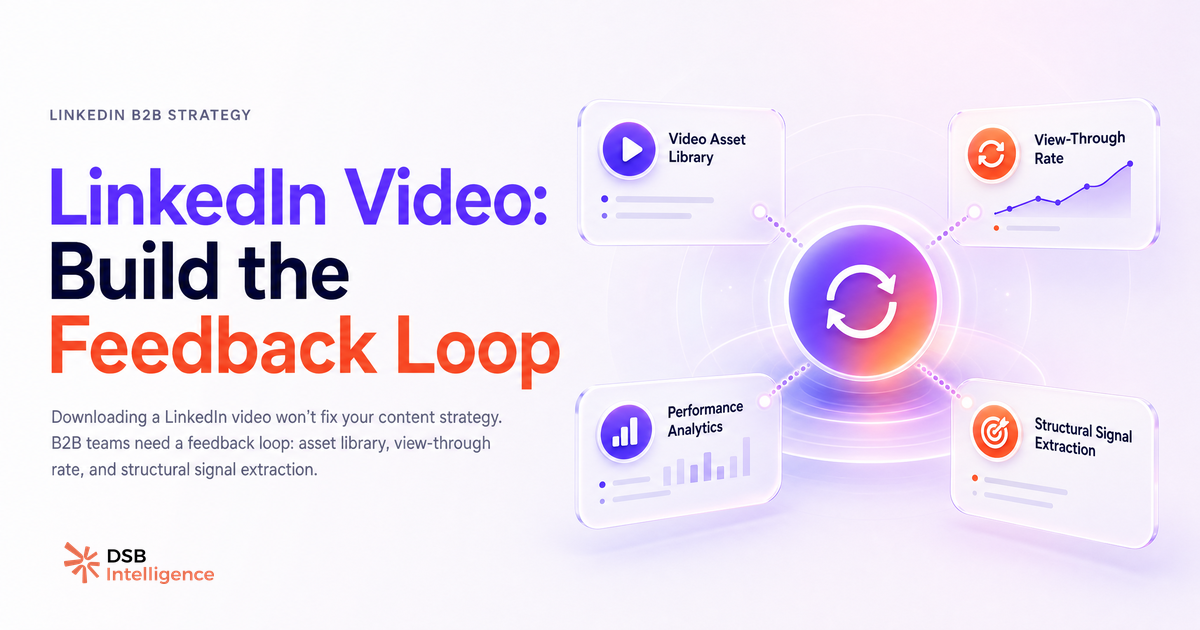
The fix is a content feedback loop, not a better downloader.
Step one: never lose the source. Every video published on LinkedIn should live in a shared asset library with metadata — topic, format, publish date, target persona. This takes ten minutes to set up and eliminates the reason most teams go looking for a downloader in the first place.
Step two: measure the right things. View-through rate, comments from target-persona accounts, and post-publication profile visits. Not likes. Not raw view counts. If your current setup doesn't surface these, LinkedIn for B2B Marketing: Fix the Scoreboard First is the right starting point.
Step three: extract the structural signal before repurposing. Before you clip or repost a video, answer: what was the hook? What was the single idea? What audience segment engaged first? Repurpose the structure, not just the footage.
Step four: treat video as part of a system. Align video topics with your active content cluster. A video that contradicts your written posts' angle creates cognitive dissonance for the audience and dilutes the authority signal you're trying to build. B2B Marketing with LinkedIn: Fix the System First lays out how to connect these pieces.
Now what?
- Audit your last ten video posts. For each, record view-through rate, comment quality (target persona or not), and profile visits in the 48 hours after publication. You'll see a pattern in two hours.
- Build a shared asset library today — a simple spreadsheet with file location, topic, format, publish date, and performance tier. No tool required to start.
- Before your next video, write the hook as a text overlay first. If it doesn't work without audio, rewrite it until it does.
- If you want the feedback loop automated — reach, signal extraction, repurposing recommendations — try DSB Intelligence free and connect your LinkedIn account. The Insight Narrator runs the attribution you'd otherwise do manually.