
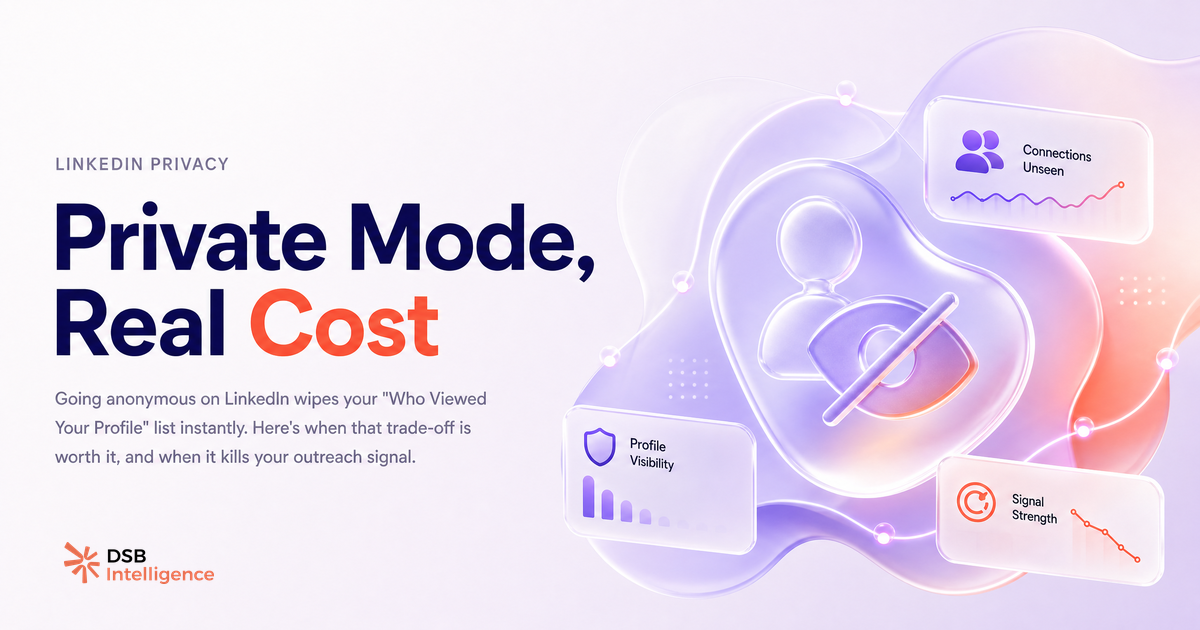
Most people who want to browse LinkedIn anonymously don't realize they're also opting out of one of the platform's most useful B2B signals. The setting is easy to find. The consequence is buried.
Yes, you can browse anonymously — here's the exact setting
Turning off profile views on LinkedIn takes three steps.
- Click your profile photo in the top-right corner and open Settings and Privacy.
- Navigate to Visibility, then select Profile viewing options.
- Choose Private mode.
From that moment, anyone whose profile you visit sees "LinkedIn Member" instead of your name and headline. Your visit is logged, but your identity is hidden.
There's also a middle option: "Semi-private mode" shows your general industry and title without your name. It's a compromise that satisfies almost no use case well — too visible for competitive research, too anonymous to generate inbound curiosity.
The setting applies instantly and persists until you change it. There's no session-based toggle, no "private for the next hour" option. You're either on or off.
The trade-off LinkedIn buries in the fine print: you go dark, they go dark too
Here's what the settings screen doesn't say clearly: LinkedIn's reciprocity rule is absolute.
The moment you switch to private mode, your "Who Viewed Your Profile" list goes blank. Not partially — completely. You can no longer see who has visited your profile, regardless of your subscription tier. Premium subscribers often assume they're exempt. They're not.
This is a deliberate design choice, not a bug. LinkedIn frames it as fairness: if you want anonymity, you grant it to others by default. The platform enforces this symmetry at the infrastructure level.
The practical consequence is significant. If you're a founder, sales rep, or marketer who checks their viewer list weekly to spot warm accounts, private mode eliminates that data stream entirely. You trade your anonymity for theirs — and theirs was already protected by default.
For most B2B practitioners, the "Who Viewed Your Profile" list is a low-volume but high-intent signal. Someone who visits your profile after seeing a post, after receiving a cold email, or after being mentioned in a comment is expressing a form of interest. That signal disappears the moment you go private.
DSB Intelligence's Insight Narrator flags exactly this pattern: when a profile view cluster follows a content publication or outreach sequence, it surfaces the connection so you can act on it before the intent cools.
When anonymous mode actually hurts your B2B prospecting signal
Private mode makes sense in a narrow set of scenarios: competitive intelligence gathering, researching candidates before a sensitive negotiation, or auditing a prospect's team structure before a first call. In those cases, the anonymity is worth the cost.
In most other B2B contexts, it works against you.
Consider the standard outreach sequence. You send a connection request or a cold message. The recipient checks your profile before deciding whether to respond. If your profile view of theirs triggered their curiosity — a common pattern — your visibility is part of the conversion. Going private removes that nudge.
There's also a subtler issue. When you view a profile and the person sees your name, headline, and company, you've made a soft impression. In B2B sales, that impression can precede a reply, a follow, or a referral. Anonymous browsing eliminates that touchpoint entirely.
The accounts where private mode consistently backfires are those running account-based marketing or targeted outreach. Viewing twenty profiles at a target company while in private mode generates zero reciprocal curiosity. The same twenty views in full-visibility mode can generate two or three inbound profile visits — and those visits are warm.
For context on how LinkedIn content strategy intersects with visibility signals, LinkedIn Video Editor Jobs: What B2B Hiring Reveals shows how platform behavior shifts when companies invest in content infrastructure.
How to read who's viewing you before you decide to disappear
Before switching to private mode for any research session, spend five minutes auditing your current viewer list. This is the data you're about to cut off — it's worth knowing what you're leaving behind.
Look for three patterns in your viewer list:
Cluster timing. Did a group of views arrive within 24 to 48 hours of a specific post or outreach batch? That's a signal that your content or message reached the right people. Disappearing now means you can't track whether the next wave arrives.
Company concentration. Multiple views from the same organization in a short window suggest internal discussion. Someone shared your profile. That's a buying signal worth following up on, not a moment to go dark.
Title patterns. If your viewers skew toward decision-maker titles (VP, Director, Head of), your profile is doing its job. Switching to private mode doesn't change your content — but it removes the feedback loop that tells you it's working.
Once you've logged those patterns, you can make an informed decision. If the research you're about to do genuinely requires anonymity, switch to private mode, do the session, then switch back. The toggle is instant in both directions.
For teams managing a company presence alongside personal profiles, the visibility question gets more layered. How to Set Up a LinkedIn Company Page That Doesn't Flatline covers how page-level visibility settings interact with individual profile behavior. And if you're managing admin access across multiple team members, How to Add an Admin to a LinkedIn Page (The Right Way) is the operational reference.
If your outreach relies on LinkedIn InMail alongside profile visits, What Is an InMail on LinkedIn? A B2B Practitioner's Guide explains how the two channels interact. For teams running multi-product or segment-specific content, Showcase Pages LinkedIn: The B2B Team System adds the structural layer.
Now what?
- Audit your viewer list today, before touching any visibility setting. Note cluster timing, company concentration, and title patterns. That's your baseline.
- Use private mode surgically, not as a default. Switch on for a specific research session, switch off when you're done. The toggle is instant.
- Match your visibility setting to your goal. Full visibility during active outreach and content publishing. Private mode only for competitive or sensitive research where anonymity outweighs the signal cost.
- Track the feedback loop. If you publish a post or run an outreach sequence, stay visible for at least 72 hours afterward. That's the window where profile view intent is freshest.
Want to see which profile view clusters are worth acting on? Start a free trial of DSB Intelligence and let the platform surface the patterns before they go cold.