

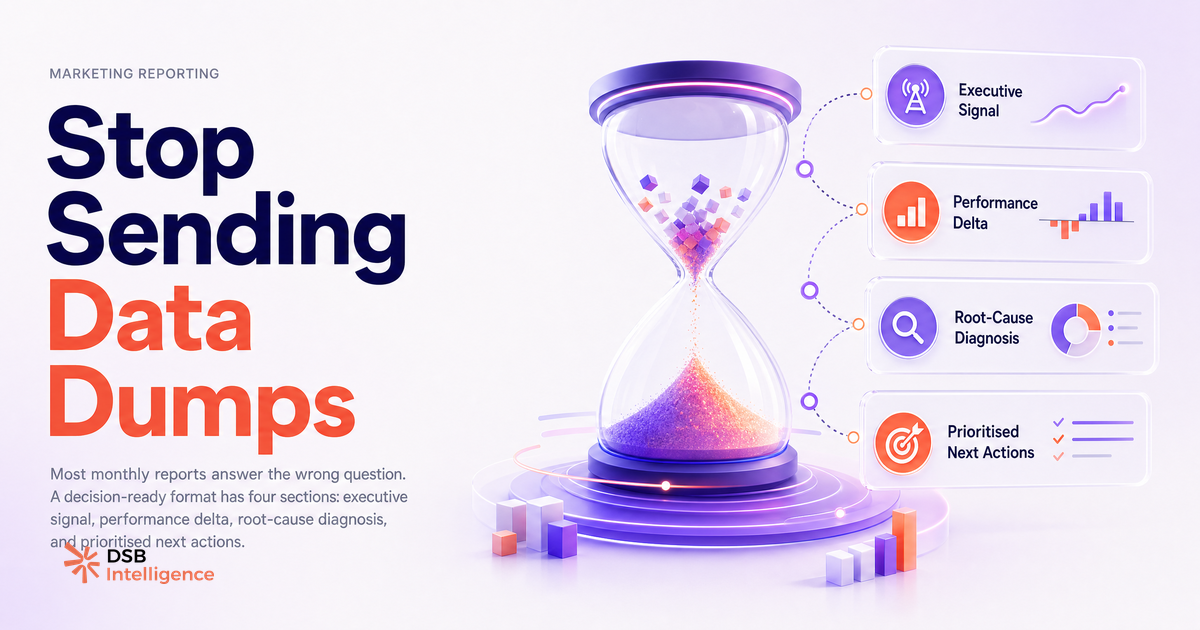
The monthly marketing report most agencies send is a liability. Not because the data is wrong, but because it makes the client do the thinking.
A PDF with 14 charts and no verdict is not a report. It is homework you are assigning to the person paying your retainer.
Most monthly marketing reports answer the wrong question
The wrong question is: "What happened this month?"
The right question is: "What should we do differently next month?"
These sound similar. They produce completely different documents. A report built around "what happened" organizes itself by channel, then by metric, then by time period. The client reads it linearly, tries to form a view, and arrives at the review meeting with questions. That meeting becomes a briefing, not a decision session.
A report built around "what should we do differently" opens with a verdict. It states the single most important signal of the month in the first paragraph. Everything else is evidence for or against that signal.
The structural shift is small. The impact on client trust is not.
Agencies that report on LinkedIn for B2B Marketing : métriques qui comptent know this tension well: LinkedIn generates engagement data that looks impressive in a table and means almost nothing without a pipeline context. The metric is not the insight. The insight is whether that engagement is moving the right people toward a conversation.
What are the 4 sections that separate a decision-ready report from a data dump?
A decision-ready marketing monthly report has four sections, in this order. The order matters.
Section 1: Executive signal. One paragraph, maximum five sentences. States the month's single most important development, its business implication, and whether it changes anything about the current strategy. No channel breakdown here. No tables. Just the signal.
Section 2: Channel performance with verdicts. One block per active channel. Each block opens with a one-word verdict: Performing, Watch, or Underperforming. Then one sentence explaining why. Then the supporting metrics. Clients scan the verdicts first. If they want the numbers, they read on. If they trust the verdict, they skip to section three.
This structure also protects the agency. A clear verdict is a documented position. If the client later claims they were not warned about an underperforming channel, the report shows otherwise.
Section 3: Prioritized action list. Three to five items, each with one owner and one deadline. Not "we should consider improving CTR on paid." Instead: "Pause the two lowest-performing ad sets by [date], reallocate budget to the top-performing creative. Owner: [name]." Specificity converts a report from a read to a decision.
Section 4: Forward-looking flag. One risk or one opportunity the client should be aware of before next month's cycle. A seasonal shift, a competitor move, a budget threshold approaching. This section is what separates a reporting agency from a strategic partner. It signals that the team is watching, not just measuring.
For a deeper look at why automated reporting often breaks down before it reaches this level of clarity, the piece on Automated Reporting B2B : pourquoi ça casse en réunion client is worth reading alongside this one.
How does DSB Intelligence Insight Narrator turn raw metrics into a client-ready narrative?
The bottleneck in most agency reporting workflows is not data collection. Pulling numbers from LinkedIn, Google Analytics 4, or a paid search dashboard is fast. The bottleneck is interpretation: turning a spreadsheet into a paragraph a client can act on.
This is where the Insight Narrator earns its place in the workflow. It reads the raw metric output for a given period and generates a first-draft narrative: what moved, in which direction, and what pattern that suggests. The account manager edits for client context and tone. The structure (signal, verdict, action) is already there.
The result is not a fully automated report. It is a report where the human effort concentrates on judgment, not formatting. That is the right division of labor.
For agencies managing multiple accounts, this matters at scale. Writing a coherent narrative for twelve clients in the same week, each with different goals and different channel mixes, is where quality degrades. A consistent first-draft layer keeps the standard high without adding headcount.
How does a single format work across channels without adding reporting overhead?
The answer is structural consistency, not template rigidity.
The four-section format described above does not change by channel. What changes is the content inside each section. A monthly digital marketing report covering LinkedIn organic, paid search, and email marketing uses the same executive signal, the same verdict system, the same action list format. The client builds one mental model and applies it every month, across every channel.
This matters for agency client analytics at scale. When each account manager invents their own format, clients cannot compare months, cannot onboard new stakeholders easily, and cannot hold the agency accountable to a consistent standard. A shared format is a quality floor.
The overhead argument against standardization is usually about flexibility: "Every client is different." That is true for goals and context. It is not true for structure. A client in SaaS and a client in professional services both benefit from knowing, at a glance, whether their channels are performing or not.
The White Label SEO Reporting: ce que les agences font vraiment piece covers how agencies that standardize their reporting format also tend to standardize their retention rates, for the same reason: predictability builds trust.
The SEO Client Reporting : les agences mesurent le mauvais truc article makes a related point about metric selection: the format only works if the KPIs inside it are tied to business outcomes, not channel vanity metrics.
When should you break the monthly cadence (and what to send instead)?
The monthly cadence is a convention, not a law. Three situations justify breaking it.
First, a campaign launch mid-month. Waiting four weeks to report on a campaign that went live on the 10th means the client has no signal for three weeks. A brief async update at the end of week one (a short written summary, a Loom recording, a Slack message) is more useful than silence.
Second, a budget reallocation. If the client approves a significant shift in spend during the month, the next report needs a before/after framing that the standard monthly template does not accommodate. Send a short one-pager at the moment of the shift, not a footnote at month end.
Third, a pre-agreed threshold metric is crossed. If the client and agency agreed at onboarding that a cost-per-lead above a certain level triggers a review, that review should not wait for the monthly cycle. The threshold exists precisely to create a faster feedback loop.
In all three cases, the out-of-cycle communication is short: one signal, one implication, one proposed action. It is not a mini-report. It is a flag.
The B2B Marketing with LinkedIn : système, pas contenu piece argues that sustainable B2B marketing is built on systems, not one-off content decisions. The same logic applies to reporting: a system that knows when to deviate from its own cadence is more reliable than one that follows the calendar blindly.
Et maintenant ?
- Audit your last three monthly reports. For each one, identify whether it opens with a verdict or with a channel summary. If it is the latter, rewrite the opening paragraph before the next cycle.
- Add a one-word verdict (Performing / Watch / Underperforming) to each channel section in your next report. Share it with one client and ask if it changes how they read the document.
- Build a threshold list with each client: three metrics that, if crossed, trigger an out-of-cycle update. Document it in the onboarding materials.
- If narrative writing is the bottleneck in your reporting workflow, try DSB Intelligence free and see how the Insight Narrator handles the first draft.