

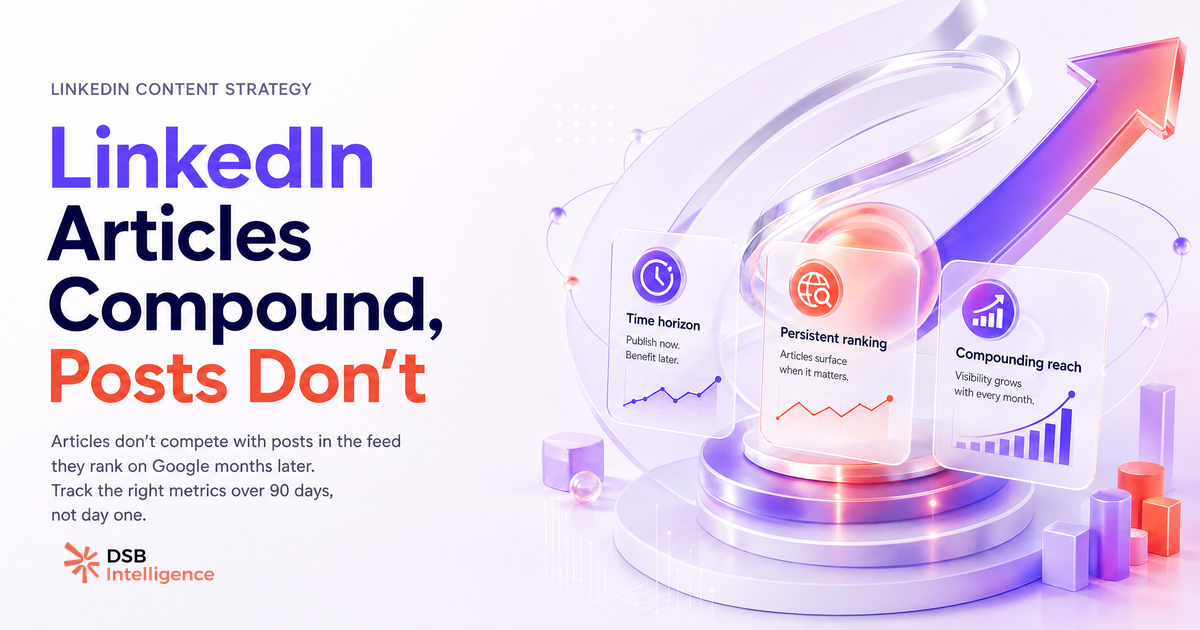
Most creators try LinkedIn articles once. The reach is lower than their last post. They conclude the format is dead and go back to carousels.
That's the wrong read — and it's costing them a compounding asset they'll never build by posting alone.
Why do most LinkedIn creators abandon articles after one try?
The feed punishes articles on day one. That's not a bug — it's the structural reality of a format that wasn't designed for the feed in the first place.
When you publish a post, LinkedIn's algorithm tests it with a small batch of your connections, reads the early engagement signals, and decides how far to push it. The whole cycle plays out in 24 to 72 hours. Articles don't get that same treatment. Their initial distribution is narrower, their engagement rate in the feed looks lower, and creators who compare the two on the same metrics walk away with the wrong conclusion.
What they miss: the feed is not the primary surface for articles. Search is.
The pattern is consistent across B2B content: a creator publishes an article in week one, sees modest numbers, and never writes another. Six weeks later, that same article is quietly ranking on Google for a niche query their target buyer actually types. They'll never know, because they stopped tracking it.
The comparison that matters is not "article vs. my last post." It's "article vs. nothing, over 90 days." For a deeper look at how the two formats distribute differently, LinkedIn Articles vs Posts: What Actually Builds Authority breaks down the mechanics side by side.
What can LinkedIn articles do that posts can't: indexability, dwell time, and search surface?
Articles have a persistent public URL. Google crawls it. That single fact changes the entire distribution logic.
A post lives in the feed for 48 to 72 hours, then effectively disappears from search. An article published today can surface in a Google result three months from now, for a query typed by someone who has never heard of you. That's a fundamentally different acquisition channel, not a variation of the same one.
Dwell time is the second structural advantage. When someone clicks through to an article, they land on a full-page reading experience — no feed noise, no competing content, no "see more" truncation. Readers who engage spend more time on the page than they would on a post card. That dwell time signal is one LinkedIn uses to assess content quality, and it accumulates over the lifetime of the article, not just in the first 48 hours.
Search surface is the third lever. Articles let you target specific, low-competition queries that your buyers actually search — both inside LinkedIn's own search bar and on Google. A post titled "My take on AI in sales" disappears. An article titled "How mid-market sales teams are using AI to cut discovery call prep time" can rank for that exact phrase.
This is why LinkedIn Newsletter: When It Generates, When It Doesn't is worth reading alongside this one: newsletters and articles are often conflated, but they operate on completely different distribution logic.
How does reading article performance differ from feed post metrics?
Feed post metrics are designed for a 48-hour window: impressions, reactions, comments, shares, click-through rate. They're useful for that window. Applied to articles, they're misleading.
An article's meaningful metrics are different in kind. Profile visits in the days after publication. Connection requests from people outside your existing network. Search impressions inside LinkedIn's own analytics (available under "Article analytics"). Google Search Console impressions if you've linked your site. Inbound messages that reference the article by name — weeks after you published it.
The problem is that most LinkedIn analytics tools, including native LinkedIn analytics, surface the same engagement dashboard for posts and articles. The numbers look comparable, the article looks like it underperformed, and the creator draws the wrong conclusion.
DSB Intelligence's Insight Narrator is built to flag exactly this kind of category error: it reads article performance through a different lens than feed post metrics, surfacing the signals that actually indicate whether an article is building search traction versus just sitting idle.
For teams tracking multiple content formats simultaneously, LinkedIn Scheduling Tools Ranked for B2B Accounts covers how to structure a publishing workflow that doesn't collapse everything into the same feed-first logic.
Which article formats generate inbound signals — and which don't?
Not all article formats compound equally. The ones that generate consistent inbound share three characteristics: a specific scope, a named structure, and a documented claim.
Deep guides work because they answer a question with enough depth that the reader doesn't need to search again. "How to structure a LinkedIn outreach sequence for enterprise SaaS" is a guide. "Tips for better LinkedIn outreach" is a post dressed up as an article.
Named frameworks work because they're citable. When you coin a term — even a simple one — and build an article around it, other people reference it. That reference creates backlinks, profile visits, and search co-occurrence. The framework doesn't need to be complex. It needs to be named and repeatable.
Documented case studies work because they're specific. Before/after structure, named context (industry, company size, timeframe), and a clear outcome. Vague success stories don't generate inbound. Specific ones do.
The formats that don't compound: opinion pieces without a clear stance, listicles that could have been a post, and "my journey" narratives without a transferable insight. These might perform fine in the feed on day one. They rarely surface in search 60 days later.
For teams thinking about how video fits alongside long-form content, LinkedIn Video Size: Specs, Ratios & What Drives Reach is a useful reference on format-specific distribution logic.
When are articles the wrong call — and what should you use instead?
Articles are the wrong format when your goal is speed, conversation, or testing an idea.
If you want to know whether a take resonates with your audience, write a post. The feedback loop is 24 hours. An article takes days to write, has a slower feedback cycle, and is the wrong tool for hypothesis testing.
If you want to drive immediate reach to a time-sensitive announcement — a product launch, an event, a hiring post — use a post or a LinkedIn Showcase Page if you're managing a brand presence. Articles don't spike; they compound.
If you want to build a recurring relationship with an existing audience, a newsletter beats an article. Newsletters push to subscribers directly. Articles wait to be found. The choice depends on whether you're trying to reach people who already know you, or people who don't yet.
The honest framework: write an article when you have something worth indexing. Write a post when you have something worth saying today. Most creators have a 90/10 split in favor of posts. The ones building durable inbound pipelines tend to run closer to 70/30.
Now what?
- Pull your last three articles in LinkedIn analytics and look at profile visits in the 30 days after each publication — not the day-one impressions. That's the metric that tells you whether the article is working.
- Pick one topic you know well enough to write a 1,000-word guide on. Give it a specific scope and a named structure. Publish it, then check search impressions inside LinkedIn analytics at the 30-day and 60-day marks.
- Stop comparing article reach to post reach on the same dashboard. They're different formats with different time horizons. Treat them that way.
- If you want to track which of your content formats is actually building search traction over time, try DSB Intelligence free — the Insight Narrator reads article and post performance separately, so you're not making format decisions based on the wrong numbers.