

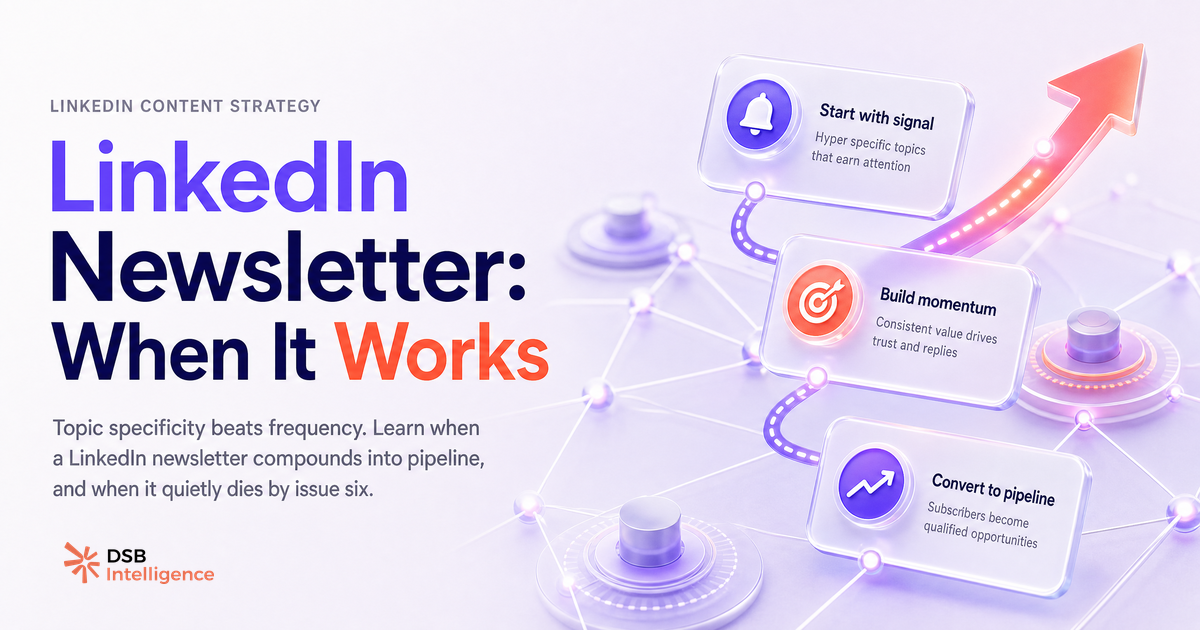
Most LinkedIn newsletters are abandoned by issue six. Not because the author ran out of ideas, but because they never defined what the newsletter was supposed to do.
That's the real problem. Not the format, not the algorithm.
Are LinkedIn newsletters worth it in 2026? The honest answer depends on one variable
The one variable is whether your target buyer reads LinkedIn content habitually, not just posts it.
A large share of LinkedIn's active user base is there to publish and network. A smaller share reads long-form content regularly. If your ICP sits in the second group — think marketing leaders, founders, revenue ops practitioners — a LinkedIn newsletter reaches them in a context where they're already in a learning mindset. If your ICP is in the field, in a plant, or in a role that doesn't involve a daily LinkedIn scroll, the newsletter won't reach them regardless of how good the content is.
This is the question to answer before you publish issue one. Not "what should I write about?" but "does my buyer read newsletters on LinkedIn?"
The format itself has a structural advantage most people underestimate: when someone subscribes, LinkedIn sends them a notification for each new issue. That's a push mechanism you don't get with a standard post. It's also why subscriber count at launch matters less than subscriber quality. A list of 400 decision-makers who open every issue outperforms a list of 4,000 peers who subscribed once and forgot.
For context on how LinkedIn distributes content more broadly, LinkedIn Articles vs Posts: What Actually Builds Authority covers the distribution mechanics that also apply to newsletter visibility.
What the top-performing LinkedIn newsletter examples actually have in common (it's not frequency)
It's not frequency. It's not design. It's topic specificity.
The LinkedIn newsletter examples that consistently generate inbound leads share one structural trait: every issue answers a version of the same recurring question. The question changes slightly each time, but the reader always knows exactly what problem the newsletter helps them solve.
Take a revenue operations leader who publishes a newsletter on CRM data hygiene. Every issue covers a different angle of the same problem: bad data, attribution gaps, pipeline leakage. The reader who subscribes is a RevOps practitioner or a VP Sales who has felt that pain. The newsletter becomes a reference, not a content calendar item.
Compare that to a newsletter that covers "B2B marketing tips" — one week it's LinkedIn, the next it's SEO, the next it's event strategy. The subscriber who opted in for the LinkedIn angle disengages by issue four. Open rate drops. The author interprets this as a format problem and abandons the newsletter. The real problem was scope.
The practical test: write your newsletter's premise in one sentence. If the sentence contains the word "and" more than once, the scope is too wide.
Cadence follows from this. A tight topic published once a month is more sustainable and more readable than a broad topic published every week. The best LinkedIn newsletter examples in B2B tend to publish every two to four weeks, not daily.
How to read your newsletter's engagement signal before it flatlines
Open rate is the primary signal. Dwell time per issue is the secondary one.
LinkedIn's native newsletter analytics show you open rate per issue. Most practitioners look at this number once, screenshot it if it's good, and move on. The useful move is to track it across issues in a simple table: issue number, date, open rate. Three consecutive drops is a signal worth acting on, not explaining away.
A drop in open rate usually means one of two things: topic drift (you published something off-brief for your subscriber base) or cadence fatigue (you published too frequently for the value you delivered). Both are recoverable. Topic drift is fixed by returning to your core question. Cadence fatigue is fixed by spacing issues further apart and making each one denser.
Dwell time is harder to read in LinkedIn's native interface, but the proxy is comment quality. If comments are substantive ("this matches exactly what we're seeing in our pipeline reviews") rather than reactive ("great post!"), readers are finishing the issue. If comments are thin and generic, most readers are skimming the first paragraph and bouncing.
This is where instrumenting your newsletter from issue one pays off. DSB Intelligence's Insight Narrator reads these engagement patterns across issues and surfaces the ones that signal a drift before it becomes a trend — so you can correct course on issue five rather than discovering the problem on issue twelve.
How to create a LinkedIn newsletter that compounds — a four-step setup
Compounding here means: each issue increases the probability that a subscriber becomes a lead, not just a reader.
Step 1: Define the one recurring question. Not a topic, a question. "How do B2B sales teams qualify faster without adding headcount?" is a question. "B2B sales tips" is a topic. The question determines who subscribes and whether they stay.
Step 2: Fix the format. Readers compound when they know what to expect. A reliable structure — one framework, one example, one action per issue — lets the reader decide in ten seconds whether this issue is relevant to their week. Variable formats create cognitive friction. Friction kills open rates.
Step 3: Set a cadence you can hold for six months. Not the cadence you aspire to. The one you can actually maintain alongside your other work. Monthly is underrated. Bi-weekly is the sweet spot for most solo practitioners. Weekly is only sustainable if the newsletter is a core part of your role, not a side project.
Step 4: Instrument from issue one. Track open rate per issue in a spreadsheet. Note what the issue covered. After six issues, you'll see which topics pull the highest open rates. Those topics are your ICP's real pain points — use them to plan the next six issues.
For the technical setup, LinkedIn's native newsletter creation is straightforward. The strategic decisions above matter more than any UI choice. If you're also thinking about how to reach subscribers outside LinkedIn, Email Finder from LinkedIn: Match Rate Is All That Matters covers how to build a parallel owned list from your LinkedIn audience.
On the distribution side, a LinkedIn newsletter works alongside — not instead of — other formats. LinkedIn Video Ads Examples That Actually Build Pipeline shows how paid formats can accelerate subscriber growth for a newsletter that already has a clear premise.
When a LinkedIn newsletter will not move pipeline (and what to do instead)
Three situations where the format will not deliver.
First: your ICP is not an active LinkedIn reader. Field roles, manufacturing, healthcare operations, logistics. These buyers are on LinkedIn to recruit or be recruited, not to read newsletters. No amount of content quality changes that distribution reality. In this case, email or industry trade publications reach them more reliably.
Second: you can't commit to a minimum of six issues before evaluating results. A LinkedIn newsletter is a compounding asset, not a campaign. Evaluating it after two issues is like evaluating a podcast after two episodes. The subscriber base hasn't had time to form a habit around your content.
Third: your goal is immediate pipeline, measured in weeks. Newsletters build authority over months. If you need pipeline in Q1, a newsletter launched in January won't contribute to it. LinkedIn Video Ads Examples That Actually Build Pipeline or a direct outreach sequence (see How Many InMail Credits Per Month on LinkedIn?) will move faster.
The newsletter is also not a substitute for a company presence. If you're building a brand at the organizational level, Company LinkedIn Page: Setup Is 20 Min, Strategy Is Forever covers the layer that sits above individual content formats.
One honest note on the LinkedIn newsletter vs email newsletter question: LinkedIn gives you built-in distribution at launch (your connections get notified when you start a newsletter), but you don't own the list. If LinkedIn changes the format, your subscriber base doesn't migrate with you. Email gives you portability. The pragmatic answer for most B2B practitioners is to run both in parallel: LinkedIn for top-of-funnel discovery, email for the subscribers worth nurturing into pipeline.
Now what?
-
Answer this question before anything else: does your ICP read LinkedIn content habitually? If you're not sure, look at the comment sections of the top five newsletters in your space. Are those commenters your buyers?
-
Write your newsletter premise in one sentence without the word "and" more than once. If you can't, narrow the topic.
-
Set up a simple open-rate tracking table before you publish issue one. Issue number, date, topic, open rate. Six issues of data will tell you more than any benchmark.
-
If you're ready to instrument your LinkedIn content performance beyond native analytics, try DSB Intelligence free — the Insight Narrator surfaces the engagement patterns that tell you what your audience actually reads, not just what they click.