
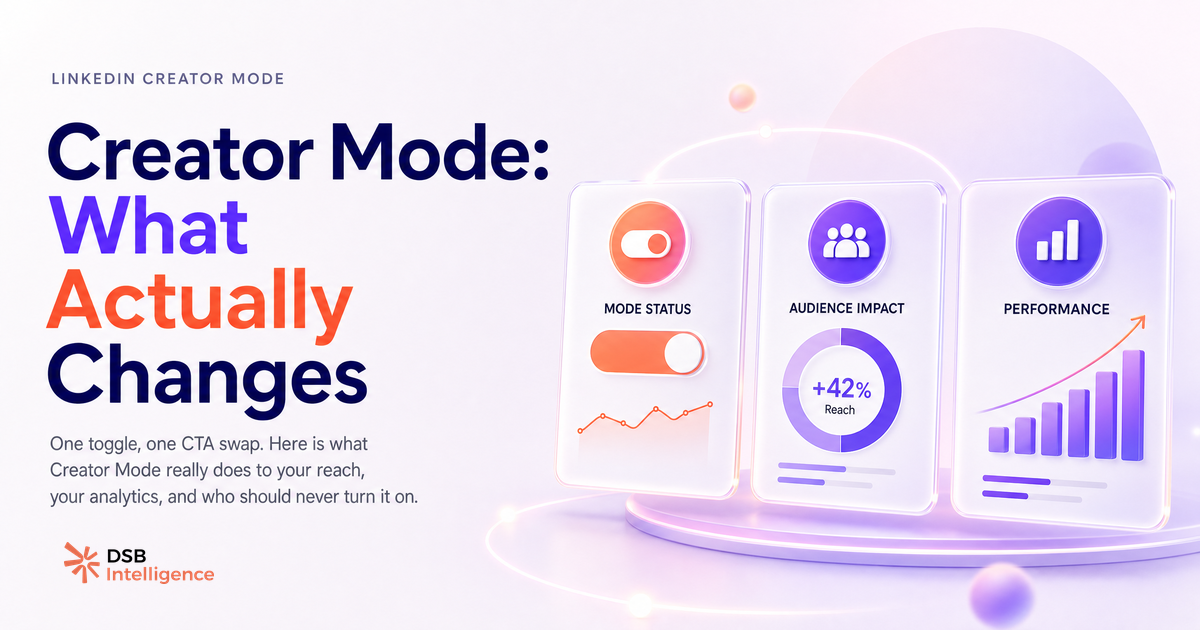
Le Creator Mode est présenté comme un levier de visibilité. La réalité est plus étroite : c'est un changement d'interface, pas un boost algorithmique.
Creator Mode change une seule chose : "Suivre" remplace "Se connecter" comme CTA principal
C'est le seul effet garanti, documenté, visible. Quand un visiteur arrive sur ton profil en Creator Mode, le bouton principal qu'il voit est "Suivre", pas "Se connecter".
Ce changement a une conséquence concrète : tu peux accumuler des followers au-delà de la limite de 30 000 connexions de premier degré. Un follower voit ton contenu dans son feed sans être dans ton réseau. Il ne peut pas t'envoyer de message directement, mais il consomme ce que tu publies.
Pour un profil dont l'objectif est de diffuser du contenu à grande échelle, c'est pertinent. Pour un commercial dont l'objectif est la prospection directe et la messagerie entrante, c'est contre-productif : tu rends le premier contact plus difficile.
Le choix entre "Suivre" et "Se connecter" comme CTA par défaut n'est pas anodin. Il dit quelque chose sur ce que tu attends de LinkedIn : une audience ou un réseau. Pour aller plus loin sur la lecture des signaux de profil, voir LinkedIn Profile Views : vanity metric ou signal d'achat ?.
Ce qui change dans la distribution du feed, et ce qui reste identique
La distribution de tes posts ne change pas mécaniquement après l'activation du Creator Mode. L'algorithme LinkedIn évalue chaque post sur ses propres signaux : engagement dans la première heure, dwell time, pertinence thématique pour les destinataires initiaux.
Creator Mode n'injecte pas un multiplicateur de reach. Il ne te place pas dans une catégorie privilégiée de diffusion.
Ce que le mode créateur modifie dans l'écosystème du feed, c'est indirect. Tes followers (par opposition à tes connexions) constituent une audience potentiellement plus large et plus hétérogène. Si ton contenu résonne avec eux, la diffusion en second cercle peut être plus large. Mais c'est la qualité du contenu qui fait le travail, pas le mode activé.
Le comportement observé dans le secteur est cohérent : les créateurs qui voient leur reach progresser après l'activation ont presque toujours augmenté leur cadence de publication au même moment, ou amélioré leur ligne éditoriale. L'attribution au Creator Mode seul est une corrélation, pas une causalité. Pour comprendre ce que l'algorithme récompense réellement, l'article LinkedIn Algorithm 2025 : ce qu'il récompense vraiment détaille les signaux de ranking actuels.
Comment l'Insight Narrator de DSB lit le signal avant/après l'activation du Creator Mode
Quand un profil bascule en Creator Mode, plusieurs métriques bougent en parallèle : ratio followers/connexions, volume de vues de profil, impressions hebdomadaires. Lire ces métriques isolément ne dit rien. C'est leur évolution relative qui compte.
L'Insight Narrator de DSB Intelligence est conçu pour ce type de lecture contextuelle. Quand tu actives Creator Mode et que tu continues à publier au même rythme, il isole ce qui change dans la distribution de tes posts par rapport à ta baseline des 30 jours précédents. Si les impressions augmentent sans que la cadence ou le format aient changé, il y a un signal à creuser. Si elles stagnent malgré l'activation, le problème est ailleurs : ligne éditoriale, horaires, ou audience mal ciblée.
Le before/after du Creator Mode n'est lisible qu'avec une fenêtre d'observation d'au moins 4 semaines et une cadence stable. En dessous, le bruit statistique écrase le signal.
Les profils qui bénéficient du Creator Mode, et ceux qui ne devraient pas s'en préoccuper
Creator Mode est utile pour un profil qui remplit trois conditions simultanément.
Premièrement, une cadence de publication régulière : au moins deux posts par semaine sur une durée continue. En dessous, le mode créateur n'a pas de matière à amplifier.
Deuxièmement, un positionnement éditorial clair : tu écris sur un ou deux sujets identifiables, pas sur tout ce qui passe. Les hashtags thématiques du Creator Mode n'ont de sens que si ton contenu est cohérent avec eux.
Troisièmement, un objectif d'audience plutôt que de réseau : tu veux que des inconnus te suivent pour ton contenu, pas que des prospects te contactent en direct.
Les profils qui ne devraient pas activer Creator Mode : les commerciaux dont la prospection repose sur les connexions entrantes, les recruteurs qui utilisent LinkedIn pour identifier des candidats, et les profils qui publient moins d'une fois par semaine. Pour ces usages, le CTA "Se connecter" par défaut est plus aligné avec l'objectif réel. La LinkedIn Content Strategy B2B : arrête de planifier dans le vide détaille comment aligner cadence et objectifs avant de toucher aux paramètres de profil.
Le paramètre que la plupart des gens laissent mal configuré dans Creator Mode
Creator Mode active automatiquement la section "À la une" (Featured) en haut du profil. C'est le premier contenu qu'un visiteur voit après ton titre et ta photo.
La majorité des créateurs y laissent un post populaire de six mois, un lien vers leur site sans contexte, ou rien du tout. C'est une erreur de conversion directe.
La section Featured est la seule surface de ton profil LinkedIn où tu contrôles entièrement le message. Elle doit répondre à une question simple : qu'est-ce que je veux que le visiteur fasse après avoir lu mon profil ? Si c'est prendre rendez-vous, le lien vers ton calendrier doit être là. Si c'est lire ton meilleur contenu, épingle le post qui illustre le mieux ton positionnement, pas le plus récent.
Les hashtags thématiques (jusqu'à 5) sont le deuxième paramètre sous-exploité. Choisis des hashtags de niche avec une communauté active, pas les plus génériques. #marketing avec ses millions d'abonnés ne t'indexe sur rien de précis. #b2bsaas ou #linkedinstrategy ciblent une audience qui cherche exactement ce que tu produis.
Pour comprendre comment la page entreprise interagit avec le profil créateur dans une stratégie de distribution globale, l'article Company Page LinkedIn : un système de distribution pose le cadre complet.
Et maintenant ?
- Vérifie ton objectif principal sur LinkedIn avant de toucher au Creator Mode : audience ou réseau entrant ? Si c'est le réseau, garde le mode standard.
- Si tu actives Creator Mode, configure la section Featured dans les 24 heures avec un contenu orienté conversion, pas un post au hasard.
- Sélectionne 3 à 5 hashtags de niche cohérents avec ton positionnement éditorial réel, pas les plus populaires.
- Mesure l'impact sur une fenêtre de 4 semaines minimum avec une cadence stable, sinon le signal est illisible.
Tu veux lire ce que tes métriques disent vraiment après le basculement ? Essaie DSB Intelligence gratuitement et laisse l'Insight Narrator faire la lecture à ta place.