

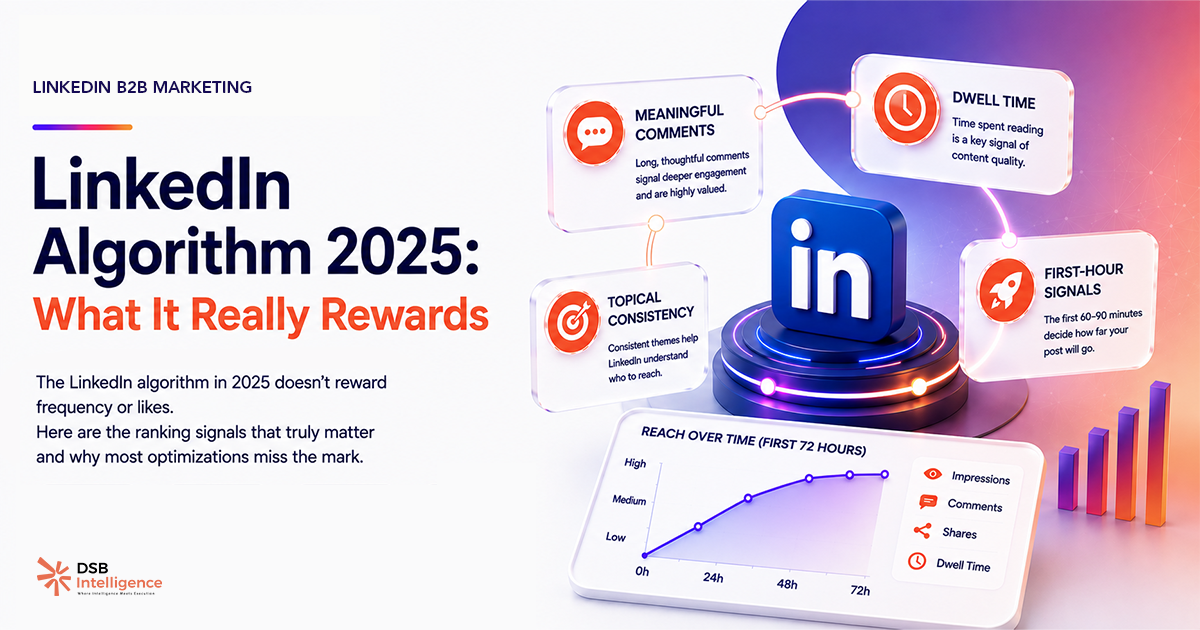
La plupart des conseils sur l'algorithme LinkedIn tournent autour de la fréquence, des hashtags et des heures de publication. Ce sont des variables secondaires. Ce qui détermine réellement la visibilité en 2025 est plus structurel — et moins facile à optimiser avec une checklist.
Pourquoi la majorité des "optimisations" LinkedIn ratent leur cible ?
L'erreur de cadre est simple : on optimise pour des métriques visibles (impressions, likes, abonnés) alors que l'algorithme optimise pour la pertinence perçue par chaque utilisateur.
Ces deux objectifs ne sont pas alignés. Un post peut accumuler des réactions superficielles d'une audience non ciblée et voir son reach s'effondrer sur les posts suivants. À l'inverse, un post avec peu de réactions mais un fort taux de lecture complète peut bénéficier d'une distribution élargie.
Le problème est que les métriques visibles dans l'interface LinkedIn ne reflètent pas les signaux que l'algorithme utilise réellement. Pour aller plus loin sur ce point, l'article LinkedIn Analytics Tools : ce que les dashboards ne mesurent pas détaille précisément ces angles morts.
Qu'est-ce que le dwell time et pourquoi l'algorithme s'en sert ?
Le dwell time est le temps qu'un utilisateur passe sur un post — sans nécessairement interagir avec lui. C'est un signal de lecture silencieuse.
LinkedIn a publiquement reconnu que le temps passé sur un contenu influence sa distribution. La logique est directe : si un utilisateur s'arrête plusieurs secondes sur un post sans le scroller, c'est une preuve d'attention. L'algorithme interprète ce comportement comme un signal de valeur, même sans réaction visible.
Ce mécanisme explique pourquoi les carrousels PDF et les posts avec "voir plus" retiennent l'attention plus longtemps qu'un texte court : ils forcent une interaction physique (scroll, clic) qui allonge mécaniquement le temps passé. Ce n'est pas une astuce — c'est la mécanique des formats qui retient le doigt.
La conséquence pratique : un post qui se lit en 8 secondes et génère 50 likes peut performer moins bien qu'un post qui se lit en 45 secondes et génère 12 commentaires.
Quel rôle joue la première heure de diffusion ?
La distribution initiale d'un post suit une logique de test : LinkedIn expose le contenu à un segment restreint d'abonnés proches et observe les signaux d'engagement dans les premières 60 à 90 minutes.
Si ce segment réagit — et surtout s'il commente ou partage — l'algorithme élargit la distribution à un cercle plus large. Si les signaux sont faibles, la diffusion reste limitée et n'est généralement pas rattrapée plus tard.
C'est pourquoi le moment de publication a un effet réel, mais pas pour la raison qu'on croit. Ce n'est pas que "l'algorithme aime les posts du mardi matin" — c'est que publier quand ton audience cible est active maximise la probabilité d'un signal fort dans cette fenêtre critique. L'article When Is the Best Time to Post to LinkedIn explore cette logique avec plus de granularité.
La distribution des impressions sur les 72 premières heures suit généralement une courbe en puissance : la grande majorité du reach se joue dans les premières heures, puis décroît rapidement. Planifier en fonction de cette fenêtre est plus efficace que d'optimiser la fréquence globale.
Comment la cohérence thématique influence-t-elle le reach ?
L'algorithme LinkedIn construit une représentation de chaque compte à partir de ses publications passées. Il est raisonnable de supposer que cette représentation sert à identifier l'audience la plus susceptible d'être intéressée par un nouveau post.
Un compte qui publie alternativement sur le management, la cuisine et la politique internationale rend cette tâche difficile. L'algorithme ne sait pas à qui distribuer le contenu — et distribue à tort, ce qui génère un faible engagement, ce qui réduit le reach futur.
À l'inverse, un compte avec une cohérence éditoriale forte sur un périmètre thématique précis permet à l'algorithme de cibler une audience stable. Cette prédictibilité améliore la précision de la distribution et, mécaniquement, le taux d'engagement moyen.
C'est ici qu'intervient notre Insight Narrator : il analyse la distribution thématique de tes publications sur les 90 derniers jours et identifie les sujets qui génèrent le meilleur ratio engagement/impressions pour ton audience spécifique — pas pour une audience générique.
Quels signaux d'engagement pèsent le plus lourd ?
Tous les signaux d'engagement ne sont pas équivalents dans le scoring de distribution du linkedin feed ranking.
Les commentaires longs — plusieurs phrases, avec une prise de position — signalent une lecture attentive et une réaction réfléchie. Ce sont les signaux les plus valorisés. Les partages avec texte ajouté ont un effet similaire : ils indiquent que le contenu a déclenché une réflexion suffisamment forte pour que quelqu'un veuille la partager avec son propre contexte.
Les réactions simples (like, célébration) ont un effet positif mais limité. Elles peuvent être données sans lire le post — l'algorithme le sait et pondère en conséquence.
Les tags de contacts sans pertinence contextuelle sont contre-productifs. Si la personne taguée ignore le tag ou masque le post, ce comportement envoie un signal négatif. Le linkedin content visibility d'un compte peut se dégrader durablement à force de tags non pertinents.
Pour aller plus loin sur la lecture des métriques d'engagement, LinkedIn Engagement Rate Benchmark : ce que les chiffres cachent pose les bases d'une interprétation honnête des ratios.
Qu'est-ce qui a réellement changé dans le linkedin algorithm 2025 ?
Les linkedin algorithm changes 2025 les plus significatives portent sur deux axes.
D'abord, une pondération accrue des contenus de niche à forte pertinence, au détriment des contenus grand public à fort volume de réactions. LinkedIn cherche à augmenter le temps passé sur la plateforme par des utilisateurs professionnels — ce qui passe par une meilleure pertinence, pas par plus de viralité.
Ensuite, une pénalisation plus marquée des comportements de linkedin reach signals artificiels : pods d'engagement coordonnés, tags massifs, republication de contenu viral sans valeur ajoutée. Ces comportements sont détectables par des patterns d'engagement anormaux (vitesse, profils participants, géographie).
Le résultat net : les comptes qui ont misé sur ces tactiques voient leur reach organique se dégrader progressivement, sans signal d'alerte explicite. Pour comprendre comment lire ces signaux de dégradation dans les données, LinkedIn Analytics Tools : au-delà des métriques API et LinkedIn for B2B Marketing : métriques qui comptent donnent un cadre d'analyse concret.
Et maintenant ?
- Audite ta cohérence thématique sur les 60 derniers jours : identifie les 2-3 sujets qui génèrent le meilleur ratio commentaires/impressions et concentre ta production sur ces axes.
- Mesure le dwell time indirect : compare tes posts avec "voir plus" vs. tes posts courts sur le ratio commentaires/impressions — pas sur les impressions brutes.
- Protège ta fenêtre de première heure : publie quand ton audience cible est active, réponds aux premiers commentaires dans les 30 minutes pour amplifier le signal initial.
- Supprime les tags non pertinents de ta pratique éditoriale — chaque tag ignoré est un signal négatif que tu offres à l'algorithme.
Si tu veux un diagnostic structuré de tes signaux de ranking LinkedIn, essaie DSB Intelligence gratuitement — le Recommendations Engine identifie les patterns de dégradation avant qu'ils deviennent visibles dans tes impressions.