


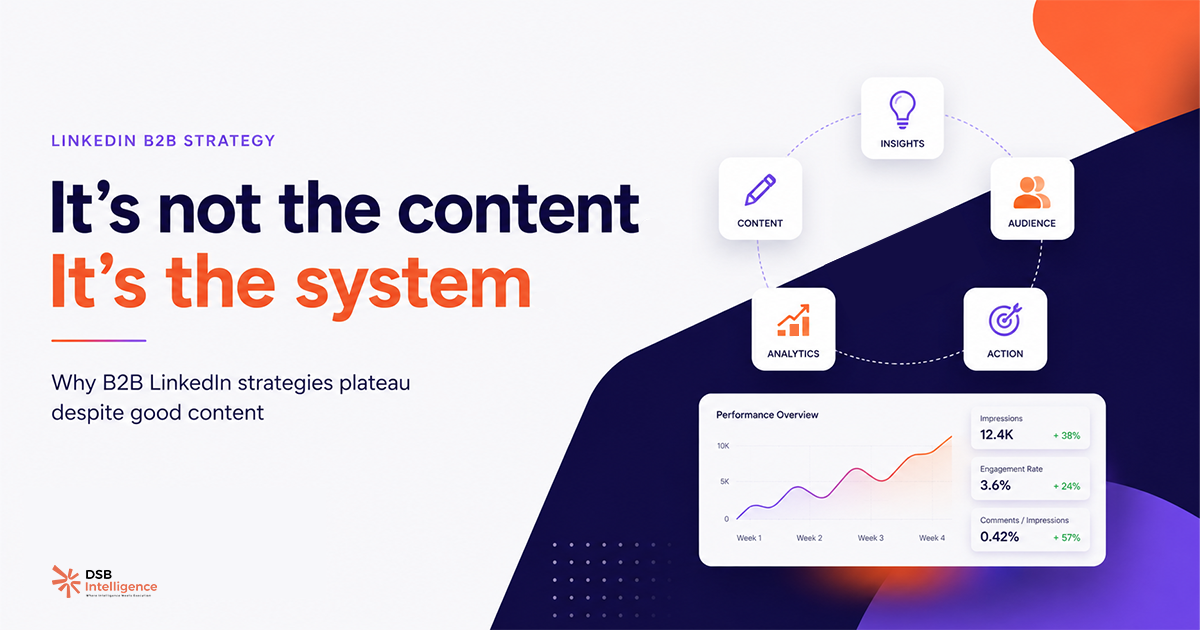
Most B2B teams don't have a content problem on LinkedIn. They have a systems problem dressed up as a content problem. More posts won't fix it.
Why does B2B LinkedIn marketing stop scaling?
The ceiling isn't the algorithm. It's the absence of a feedback loop.
Most B2B teams build their LinkedIn presence the same way: hire a content manager, set a posting cadence, track likes and follower counts at the end of the month. That works until it doesn't — usually when the team grows, a second or third author joins, and no one agrees on what "working" means anymore.
The core issue is that reach on LinkedIn follows a power law. A small fraction of posts — across any account — captures a disproportionate share of total impressions, and the rest generates noise. Without a system to tell which posts are in which category within the first 48 hours, teams keep investing in formats and topics that stopped working weeks ago.
This isn't a content quality problem. A well-written post in the wrong format, published at the wrong cadence, by an author whose network has drifted from the target audience, will underperform no matter how good the copy is. The signal is in the distribution pattern, not the prose.
The fix starts with one question: what data do we look at, how often, and who owns the decision to change course? If that question doesn't have a clear answer, the program isn't scalable yet.
What does a functional LinkedIn team workflow actually look like?
Three roles, three cadences — and they don't belong to the same person.
The editorial role owns what gets published: topic selection, format, author assignment, timing. It runs weekly, and needs visibility into what performed the prior week before committing to the next one.
The performance-review role owns signal interpretation: which posts are gaining traction, which authors are reaching new audiences, where engagement is dropping. It runs on a 48-to-72-hour cadence — fast enough to catch a post in its distribution window, slow enough to avoid reacting to noise.
The strategic-adjustment role owns the bigger picture: is the content mix aligned with pipeline stage, are we reaching the right job titles, is organic complementing paid or duplicating it? It runs monthly, and needs aggregated data across authors, formats, and topics.
When one person holds all three roles, the cadences collapse into each other. Monthly reviews replace weekly ones. Strategic decisions get made on gut feel because there's no time to process the data, and the program stagnates.
For a team of two to five people, the minimum viable split is one person on editorial plus performance review, and one person on strategic adjustment with a monthly data handoff. That handoff only works if the data is structured — not a screenshot of LinkedIn's native dashboard, but a consistent view of reach-per-author, engagement rate by format, and profile-visit-to-impression ratio over time.
How do you build a signal layer for LinkedIn organic reach?
Start with author-level reach, not page-level aggregates.
LinkedIn's native analytics default to page-level stats: total impressions, follower growth, page views. Those numbers are useful for reporting up to a CMO. They're useless for running the program week to week.
The signal layer that actually drives decisions tracks four things. First, reach per author per week — who is generating impressions, and is that number growing or shrinking? Second, engagement rate by post type — are carousels outperforming text posts for your specific audience, or is that a general pattern that doesn't apply to your niche?
Third, the profile-visit ratio — of the people who saw a post, how many clicked through to the author's profile? A high ratio signals intent; a low one signals passive scrolling. Fourth, reach trajectory over 30 days — trending up, flat, or down? Flat is the most dangerous: it feels stable while the audience quietly disengages.
This is where DSB Intelligence's Insight Narrator becomes a practical shortcut. Instead of manually assembling these signals across multiple authors, it reads the pattern and surfaces the interpretation — "author X's reach dropped 35% over 14 days, driven by a shift from text to link posts" — so the performance-review role has something to act on, not just a spreadsheet to stare at.
The point isn't the tool. It's that signal interpretation has to happen on a cadence short enough to be actionable. If you read your LinkedIn analytics once a month, you're reading a post-mortem, not a dashboard.
For a deeper look at what reach actually measures — and what it systematically misses — What Are LinkedIn Impressions — and What They Miss is worth the ten minutes.
Which LinkedIn analytics actually predict pipeline — and which ones don't?
Follower count predicts nothing. Profile visits predict something.
The metrics most B2B teams optimize for — likes, comments, follower growth — are weakly correlated with pipeline at best. They're easy to measure, which is why they dominate dashboards. They're not useless, but they're trailing indicators: they tell you what already happened, not what's likely to happen next.
Profile visits per post carry more weight. When a post drives someone to the author's profile, that's a behavioral signal of intent — the viewer didn't just scroll past, they wanted to know more. For B2B, where the sales cycle is long and trust-building is the actual job, that matters more than a like.
Reach to new audiences matters too. Reach that stays within your existing first-degree network is brand reinforcement; reach that breaks into second and third degrees is growth. LinkedIn's native analytics expose a "new vs. existing" breakdown for page posts, and for personal profiles the equivalent is tracking whether reach is expanding beyond the network you already have.
Engagement rate by job title is the commercial check. LinkedIn's audience insights for company pages show the job-function breakdown of who engaged. If you're targeting VP-level buyers and your engagement is dominated by peers and competitors, the content is working socially but not commercially.
None of these signals are hard to collect. They're hard to collect consistently, across multiple authors, over multiple weeks, without a structured process. That's the systems problem — not the content.
Is LinkedIn organic still worth the investment for B2B in 2025?
Yes — but the bar for "systematic" has risen.
Two years ago, consistent publishing was enough to stand out. The feed was less competitive, algorithmic amplification was more generous to personal profiles, and the average quality of B2B content was low enough that simply showing up regularly was a differentiator.
That's no longer true. The feed is denser. More teams have figured out that personal profiles outperform company pages for organic reach. More founders and sales leaders are publishing. The signal-to-noise ratio has dropped.
What still works is authors with a defined point of view, publishing in formats that hold attention, on a cadence that's sustainable without burning out the person behind the keyboard. What doesn't work is a content factory producing generic thought leadership at volume, with no feedback loop to catch drift.
The teams winning at LinkedIn marketing for B2B in 2025 aren't publishing more than their competitors. They're publishing smarter — they have a system that tells them, within 48 hours of a post going live, whether to double down on the format or cut it from the rotation. That's a systems advantage, not a content advantage.
Now what?
- Audit your current signal layer. List every LinkedIn metric your team reviews regularly. If the list is shorter than five signals, or if it's all page-level, you're flying blind at the author level.
- Split the three roles. Even with just two people, assign editorial ownership separately from performance review, and set a 48-hour review cadence for posts in their first distribution window.
- Add the profile-visit ratio to your weekly review. It's available in LinkedIn's native analytics for personal profiles, and it's the closest proxy to intent you have without paid data.
- Set a 30-day reach-trajectory review. If total reach is flat or declining over 30 days, that's a system problem — not a content problem. Diagnose the format mix and author cadence before writing more posts.
If you want a system that does the signal interpretation for you — author-level reach, format performance, trajectory alerts — start a free trial of DSB Intelligence and connect your LinkedIn accounts in under five minutes.