


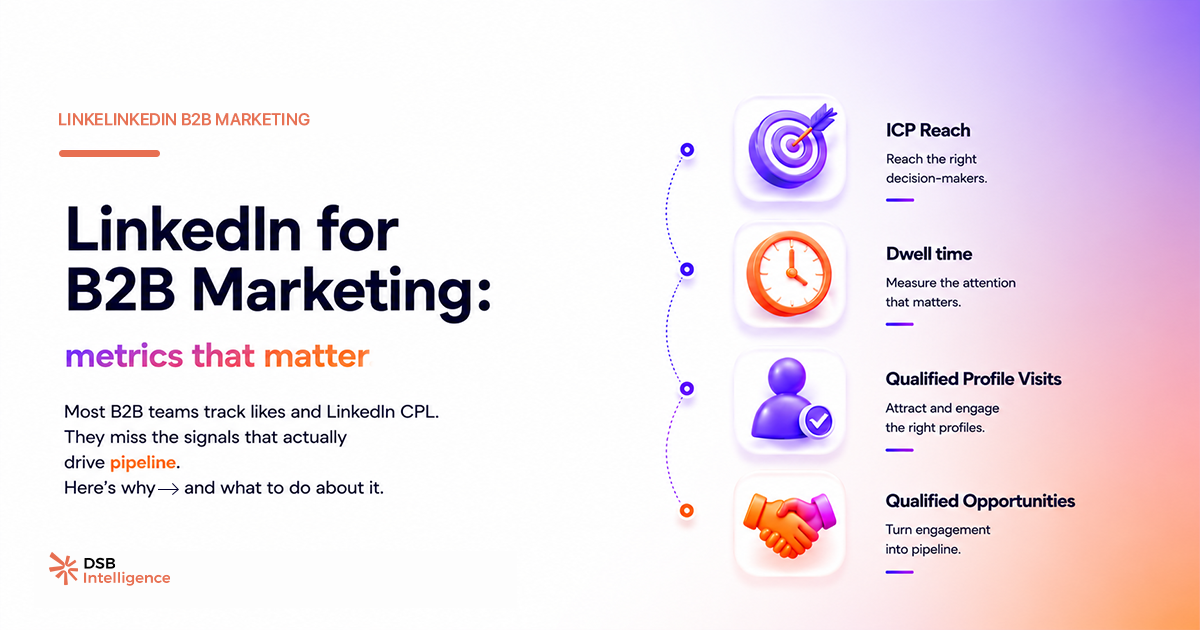
Most B2B marketing teams on LinkedIn are running the right platform with the wrong scoreboard. They're winning at metrics that don't pay the bills.
Why is "linkedin for b2b marketing" still misunderstood in 2026?
The platform hasn't changed as much as the competitive environment around it. LinkedIn remains the highest-concentration professional network for B2B buyers — that part is settled. What's shifted is the cost of attention. Feed density has increased, ad inventory has tightened, and buyers have developed sharper filters for content that wastes their time.
The teams still measuring success by follower growth or post impressions are using a 2019 playbook in a 2026 market. Impressions tell you your content appeared in a feed. They say nothing about whether it landed with someone who could actually buy.
The more useful question is: which content formats, topics, and audience segments are generating pipeline? That requires connecting LinkedIn data to CRM outcomes — a loop most teams haven't closed.
For a deeper look at why the workflow matters before the tactics, B2B Marketing with LinkedIn: Fix the System First is worth reading before you touch another campaign setting.
What does the LinkedIn algorithm actually reward for B2B content?
It rewards content that earns attention past the first scroll — not content that gets the most impressions.
LinkedIn has publicly acknowledged that time spent on a post influences its distribution. The behavioral logic is straightforward: if a post makes someone stop, read, and react, the feed treats that as a quality signal and extends reach. If a post gets scrolled past in under two seconds, distribution contracts.
This has a direct implication for format choice. Carousels and native documents (PDFs uploaded directly to LinkedIn) force a physical interaction — the reader swipes or clicks through slides. That interaction generates dwell time in a way a static image or a link post simply cannot. Text-only posts with a strong opening line can also hold attention, but they depend entirely on the quality of the hook.
What this means practically: posting frequency is a secondary variable. A team publishing three high-attention posts per week will outperform one publishing daily filler. The algorithm doesn't reward volume — it rewards signal quality.
The implication for B2B teams is that content strategy needs to be built around format-level performance data, not just topic intuition. Which formats are generating comments versus passive likes? Which posts are being shared into private messages (dark social)? These signals exist in your analytics — most teams don't look at them systematically.
Is the organic vs. paid debate on LinkedIn a false choice?
Yes. Framing it as "organic or paid" is how teams end up with two underperforming workstreams instead of one coherent system.
Organic content on LinkedIn does something paid campaigns can't do cheaply: it surfaces real intent signals. When a post on a specific pain point generates 40 comments from directors at mid-market SaaS companies, that's not just engagement data — it's audience intelligence. You now know which topic resonates, with which seniority level, in which segment.
The move that most teams miss is feeding that signal back into paid targeting. Instead of building a LinkedIn Ads audience from scratch using job title + industry filters, you build it from the accounts and profiles that engaged with your organic content. The audience is already warm. The CPL drops. The SQL rate rises.
Running organic and paid as separate workstreams — different owners, different KPIs, no shared data layer — is one of the most common structural failures in linkedin marketing strategy b2b. It's not a budget problem. It's an architecture problem.
Our Insight Narrator surfaces exactly this pattern: when organic engagement on a topic spikes but the corresponding paid campaign isn't targeting the same audience segment, it flags the gap and quantifies the reach you're leaving on the table.
For a clear-eyed look at what the paid benchmarks actually mean (and what they hide), LinkedIn Ads Benchmark: What the Averages Hide breaks down why industry averages are often misleading for B2B campaign planning.
Why does LinkedIn B2B advertising underperform for most teams?
Because most campaigns are built around the wrong targeting layer and optimized for the wrong conversion event.
Broad job-title targeting is the default for most teams new to linkedin b2b advertising. "Director of Marketing, 500-5000 employees, SaaS" sounds precise. In practice, it's a large, cold audience with highly variable intent. You're paying LinkedIn's premium CPM to reach people who may be nowhere near a buying decision.
The sharper approach is account-level targeting: building audiences from companies that have already shown intent — visited your pricing page, engaged with your content, matched your ICP firmographics. LinkedIn's Matched Audiences feature supports this, but it requires a clean CRM integration and a defined ICP. Most teams skip the setup work and default to job-title filters.
The second failure point is the optimization event. Campaigns optimized for form fill rate produce a lot of fills. They don't necessarily produce SQLs. A form with a 12% fill rate that generates zero qualified pipeline is worse than one with a 5% fill rate that books ten discovery calls. The metric you optimize for shapes the audience the algorithm finds for you.
LinkedIn Lead Gen Forms: Fix Fill Rate vs. SQL Rate goes deep on this specific failure mode and how to restructure campaigns around downstream conversion data.
What intent signals on LinkedIn actually predict pipeline?
The signals that predict pipeline are not the ones most teams track.
Likes are passive. They require one tap and no cognitive commitment. Comments require a formed opinion. Profile visits after a post require active curiosity. Saves (bookmarks) signal "I want to return to this" — one of the strongest intent signals available on the platform.
For linkedin lead generation, the highest-value signals are:
- Repeat engagement from the same account across multiple posts (suggests the company is actively researching your category)
- Comment quality — a comment that references a specific pain point is worth more than ten generic "great post" reactions
- Profile visits from target accounts in the 48 hours following a post
These signals exist in LinkedIn's native analytics, but they're fragmented. Connecting them to account-level pipeline data requires either a manual process or a tool that aggregates them systematically.
LinkedIn Lead Generation: 4 Intent Signals That Build Pipeline maps these signals to specific pipeline stages — worth bookmarking if your team is trying to move from engagement metrics to revenue attribution.
And if you're still relying on post impressions as a primary KPI, What Are Post Impressions on LinkedIn — and What They Miss explains exactly why that number flatters your content more than it informs your strategy.
Now what?
-
Audit your current KPI set. List every metric your team reports on LinkedIn. For each one, ask: does this correlate with pipeline in our CRM? If you can't answer yes with data, deprioritize it.
-
Close the organic-to-paid loop. Identify your three best-performing organic posts from the last 90 days. Build a Matched Audience from the accounts that engaged. Run a paid campaign to that audience with a direct conversion offer. Compare CPL and SQL rate to your standard job-title-targeted campaigns.
-
Shift one campaign's optimization event. Pick one active Lead Gen Form campaign. Change the optimization target from form fills to a downstream event (meeting booked, opportunity created). Let it run for 30 days and compare SQL rate.
-
Track format-level attention, not just reach. Pull comment rate and share rate by format (carousel vs. text vs. video) for the last 60 days. Let the data tell you which format earns attention — then double down on it.
If you want a system that surfaces these signals automatically — flagging when organic and paid are misaligned, tracking intent signals at the account level, and connecting content performance to pipeline — start a free trial of DSB Intelligence and see what your LinkedIn data is actually telling you.