


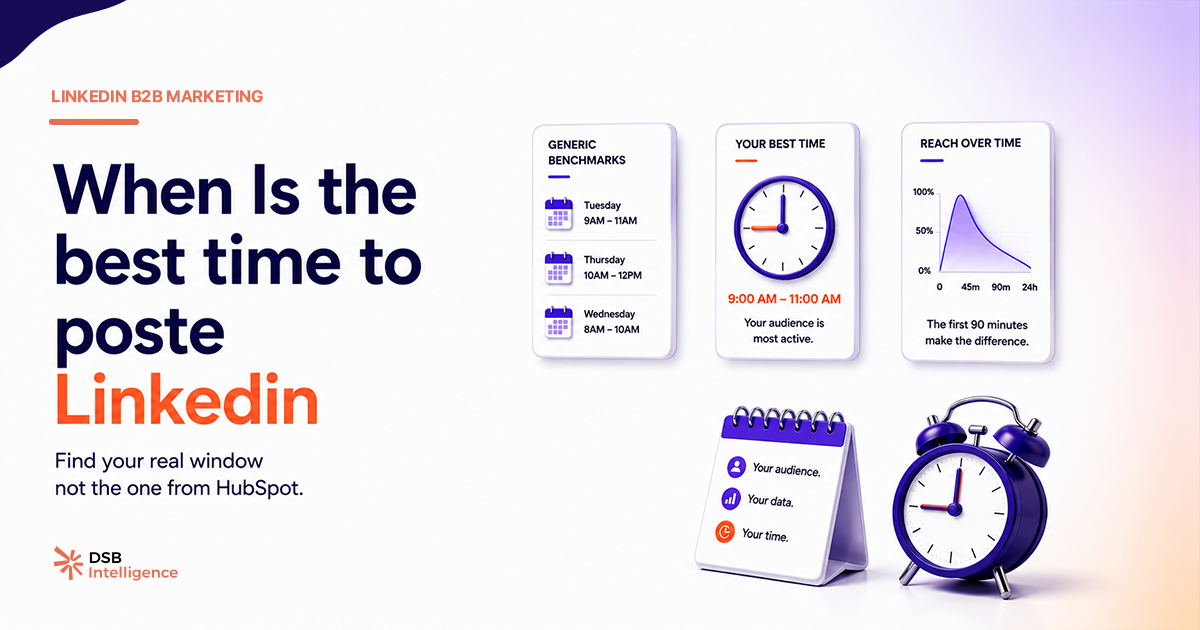
The "best time to post on LinkedIn" is one of the most-recycled pieces of advice in B2B marketing. Every tool vendor, every creator coach, every LinkedIn-growth newsletter has a version of it. Most of them are citing the same three or four aggregated studies — then presenting the output as if it applies to your account specifically.
It doesn't. Here's what does.
Why do generic timing benchmarks keep circulating?
They're easy to produce and easy to consume. Aggregate millions of posts, bucket them by hour, surface the top-performing slots — done. The problem is that this method flattens the signal.
A post targeting C-suite buyers in London behaves differently from one aimed at junior marketers in São Paulo. A thought leadership piece from a founder with 15,000 followers in a tight niche behaves differently from a company page update with 200 followers. Averaging across all of them produces a number that's technically correct and practically useless for any individual account.
The benchmark that keeps appearing — Tuesday through Thursday, 8–10 AM local time — is a reasonable starting hypothesis. Treat it as the null hypothesis you're trying to disprove with your own data, not a schedule to copy-paste.
What does LinkedIn's algorithm actually do with timing?
LinkedIn doesn't publish its ranking mechanics. What the observable behaviour suggests, consistently, is that early engagement velocity matters.
When you publish a post, LinkedIn surfaces it to a small initial slice of your network. If that slice engages — reactions, comments, shares, and critically, time spent reading — the algorithm expands distribution. If it doesn't, reach stalls. The decisive window is roughly the first 60 to 90 minutes after publishing.
This means timing is really a proxy for one thing: are the right people online and scrolling when your post goes live? If your audience is a cluster of US-based VP-level buyers, posting at 8 AM CET puts your content in their feed at 2 AM EST. The early-velocity window fires into an empty room.
It's also worth noting that LinkedIn's feed isn't purely chronological. A post can resurface hours or days later if it keeps accumulating engagement. But that second wave is almost always smaller than the first. You don't get to skip the launch window and rely on a comeback.
How does audience seniority shift the optimal window?
Seniority changes online behaviour more than most timing guides acknowledge.
Director and VP-level professionals tend to check LinkedIn in short bursts — early morning before meetings, occasionally at lunch, rarely in the afternoon. They're not scrolling at 3 PM on a Tuesday. Entry-level and mid-level audiences are more active throughout the day and more likely to engage in the evening.
Founders and solo operators are a different case entirely. Many of them are active on LinkedIn outside standard business hours — early mornings, late evenings — because that's when they're not in back-to-back calls.
If you know your ICP's seniority level and typical work rhythm, you already have a better timing model than any generic benchmark. The question is whether you're using it. LinkedIn Analytics Tools: Measure ICP Reach, Not Vanity covers how to track whether your reach is actually landing on the right seniority tier — because impressions from the wrong audience don't move pipeline regardless of when you post.
How do you find your actual best posting window?
You run the experiment yourself. There's no shortcut.
The minimum viable dataset is 60 days of post-level data: publish timestamp, impressions, and — if you can get it — follower vs. non-follower reach split. Group your posts into time slots (e.g., 7–9 AM, 9–11 AM, 11 AM–1 PM, afternoon, evening) and compare median impressions per slot. Look for a cluster that consistently outperforms the others.
A few things to control for:
- Content format: carousels and documents tend to hold attention longer than text posts, which inflates their reach independently of timing. Don't mix formats when comparing slots.
- Topic relevance: a post that hits a trending topic will overperform regardless of timing. Exclude obvious outliers.
- Posting frequency: if you post three times in one week and once the next, the frequency effect contaminates the timing signal.
DSB Intelligence's Insight Narrator surfaces exactly this pattern — it reads your post-level distribution across time slots and flags where your reach consistently peaks versus where it flatlines, so you're not eyeballing a spreadsheet manually.
Once you have a candidate window, test it deliberately: post consistently in that slot for four weeks, then compare against your previous baseline. That's the experiment. It's not glamorous, but it's the only method that produces a number you can actually trust.
For a deeper look at how benchmarks compare across account sizes and industries, Best Time to Post on LinkedIn: Find Your Window walks through the published data and where it holds up.
Does posting time matter more than content quality?
No — and conflating the two is where most timing advice goes wrong.
Timing is a multiplier. It amplifies what's already there. A strong post at a decent time outperforms a weak post at the optimal time, every time. If your content isn't generating engagement in the first place, shifting your publish time from 9 AM to 8 AM will not fix it.
The more productive question is: what's actually limiting your reach right now? If your posts consistently underperform, the culprit is more likely content relevance, hook quality, or audience mismatch than a 45-minute scheduling error. What Are Post Impressions on LinkedIn — and What They Miss breaks down how to read your impression data to diagnose the real constraint.
Timing becomes a meaningful lever only after you've established that your content resonates. At that point, optimising the window can meaningfully increase the reach of posts that were already working. Before that point, it's a distraction.
The same logic applies to frequency. Posting five times a week at the "wrong" time will likely outperform posting once a week at the "right" time — because volume gives the algorithm more chances to find a winner. Timing and frequency interact; neither operates in isolation.
For B2B teams trying to connect posting schedules to pipeline outcomes rather than vanity metrics, LinkedIn for B2B Marketing: Fix the Scoreboard First is the right frame to start with.
Now what?
- Pull 60 days of your post history with publish timestamps and impressions. If you don't have this data yet, start logging it today — every post, every time.
- Group by time slot and compare medians, not averages. Outliers skew averages; medians show the repeatable pattern.
- Pick one candidate window and test it for four weeks, holding content format and frequency constant. Treat it as an experiment, not a commitment.
- Track ICP reach, not just total impressions. A timing shift that increases reach from the wrong audience is noise. LinkedIn Lead Generation: 4 Intent Signals That Build Pipeline shows what signals to watch instead.
If you want the analysis done without the spreadsheet, try DSB Intelligence free — the Insight Narrator maps your timing patterns automatically and tells you where your reach window actually sits.