

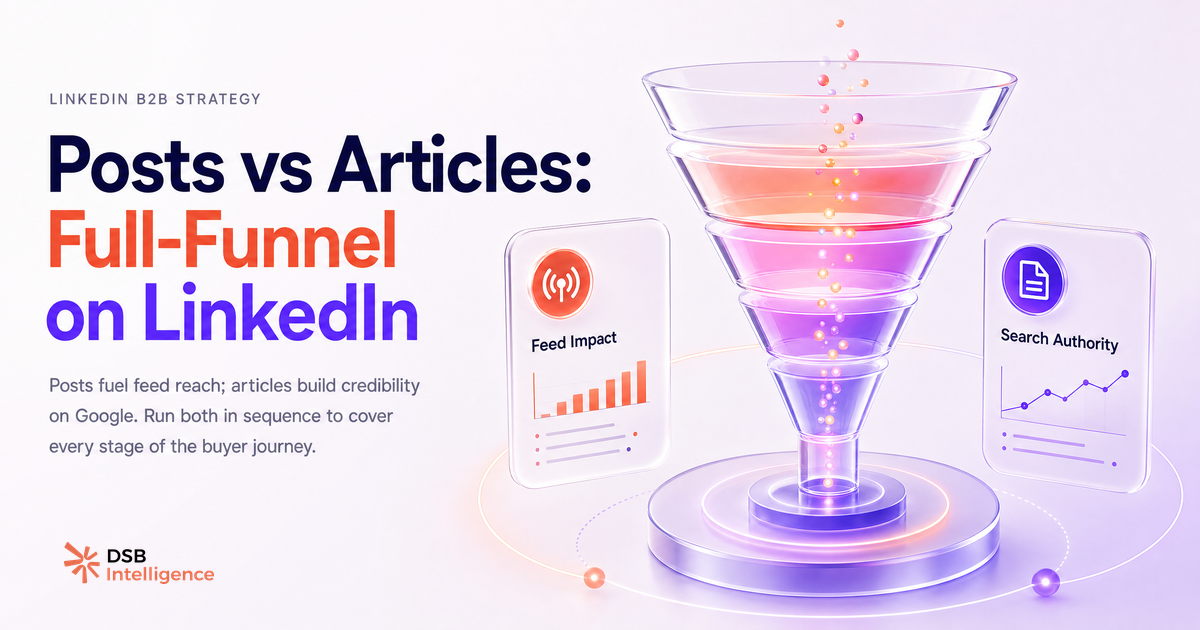
Most comparisons of LinkedIn articles vs posts answer the wrong question. They rank formats by reach, declare posts the winner, and move on. That framing misses the point entirely — and it's why most B2B content strategies on LinkedIn generate impressions without generating pipeline.
The SERP answer is wrong: articles and posts don't compete for the same job
The dominant SERP answer is: "posts get more reach, articles are for thought leadership." That's technically true and practically useless.
Posts and articles operate on different distribution mechanics, different time horizons, and different buyer contexts. Treating them as substitutes — and picking one over the other — is like choosing between a billboard and a whitepaper because both are "marketing."
A post lives in the feed. It gets distributed algorithmically to your first-degree connections and, if engagement is strong in the first hours, to second-degree networks. Its window is short: most of the reach happens within the first 72 hours, then impressions drop sharply.
An article lives on your LinkedIn profile and on the open web. It gets indexed by Google. It appears when someone searches your name, your company, or a topic you've written about. A buyer who's already heard of you and is now doing due diligence will land on your articles — not your posts.
These are two different moments in a buyer's journey. Conflating them because they both live on LinkedIn is the core mistake.
What the distribution mechanics actually look like (and why articles get less reach than you think)
Articles get less feed reach than posts. That's not a bug — it's a design choice by LinkedIn. The feed algorithm prioritises native, short-form content that keeps users scrolling. Articles don't fit that mechanic well: they take users off the feed and onto a separate page.
The trade-off is discoverability over time. A post published today is largely invisible in six weeks. An article published today can still surface in Google results in six months. For linkedin long-form content, the relevant metric isn't impressions in the first 48 hours — it's cumulative views over a 90-day window.
There's a second distribution channel that most creators ignore: the LinkedIn newsletter. A newsletter is not a separate format — it's a subscription layer on top of the article format. When you publish a newsletter edition, your subscribers get a direct notification. That's a fundamentally different distribution mechanic than hoping the feed algorithm picks up your article. If you're investing in articles, setting up a newsletter is the highest-leverage distribution move available. (See LinkedIn Newsletter Cover Image Size: Specs & Visual Mistakes for the setup details that most people get wrong.)
The practical implication: articles underperform not because the format is weak, but because most creators publish them without a distribution strategy. No companion post, no newsletter, no cross-link from recent content. The article sits on the profile and waits. That's a distribution failure, not a format failure.
The pipeline signal: which format moves buyers, not just readers
Here's the frame that matters for linkedin content strategy b2b: reach measures attention, pipeline measures intent.
A post with 15,000 impressions and 200 reactions tells you the topic resonated. It doesn't tell you whether anyone moved closer to a buying decision. An article with 800 views, read by three VP-level buyers at a target account, followed by a connection request and a DM — that's pipeline signal.
The format that moves buyers is whichever one they consume during the evaluation phase. And during evaluation, buyers are doing two things: searching for information (Google, LinkedIn search) and reviewing your profile. Articles show up in both contexts. Posts almost never do.
This is why the "articles vs posts" framing collapses when you apply a pipeline lens. Posts are awareness vehicles. Articles are credibility assets. A content pipeline that only has posts is top-of-funnel only. A content pipeline that only has articles has no distribution engine. You need both, in sequence.
The sequencing that works: publish the article, then write a post that extracts the sharpest insight from it and links back. The post drives feed reach. The article captures the buyers who click through and want depth. Each format does its job.
For a broader look at why articles specifically tend to be abandoned before they compound, LinkedIn Articles in 2026: Stop Abandoning Them Too Early covers the compounding dynamic in detail.
How does format-level engagement reveal what's actually working?
Aggregate metrics hide format-level signals. If you're looking at total impressions across your LinkedIn content, you can't tell whether your articles are pulling weight or whether all your reach is coming from three viral posts.
The diagnostic question is: what's the engagement pattern by format, not in aggregate?
For posts, the relevant signals are impressions in the first 48 hours, reaction rate, and comment quality (generic "great post" vs. substantive replies). For articles, the relevant signals are cumulative views over 30-90 days, time spent on the article (a proxy for whether people actually read it), and what happens after — profile visits, connection requests, DMs that reference the article.
These are different measurement frameworks, and conflating them produces misleading conclusions. A creator who sees "low engagement" on articles because they're comparing reaction counts to post reaction counts is measuring the wrong thing.
This is exactly the kind of format-level pattern that DSB Intelligence's Insight Narrator is built to surface: it reads engagement at the content-type level and flags when a format is underperforming relative to its own baseline, not relative to a different format's mechanics. Instead of "your articles get less engagement than your posts" (which is almost always true and almost always irrelevant), the signal becomes "your articles are generating profile visits but no follow-through" — which is an actionable diagnosis.
If you're also experimenting with video alongside articles and posts, LinkedIn Video Size: Specs, Ratios & What Drives Reach covers the distribution mechanics for that format specifically.
Are LinkedIn articles still worth it in 2025? A direct answer
Yes. Not for feed reach — posts will always win that comparison. For three things posts can't do:
Google indexing. Articles appear in search results. Posts don't. If your buyers search your name or your topic before a meeting, your articles are what they find.
Profile credibility. A profile with 20 published articles signals a different level of commitment than a profile with only posts. Buyers in evaluation mode read profiles differently than casual scrollers.
Depth on complex topics. Some arguments can't be made in 1,300 characters. Articles let you build a case, cite evidence, and demonstrate the kind of thinking that closes enterprise deals.
The caveat: articles only deliver on these three things if they're actually good. A thin, generic 600-word article published for the sake of "having articles" does none of the above. The bar for articles is higher than for posts — which is exactly why most people abandon them too early.
For teams managing a content calendar across formats, LinkedIn Scheduling Tools Ranked for B2B Accounts covers the tooling side of keeping both formats in rotation without the overhead.
Now what?
-
Audit your last 90 days by format. Separate your post metrics from your article metrics. Look at cumulative article views, not just the first-week spike. If you haven't published an article in 60 days, that's the gap to close first.
-
Set up the companion post mechanic. Every article you publish should have a companion post that extracts one sharp insight and links back. This is the distribution engine articles don't have on their own.
-
Check your newsletter setup. If you're publishing articles without a newsletter, you're leaving the most direct distribution channel on the table. Set up the newsletter, import your existing articles, and let subscribers drive the initial view count.
-
Track format-level signals separately. Stop averaging posts and articles into a single "content performance" number. The diagnostic value is in the difference between formats, not the aggregate.
Ready to track what's actually driving pipeline from your LinkedIn content? Start your free trial with DSB Intelligence and get format-level analytics without the manual spreadsheet work.