

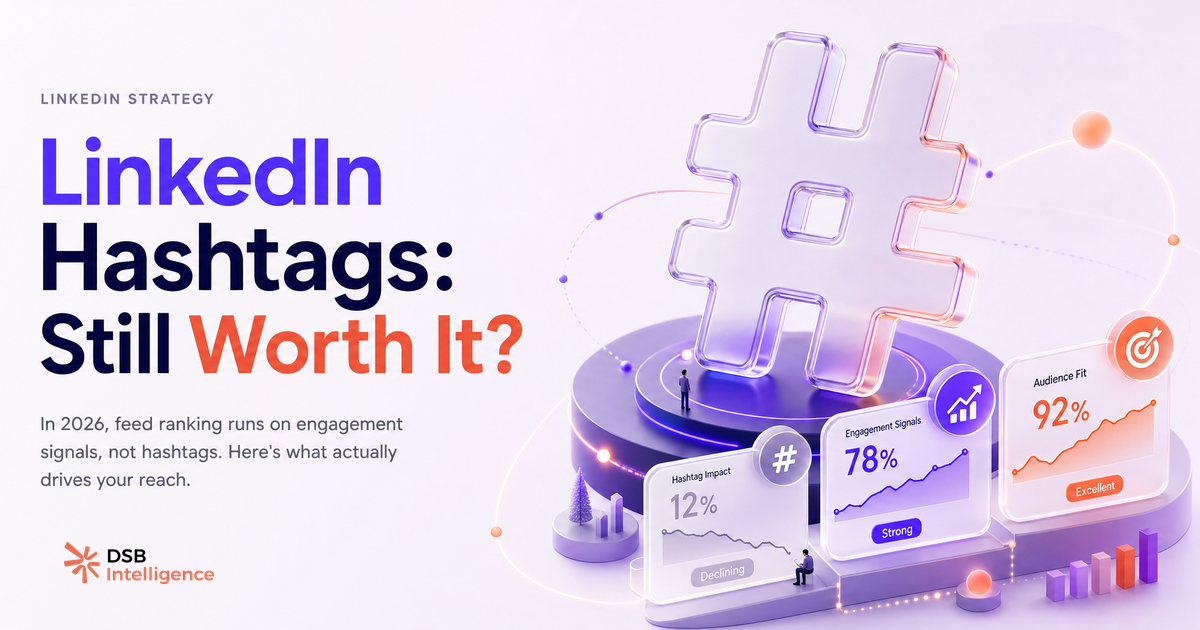
Most LinkedIn advice on hashtags is five years out of date. The playbook of stacking five to ten tags at the bottom of every post made sense when LinkedIn was actively building its hashtag-following feature. That era is over.
Here is what the platform actually does in 2026, and what you should be measuring instead.
Are LinkedIn hashtags still relevant in 2026? The short answer is: barely
LinkedIn hashtags peaked as a distribution tool around 2019 to 2021, when the platform was aggressively promoting the "follow a hashtag" feature and surfacing tagged content in dedicated feeds. That infrastructure still exists. The weight it carries in content ranking does not.
LinkedIn's feed ranking has shifted toward behavioral signals: how long someone pauses on your post, whether early commenters are high-quality connections, and how well your content matches the inferred topic interests of each viewer. A hashtag tells the algorithm what your post is about. The algorithm already infers that from the text itself.
The practical consequence: two posts on the same topic, one with three hashtags and one with none, will distribute almost identically if their engagement patterns are similar. The hashtag is not the variable that explains the difference.
This does not mean hashtags are completely inert. It means they are no longer a lever worth optimizing. There is a meaningful gap between "not harmful" and "worth your strategic attention."
For a deeper look at how this shift played out, Hashtags on LinkedIn in 2026: Do They Still Matter? covers the timeline in detail.
What does LinkedIn actually use to distribute your content (it is not hashtags)?
LinkedIn distributes content through a layered ranking process. The first layer is your immediate network: your first-degree connections see the post first. If they engage quickly and substantively, the post gets pushed to second-degree connections and to people whose interest graph matches the topic.
Three signals dominate that second-layer push:
Engagement velocity is the rate at which reactions and comments accumulate in the first hour. A slow start is hard to recover from, regardless of how many hashtags you added.
Dwell time is the time a viewer spends with the post visible on screen before scrolling. LinkedIn has publicly acknowledged that time-on-post influences visibility. Carousels and native video hold attention longer than text posts, which is why format has a larger effect on reach than any tag.
Network relevance is how closely the people engaging with your post match the audience LinkedIn thinks you write for. A comment from a CFO on a finance post signals stronger relevance than ten reactions from unrelated connections.
Hashtags sit below all three of these. They help LinkedIn categorize the post, but the categorization work is largely redundant with what the natural language processing layer already does on the post body.
If you want to understand the format side of this equation, Video Format for LinkedIn in 2026: What Actually Matters breaks down how native video stacks up against other formats on distribution signals.
When do hashtags still make sense, and when are they dead weight?
There are two narrow cases where hashtags on LinkedIn retain genuine value.
The first is niche professional communities. Tags like #industrialautomation or #regulatoryaffairs have smaller but highly active follower bases. If your content is genuinely for that community, the tag connects you to people who opted in to see it. The key word is niche: broad tags like #marketing or #leadership have millions of followers and near-zero signal value because the feed competition is too dense.
The second is branded content series. If you publish a recurring series, a consistent branded hashtag lets your audience filter your archive and signals editorial discipline. This is a UX and community-building tool, not a reach tool.
Outside these two cases, hashtags are dead weight. Three generic tags at the bottom of a post do not expand your audience. They add visual noise and, in some cases, may read as low-effort to the readers you most want to impress.
One practical rule worth applying: if you cannot explain why a specific tag is on a specific post, remove it. The burden of proof should be on keeping the tag, not removing it.
LinkedIn Articles vs Posts: What Actually Builds Authority is worth reading alongside this, since the format decision often matters more than the tagging decision for long-term content distribution.
How does reading post-level distribution signals separate hashtag noise from real reach drivers?
The problem with most LinkedIn analytics is that they surface vanity metrics: total impressions, total reactions, follower count. None of these tell you why a post reached the people it reached.
The signal that matters is the follower-to-non-follower impression split. When a post reaches a high proportion of non-followers, it means the second-layer distribution fired. That is the signal that your content broke out of your immediate network. Hashtags almost never explain that breakout. Engagement velocity and dwell time almost always do.
DSB Intelligence's Insight Narrator is built to read exactly this pattern: it decodes post-level distribution signals and surfaces which variables (format, timing, topic, engagement profile) correlate with non-follower reach on your specific account. That distinction matters because the drivers are not universal. What works for a founder audience differs from what works for a sales team audience.
The practical implication: stop A/B testing hashtag combinations. Start tracking which content types consistently generate non-follower impressions on your account. That is the variable worth optimizing.
For context on how posting frequency interacts with these signals, How Often to Post on LinkedIn: Daily Is Backfiring is a useful companion read.
A practical approach: what to track instead of hashtag counts
Replacing a hashtag strategy with a signal strategy means shifting what you measure. Here is a concrete starting point.
-
Track your follower-to-non-follower impression ratio per post. A rising non-follower share over time means your second-layer distribution is improving. A flat or declining share means your content is not breaking out of your existing network, regardless of how many tags you use.
-
Segment engagement rate by content format. If carousels consistently outperform text posts on your account, that is a format signal worth acting on. Hashtag variation rarely produces a comparable signal.
-
Audit your hashtag usage against actual outcomes. Pull your last twenty posts. Sort by non-follower reach. Check whether the high-reach posts share a hashtag pattern. If they do not, the hashtag is not the driver. If they do, check whether the format and topic are also consistent before attributing the result to the tag.
-
Keep one or two niche or branded tags if they fit. Drop the rest. The cognitive overhead of managing a hashtag strategy is not worth the marginal benefit in 2026.
The honest answer is that most LinkedIn creators would see no measurable change in reach if they stopped using hashtags tomorrow. The time spent on hashtag research is better spent on format quality, posting timing, and early engagement cultivation.
Email Finder from LinkedIn: Match Rate Is All That Matters is a different angle on the same underlying principle: the metric that looks important is often not the one that drives results.
Now what?
- Pull your last 20 posts and sort by non-follower impressions. Note which format and topic variables correlate. Hashtags are almost certainly not the pattern.
- Remove hashtags from your next three posts entirely. Compare reach against your hashtagged baseline. The difference will likely be within noise.
- If you run a content series, pick one branded hashtag and use it consistently. That is the only hashtag worth maintaining as a deliberate strategy.
- Shift your weekly content review from "which hashtags to use" to "what drove non-follower reach this week and can I replicate it."
Ready to stop guessing and start reading your actual distribution signals? Try DSB Intelligence free and let the Insight Narrator show you what is really driving your LinkedIn reach.