

Most companies hire a LinkedIn video editor the same way they hire a graphic designer: portfolio review, turnaround test, rate negotiation. The result is a polished video that gets 4,000 impressions and zero pipeline. The problem isn't the editor. It's the brief.
Why do most LinkedIn video editors optimize for aesthetics, not for pipeline signals?
Because that's what they're asked to do. The typical LinkedIn video editing job description lists deliverables: vertical format, captions, color grade, 60-90 seconds, delivered in 48 hours. None of those criteria have a direct relationship with whether a CFO watches past the five-second mark or clicks through to a profile.
Aesthetics and pipeline signals are not the same optimization target. A beautifully graded video with a generic hook ("Here's what I learned about leadership...") will lose a B2B buyer in the first three seconds. A rougher cut that opens with a specific, uncomfortable truth ("Your SDRs are calling accounts your LinkedIn content already warmed up — and they don't know it") will hold the right viewer.
The editor can only optimize for what they're measured on. If the brief says "make it look clean," they'll make it look clean. If the brief says "the hook must retain a VP of Sales past five seconds," the editor has a different job. Most LinkedIn video editing jobs never make that distinction explicit.
Understanding LinkedIn Video Size: Specs, Ratios & What Drives Reach is table stakes. The strategic layer — what the video is supposed to do in the feed — is what most briefs skip entirely.
What are the 3 content behaviors that separate a video that generates leads from one that gets views?
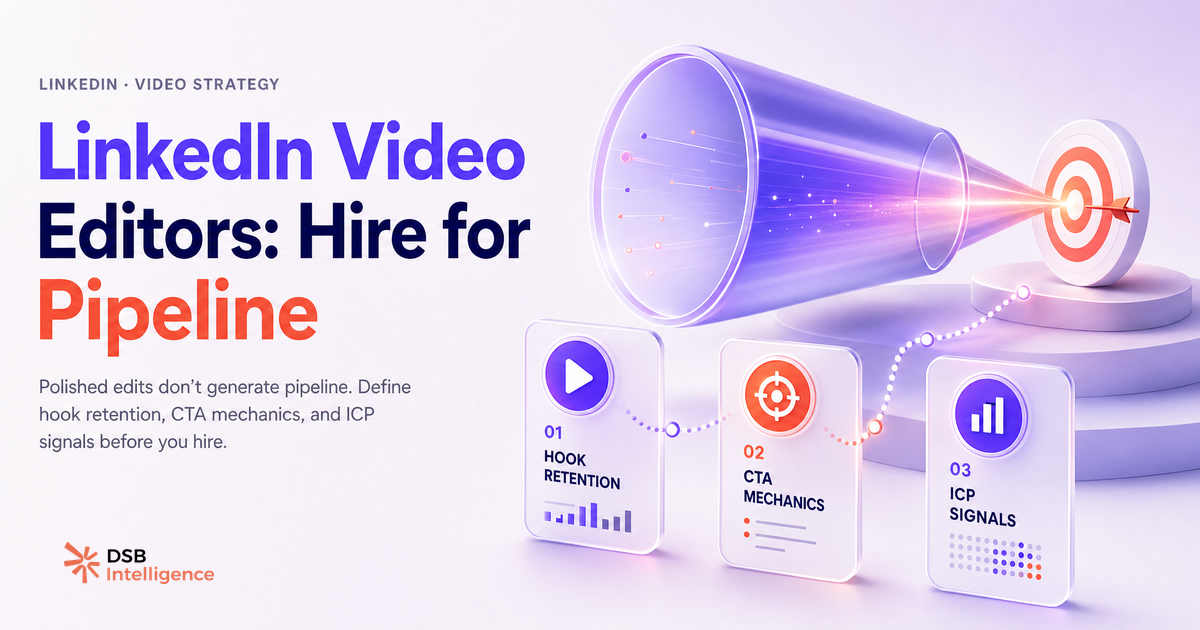
The gap between a video that gets views and one that generates pipeline comes down to three structural behaviors, not production quality.
Hook specificity. A hook that names a role, a pain, or a situation filters the feed for you. "If you run a 5-person sales team and your close rate dropped in Q2" is not for everyone — and that's the point. Generic hooks attract generic engagement. Specific hooks attract the right viewer and repel the wrong one, which is exactly what you want in a B2B context.
CTA placement and friction. Most LinkedIn videos end with "follow me for more" or nothing at all. Both are pipeline dead-ends. A pipeline-aware CTA gives the viewer a low-friction next step that matches where they are in the buying journey: "DM me the word X and I'll send you the framework," "the link to the full breakdown is in the first comment," or a direct question that invites a reply. The CTA is not an afterthought — it's the conversion mechanism. Posting Video to LinkedIn: What Actually Drives Reach covers how CTA structure interacts with the feed's distribution logic.
Comment-bait structure. Comments from your ICP are worth more than likes from anyone. A video structured to provoke a specific reaction ("drop your number below," "what's your take on this?") from a named persona is doing active pipeline work. The editor needs to understand that comment quality, not comment volume, is the signal that matters.
These three behaviors are editorial decisions, not production decisions. An editor who understands them is a strategist with a timeline. One who doesn't is a skilled technician — useful, but not sufficient for B2B LinkedIn video.
How do you write a job brief that filters for pipeline-aware editors, not just skilled ones?
The filter is in the application question, not the job description. One question does most of the work: "Share a LinkedIn video you edited and tell us what happened after it went live."
A pipeline-aware editor will answer with something measurable: profile visits, DMs, a specific comment from a target account, a conversation that turned into a call. A production-focused editor will describe the edit itself — the color grade, the caption style, the turnaround. Both answers are honest. Only one tells you the editor has been thinking about the right problem.
Beyond the application question, the brief itself should specify outcomes, not just deliverables. Instead of "deliver a 90-second vertical video with captions," write: "deliver a 90-second vertical video with a hook that retains a [specific ICP role] past five seconds, a CTA that drives profile visits or DMs, and a structure that invites comments from [target persona]." That brief is harder to write. It forces you to define what success looks like before you hire — which is the actual work most companies skip.
For reference on what the platform rewards technically, LinkedIn Advertising Video: Beyond the Spec Sheet and LinkedIn Video Ads Examples That Actually Build Pipeline both cover the structural patterns that show up in high-performing B2B video, paid and organic.
How does DSB Intelligence track whether your video content is actually moving the needle?
Impressions and likes don't tell you if a video is working for pipeline. The signals that matter are downstream: profile visits in the 24-48 hours after posting, connection requests from new accounts in your ICP, and the quality of comments (are they from the persona you're targeting, or from peers and competitors?).
The DSB Intelligence Recommendations Engine connects these dots. It flags when a video generates strong early watch-time but no downstream profile activity — a pattern that typically points to a hook that retained the wrong audience. It also surfaces when a specific CTA structure is consistently outperforming others across your content history, so you can brief your editor with evidence, not instinct.
The output is a feedback loop between content structure and pipeline signal. Without that loop, you're optimizing blindly — and so is your editor.
When is hiring a video editor the wrong move entirely?
If any of the following are true, hiring a LinkedIn video editor will add cost without adding pipeline.
Your ICP is not defined at the content level. Knowing your ICP for sales is not the same as knowing which specific pain, role, and situation your video hook should name. If your team can't write that sentence, an editor can't optimize for it.
Your posting cadence is inconsistent. A single polished video every three weeks does not build the feed presence needed for pipeline. LinkedIn's distribution logic rewards consistent posting. One great video per month is a production exercise, not a content strategy. LinkedIn Articles vs Posts: Which Format Drives Pipeline? covers how cadence interacts with format choice across the feed.
You have no measurement layer. If you can't track what happens after a video goes live — profile visits, DMs, comment quality — you have no way to brief the editor on what's working. You'll optimize for aesthetics by default, because that's the only feedback signal available.
In these cases, the right move is to fix the strategy and measurement layer first. Then hire the editor.
Now what?
- Rewrite your next LinkedIn video editing job brief to specify outcomes, not just deliverables. Name the ICP role, the hook retention target, and the CTA mechanism.
- Add one application question: "Share a LinkedIn video you edited and describe what happened after it went live." Use the answer as your primary filter.
- Build a measurement layer before the editor starts. Define which downstream signals (profile visits, DMs, ICP comments) you'll track per video, and at what time window after posting.
- If your strategy or cadence isn't solid yet, pause the hire. Fix the foundation first.
Ready to connect your video content to pipeline signals? Start your free trial of DSB Intelligence and see which of your videos are actually moving the needle.