

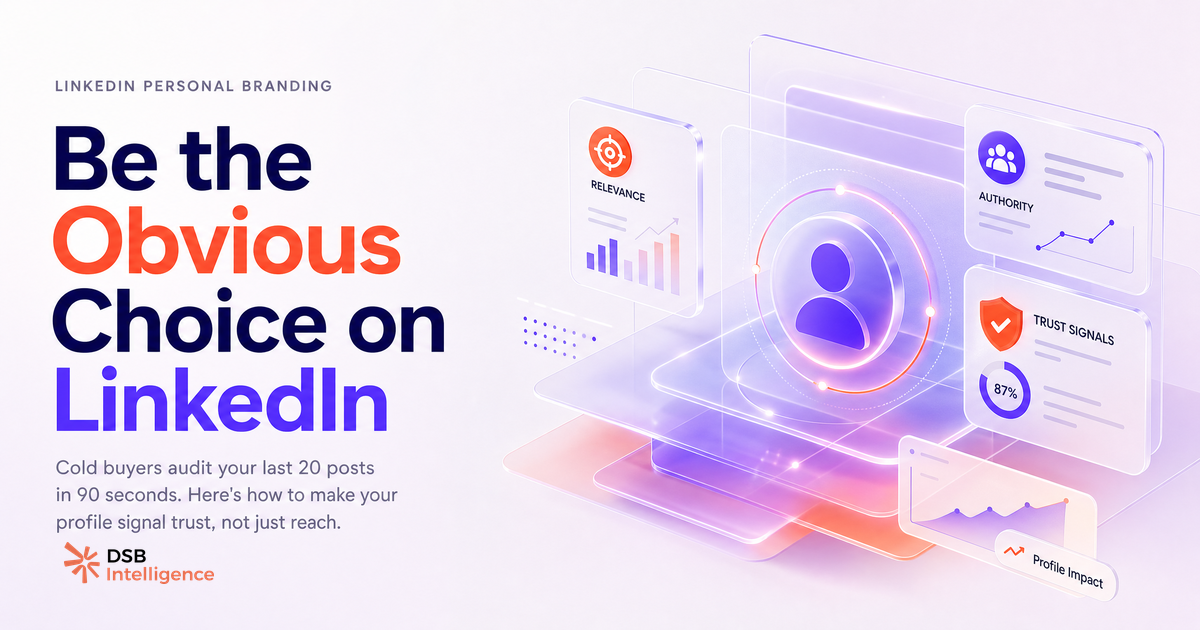
Most LinkedIn "personal branding" advice is optimizing for the wrong metric.
Likes feel good. Follower growth feels like progress. But neither of them tells you whether a cold buyer, three weeks from now, will look at your profile and think: "This is exactly who I need to talk to."
Does most LinkedIn personal branding advice optimize for applause instead of pipeline?
Yes, and the gap between the two is wider than most creators realize.
The dominant playbook goes like this: post consistently, engage with comments, use hooks that stop the scroll, and watch your impressions climb. That advice is not wrong. It is just incomplete. It optimizes for the feed algorithm, not for the buyer's decision process.
A buyer evaluating a vendor, a consultant, or a partner does not open LinkedIn to browse the feed. They open it to research a specific person. They type a name into the search bar. They land on a profile. Then they scroll.
What they find in those 90 seconds determines whether they send a message or close the tab.
The creators who win pipeline are not always the ones with the highest reach. They are the ones whose profile tells a coherent story: a clear topic, a consistent point of view, and evidence that other people in the same situation found value in what they shared.
Optimizing for applause means chasing formats and topics that perform broadly. Optimizing for pipeline means narrowing relentlessly until your content is unmistakably relevant to one type of buyer.
What do buyers actually do on LinkedIn before they reach out?
They audit your archive, not just your latest post.
This is the behavior that most LinkedIn advice ignores. When a cold prospect encounters your content and feels a pull, they do not immediately send a connection request. They visit your profile. They scroll through your last ten to twenty posts. They read your About section. They check who has commented and whether those commenters look like people they trust.
They are running a silent due diligence process. The question they are answering is not "is this person interesting?" It is "is this person credible on the specific problem I have right now?"
That question changes everything about what you should be publishing.
A post that gets strong engagement from a broad audience can actually hurt you if it signals that you talk about everything. A post that gets five comments from heads of sales at mid-market SaaS companies, with zero viral reach, is doing more pipeline work than a post that reaches ten thousand generalists.
LinkedIn Articles vs Posts: Which Format Drives Pipeline? covers the format dimension of this in detail. The underlying principle is the same: depth for the right audience beats breadth for the wrong one.
The other thing buyers check is social proof embedded in the comments. Not testimonials on your profile, which feel curated. The organic comments from peers who say "this is exactly what we ran into" or "we solved it differently, here's how" are the ones that carry weight. They signal that real practitioners are in the room.
What are the three content signals that build trust with cold audiences over time?
Trust on LinkedIn is built through three observable signals: a clear point of view, demonstrated expertise across time, and peer-validated relevance.
A clear point of view means you take positions. Not "here are five perspectives on X" but "X is wrong, and here is why." Buyers are not looking for a balanced journalist. They are looking for someone who has formed a conviction through experience and is willing to defend it. Vague takes signal that you are hedging. Sharp takes signal that you have skin in the game.
Demonstrated expertise across time means your archive holds up. A buyer who scrolls back three months should find the same core topic, treated with increasing depth. If your feed shows a pivot every six weeks, from productivity to AI to leadership to sales, you look like someone still figuring out their positioning. Consistency is not repetition. It is returning to the same territory from different angles, building a body of work.
Peer-validated relevance is the hardest to manufacture and the most powerful. It shows up when people who look like your target buyer are the ones engaging with your content. You cannot fake this. You can accelerate it by being specific enough that only the right people recognize themselves in what you write.
LinkedIn Scheduling Tools Ranked for B2B Accounts is useful context here: the cadence you maintain matters, but only if the content behind it is consistent in positioning.
How does DSB Intelligence's Insight Narrator surface which posts are doing that trust-building work?
Most analytics tools show you what performed. The Insight Narrator is built to show you what performed for whom.
The distinction matters because a post with a high impression count and a low comment rate from your target segment is not a success. It is a signal that you drifted toward a broader audience. Conversely, a post with modest reach but a high concentration of engagement from the exact profile type you are targeting is doing the work that feeds pipeline.
The Insight Narrator decodes that pattern: it surfaces which posts generated the right kind of attention, not just the most attention. That lets you double down on the angles, formats, and topics that are building trust with cold buyers, rather than chasing the posts that got the most applause from the wrong crowd.
This is where How to Turn Off Profile Views on LinkedIn becomes relevant: understanding who is visiting your profile after seeing a post is a direct signal of trust-building in action.
Is LinkedIn good for personal branding? Only if you define branding correctly.
LinkedIn is good for personal branding if you define branding as consistent positioning, not posting frequency.
The platform's feed algorithm does reward consistency and relevance to a specific audience. That alignment is real. But the mistake most creators make is treating LinkedIn as a broadcast channel rather than a trust-building archive.
Your brand on LinkedIn is not your latest post. It is the pattern that emerges when someone reads your last twenty posts in fifteen minutes. That pattern either says "this person owns a specific problem space" or it says "this person posts a lot."
LinkedIn Video Editor Jobs: A Pipeline Decision makes the same argument from a production angle: investing in format quality only pays off when the underlying positioning is already clear.
Format questions, like those covered in LinkedIn Video Size: Specs, Ratios & What Drives Reach, matter at the margin. Positioning is what determines whether any of it converts.
The creators who build durable pipeline from LinkedIn are not the ones who post every day. They are the ones who have been saying the same true thing, in different ways, for long enough that buyers recognize them before they ever reach out.
That is what personal branding on LinkedIn actually is. Not visibility. Not follower count. The moment a buyer thinks "I already know what this person stands for" before the first call.
Now what?
- Audit your last twenty posts as if you were a cold buyer. Is there a clear topic? A consistent point of view? Or does it look like a feed of unrelated takes?
- Identify the two or three posts that generated direct messages or profile visits from people who match your target buyer. Study what made them work. Replicate the angle, not the format.
- Stop tracking impressions as your primary signal. Track the quality of who engages: are they the people you want in your pipeline?
- If you want to know which posts are actually doing trust-building work with the right audience, start a free trial of DSB Intelligence and let the Insight Narrator surface the pattern for you.