

Most agencies searching for white label analytics end up on comparison pages built for a completely different buyer. That's not a minor inconvenience — it sends you down a six-week evaluation path for a tool that was never designed for your use case.
Does the SERP actually solve the agency problem — or just the product team problem?
The top results for "white label analytics platform" are dominated by embedded BI vendors: tools designed for a SaaS product team that wants to ship analytics features inside their own app. Think Looker Embedded, Sisense, or Qlik's OEM tier. These are serious platforms solving a real problem — just not yours.
An agency's reporting job is structurally different. You're not embedding a dashboard inside a product your clients log into daily. You're delivering a periodic, branded report to a marketing director who wants to know if the LinkedIn content strategy is working, not how to configure a data pipeline.
The evaluation criteria diverge immediately. Product teams care about SDK depth, multi-tenancy architecture, and query latency. Agencies care about how fast an account manager can generate a client-ready PDF, whether the email notification says "your agency name" or "noreply@vendordomain.com", and whether the platform can be explained in a 10-minute client onboarding call.
Conflating the two categories wastes time and often leads to over-engineered, overpriced contracts. The first step is recognizing that the SERP is not curated for you.
What does "white label" actually mean when your client opens the report?
White label means one thing in practice: the client has no evidence a third-party platform exists.
That sounds obvious. It rarely is. Many platforms offer "white label" as a feature tier that covers the logo and primary color. They stop there. The client still receives email alerts from a vendor domain. The PDF footer still carries a "Powered by" line. The dashboard URL still resolves to app.vendorname.com/your-workspace.
Each of those touchpoints is a leak. A client who Googles the vendor name finds pricing pages, competitor comparisons, and the realization that your "proprietary reporting system" costs $49/month per workspace. That's a trust problem, not a branding problem.
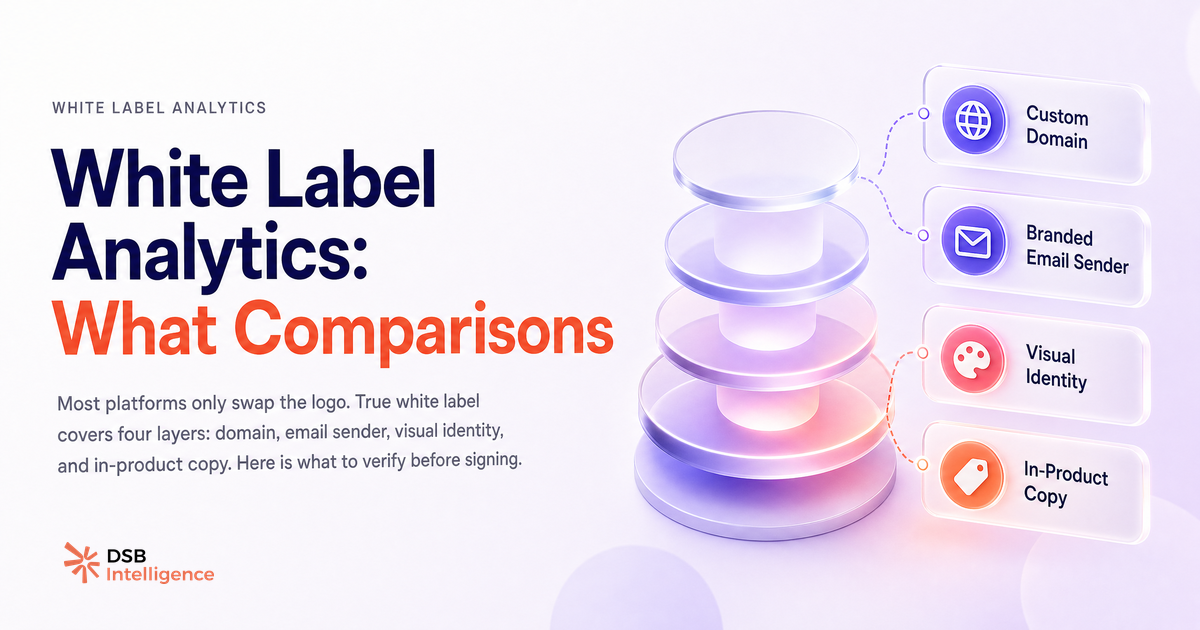
True white label for client reporting under your brand covers four layers: the visual identity (logo, colors, typography), the domain (a subdomain of your agency's domain, not the vendor's), the email sender (your agency's sending address), and the in-product copy (no vendor name in tooltips, help links, or error messages). If a vendor's "white label" tier doesn't address all four, it's partial branding, not white label.
For a deeper look at how clients actually perceive these reporting touchpoints, Marketing Agency Client Reporting: What Clients Want breaks down the gap between what agencies think clients notice and what clients actually remember.
How does a purpose-built platform handle branded reporting without SaaS overhead?
The overhead problem is real. Full embedded BI platforms require someone who can configure data models, write calculated fields, and manage workspace permissions. Most agency teams don't have that person — and shouldn't need one for client reporting.
The alternative is a platform built around a specific data domain (LinkedIn analytics, in DSB Intelligence's case) where the data model is pre-built and the branding layer sits on top. The account manager's job becomes: connect the client's LinkedIn page, apply the agency's brand kit, set the reporting cadence. No SQL, no schema mapping, no vendor support ticket to rename a metric.
This is the trade-off the agency dashboard white label comparison rarely surfaces: a narrower data scope in exchange for dramatically lower operational overhead. For agencies whose clients are running LinkedIn-first B2B strategies, that trade is almost always worth it.
DSB Intelligence's Insight Narrator is where this becomes concrete for account managers: instead of exporting raw LinkedIn metrics and writing commentary manually, the Narrator reads the data pattern and drafts the interpretive layer — the "why did reach drop this week" paragraph that used to take 20 minutes per client. The account manager edits and sends under the agency's brand. The vendor stays invisible.
What are the three things to check before picking any white label analytics platform?
Vendor comparison pages optimize for feature lists. Three things consistently fall off those lists.
First: how deep does the branding actually go? Run the test above. Check the email sender domain, the dashboard URL, the PDF footer, and the in-product help links. Ask the vendor for a sandbox with full white label enabled before signing. If they won't give you one, that's your answer.
Second: does the data model fit your client's channel mix? A platform built for LinkedIn organic analytics will not serve a client asking about Google Ads attribution. This sounds obvious, but agencies often buy a white label platform for one use case and then try to stretch it to cover the full client brief. The stretch creates manual workarounds that erode the time savings the platform was supposed to deliver. Be precise about the channel scope before evaluating.
Third: what is the data portability clause? This is the clause most agencies forget to read. If you cancel the contract, can you export your clients' historical data in a usable format? What is the retention window after cancellation? Some platforms delete workspace data within 30 days of churn. If you've built 18 months of client reporting history on that platform, losing it is a material business risk. Negotiate the portability clause before you sign, not after.
For a broader look at the arbitrage decisions agencies face when evaluating these platforms, White Label Analytics: What Vendors Won't Tell You covers the contractual and pricing dynamics that comparison pages systematically omit.
When is white labeling not the right call?
White label platforms carry fixed costs: setup, onboarding, a minimum contract term, and the operational overhead of maintaining a branded workspace for each client. That cost structure makes sense when your roster is large enough and stable enough to amortize it.
It doesn't make sense in three scenarios.
When your client roster is small (fewer than five active clients), the per-workspace cost of a white label platform often exceeds the value of the branding. A well-designed agency template inside a standard reporting tool, with your logo and color scheme applied consistently, delivers comparable perceived quality at a fraction of the cost.
When mandates are short or irregular, the setup cost per client is too high relative to the reporting volume. A three-month project with four deliverables doesn't justify a white label workspace configuration.
When the client is technically sophisticated and already uses their own analytics stack, white labeling can actually create friction. A Head of Growth who lives in Looker Studio doesn't want a separate branded portal — they want a data feed into their existing environment.
The honest read: white label analytics platforms are a retention and positioning tool for agencies with recurring, multi-year client relationships and a consistent reporting cadence. If that's not your current model, the white label SEO reporting strategy framing is worth reading before you commit to a platform contract.
Now what?
- Run the four-layer branding test on any platform you're currently evaluating: email sender, dashboard URL, PDF footer, in-product copy. Eliminate any platform that fails two or more layers.
- Map your top five clients' channel mix against the platform's data model. If more than one client requires a channel the platform doesn't cover natively, the stretch cost will outweigh the branding benefit.
- Pull the data portability clause from any contract you're close to signing. If it's not in the standard terms, ask for it in writing before the commercial conversation goes further.
- Model the per-workspace cost at twice your current client roster. If the unit economics break at that scale, negotiate a volume tier now or look for a platform with flat-fee agency pricing.
If branded LinkedIn reporting for B2B clients is the core of your agency's offering, try DSB Intelligence free and see how the white label layer works in a live environment before committing to a contract.