

Most agencies treat white label SEO reporting as a design task. Swap the logo, match the brand colors, remove the platform watermark, ship the PDF. Done.
That framing is why so many branded reports end up in a client's downloads folder, unopened after the first quarter.
What does white label SEO reporting actually mean, and what do vendors quietly skip over?
White label SEO reporting means delivering performance data under your agency's brand, with no trace of the underlying tool. The client sees your logo, your color palette, your domain. The vendor stays invisible.
Vendors sell this as a trust signal: the agency looks like it built the analytics infrastructure itself. That pitch is not wrong. It is just incomplete.
What vendors skip over is the content layer. Removing a logo does not change what the report says. It does not add interpretation, context, or a recommended next action. It changes the wrapper, not the message.
The agencies that get lasting value from white label reporting understand the distinction early. They use the branding layer to reinforce a consistent identity, and they invest separately in making the content worth reading. The ones that treat white labeling as the finish line discover the problem when a client asks, "So what does this actually mean for us?" and no one has a fast answer.
For a sharper look at how vendors frame this trade-off, White Label Analytics: What Vendors Won't Tell You covers the arbitrage most agencies miss before signing a contract.
What is the reporting gap that causes clients to churn?
The gap is not missing data. It is missing interpretation.
Clients do not leave because the report lacks a metric. They leave because the report does not tell them what to do with the metrics it includes. A dashboard full of impressions, clicks, and keyword rankings is noise if the client cannot connect those numbers to revenue, pipeline, or a decision they need to make this week.
This gap is structural. Most agency reporting workflows are built around data extraction and formatting. The analyst pulls the numbers, drops them into a template, adds a chart, and sends. The "so what" is left to the client to figure out, or to a brief verbal summary on a monthly call that no one remembers two weeks later.
The result is a predictable pattern: the client feels informed but not guided. Over time, that feeling shifts from neutral to frustrating. When a competitor agency pitches them with a clearer narrative, the switch feels obvious in retrospect.
Marketing Agency Client Reporting: What Clients Want maps this dynamic in detail, including the specific questions clients say they want answered that most reports never address.
How does automated narrative generation change the agency reporting workflow?
Automating the data pull is table stakes. The agencies pulling ahead automate the narrative layer too.
The difference is significant. A tool that automates data collection saves an analyst thirty minutes per report. A tool that also generates client-ready commentary from raw metrics saves the strategic thinking time that currently lives in someone's head and never makes it into the deliverable consistently.
This is where DSB Intelligence's Insight Narrator fits into the workflow. It reads the underlying channel data, identifies the patterns that matter for that specific account, and produces a plain-language narrative the agency can review, adjust, and send. No manual formatting. No starting from a blank commentary box for each client.
The output is not a generic summary. It reflects the account's trajectory: what moved, what stalled, and what the pattern suggests about the next reporting period. The agency's editorial voice stays consistent across accounts without requiring a senior strategist to write every client note by hand.
For context on where this fits in a broader agency stack, Marketing Agency Tools That Actually Drive Client Proof covers the full workflow picture.
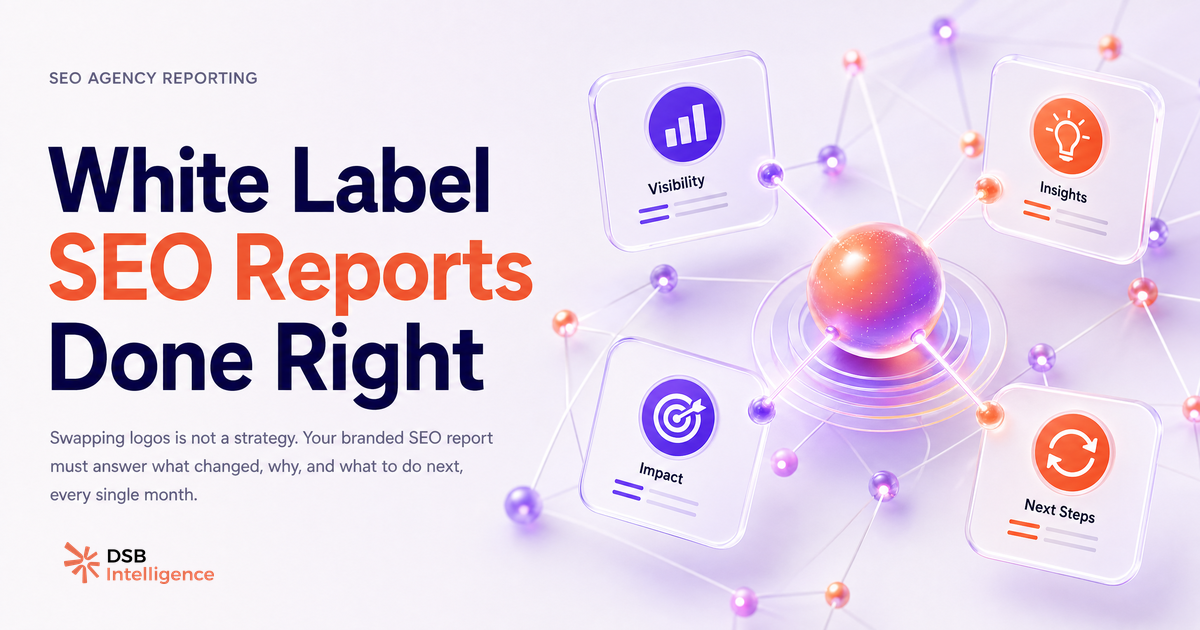
What four things must a white label report do before it earns the client's logo?
Branding a report that does not clear these four bars is a liability, not an asset.
First: it must answer what changed. Not "here are this month's numbers." A direct comparison to the prior period, with the delta stated plainly. Clients should not have to do the subtraction themselves.
Second: it must explain why it changed. This is where most reports stop being useful. A keyword ranking drop means nothing without context: algorithm update, competitor movement, technical issue, content gap. The report needs to carry that explanation, not leave it for the call.
Third: it must state what the agency recommends next. One or two concrete actions, tied to the data. Not "we will continue to monitor." A recommendation that reflects a point of view. This is what separates a strategic partner from a reporting vendor.
Fourth: it must be consistent. Same structure, same cadence, same editorial voice across every client and every month. Inconsistency signals that the report is a manual artifact, not a managed deliverable. Clients notice, even if they do not say so explicitly.
SEO Agency Reporting Software: What Most Tools Get Wrong goes deeper on the structural reasons most reporting tools fail on points two and three specifically.
When is white labeling the wrong priority?
White labeling is the wrong investment when the underlying report is broken.
If the data is incomplete, if the cadence is irregular, if the agency has no consistent point of view on the metrics it tracks, adding a logo makes the problem more visible, not less. A polished wrapper on a weak deliverable signals confidence the agency has not earned yet.
The agencies that should hold off on white label investment are the ones still figuring out what to measure and why. Fixing the content layer first, then the branding layer, is the order that compounds. It is also the order that makes the branding meaningful: when the report is genuinely useful, the logo on it becomes associated with quality, not just aesthetics.
There is also a channel-fit question worth asking. White label SEO reporting assumes SEO is the primary channel being tracked. For agencies running LinkedIn-heavy B2B programs alongside organic search, the reporting framework needs to cover both, with the same narrative discipline. A branded SEO report that ignores the LinkedIn signal leaves a gap clients will eventually notice.
LinkedIn Automation Tools in 2026: What the SERP Won't Tell You is worth reading if LinkedIn is part of the channel mix you are reporting on.
Now what?
- Audit your last three client reports. Check whether each one answers what changed, why, and what you recommend next. If any of the three is missing, that is the fix, not the branding.
- Map where manual writing time goes in your current workflow. If commentary is the bottleneck, that is the layer to automate first.
- Define a consistent reporting cadence for every active client before investing in template design. Consistency of delivery builds more trust than consistency of color scheme.
- If your reports are solid but your branding layer is still generic, that is the right moment to invest in white label customization.
Ready to see what automated narrative looks like on your actual client data? Start a free trial with DSB Intelligence and run your first branded report this week.