

Most clients who hire a LinkedIn ghostwriter think they are buying posts. They are not. They are buying a system that keeps their name visible on the platform they have no time to feed consistently.
That distinction matters, because it changes how you price, scope, and defend the engagement.
What a LinkedIn ghostwriter actually delivers (and why it's not just words)?
The deliverable is not a set of captions. It is a functioning editorial presence.
A ghostwriter handles ideation, drafts, formatting, scheduling, and often the first layer of community management. At the senior end of the market, they also own the positioning layer: which topics to own, which audiences to target, how to differentiate the client's voice from the ten other executives in the same niche posting the same takes.
That positioning work is invisible in the final post. It is also the hardest part to replace.
The practical output varies by tier. A basic package delivers a fixed number of posts per week, written from a brief or a voice-note. A full-service retainer delivers posts plus a monthly strategy session, a content calendar aligned to business priorities, and a reporting layer that shows whether the content is actually moving the right metrics.
Understanding which format drives which outcome is part of that strategy work. The choice between a long-form article and a short native post is not aesthetic: it has measurable reach and engagement consequences, as explored in LinkedIn Articles vs Posts: What Actually Drives Pipeline.
How much LinkedIn ghostwriters charge, and what justifies the price gap?
The market spans a wide range, and the spread is not explained by writing quality alone.
At the low end, templated packages offer a fixed number of posts per month, drafted from a questionnaire or a short intake call. These work for clients who need volume and consistency but are not trying to build a distinctive editorial voice.
Mid-tier retainers add strategy: a dedicated writer who learns the client's voice over time, proposes topics proactively, and adjusts the editorial calendar based on what is resonating. The relationship is closer to an embedded editor than a freelance copywriter.
At the high end, full-service ghostwriting engagements include positioning work, cross-channel alignment (newsletter, podcast, speaking), analytics reporting, and sometimes direct coordination with the client's sales or marketing team. These retainers are priced accordingly, and they are justified when the client's LinkedIn presence is a direct revenue lever.
The price gap, in short, reflects scope and accountability. A ghostwriter who can show you a monthly report linking content activity to inbound pipeline is worth more than one who sends you a Google Doc with twelve posts.
Hashtag strategy is one of those small-scope decisions that compounds over time. Getting it right or wrong affects organic distribution in ways most clients never see. LinkedIn Hashtags in 2026: What Actually Moves the Needle covers the current state of that lever.
The reporting problem: why most ghostwriting engagements die at renewal?
Here is the pattern that plays out repeatedly in the agency world.
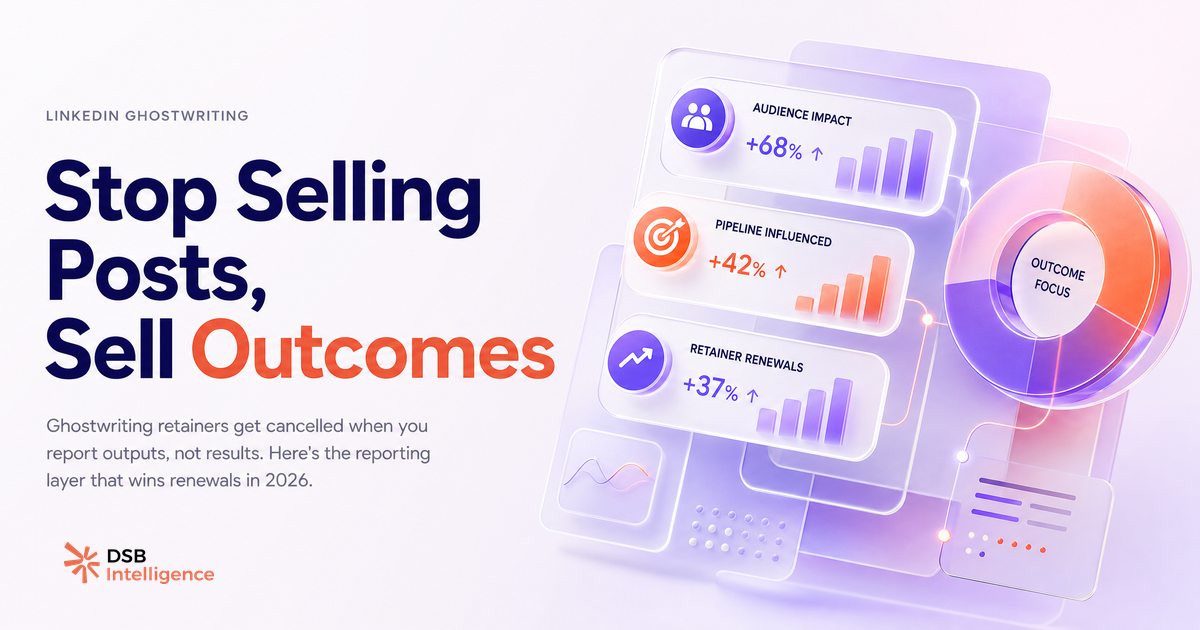
A ghostwriter onboards a client, produces good content, grows the account steadily over six months. Then the client's CFO asks what LinkedIn is generating. The ghostwriter sends a screenshot of native LinkedIn analytics. The CFO sees impressions and likes. She asks what that means for pipeline. Nobody has a clean answer. The retainer gets cut.
The writing was not the problem. The accountability infrastructure was.
LinkedIn's native analytics are post-level and backward-looking. They show what happened. They do not show why, or what to do next. They do not segment follower growth by job title or company size. They do not correlate content peaks with inbound activity. They do not produce a client-ready narrative.
Most ghostwriters are writers, not analysts. They are not equipped to build that reporting layer from scratch. So they skip it. And they pay for it at renewal.
This is not a niche problem. It is the primary reason ghostwriting is still perceived as a discretionary spend rather than a measurable channel.
How DSB Intelligence turns ghostwriting output into client-readable analytics?
This is where the agency model starts to shift.
DSB Intelligence is built specifically for this gap: it takes the raw signal from a LinkedIn account and turns it into a structured, client-readable analytics layer. The Insight Narrator module reads the distribution and engagement patterns across a client's post history, identifies which formats and topics are outperforming, and surfaces that in plain language rather than raw numbers.
For a ghostwriter, that means the monthly reporting conversation changes. Instead of "here are your impressions this month," the conversation becomes "your long-form posts targeting CFOs generated three times the profile visits of your short posts this quarter, and your follower growth from companies with 200+ employees accelerated after you started posting on operational topics."
That is a defensible narrative. It survives a budget review.
The analytics layer also catches drift early. If a content format that was working stops working, the data shows it before the client notices the silence. That is the difference between reactive and proactive account management.
What a defensible ghostwriting retainer looks like in 2026?
A retainer that survives renewal has three components beyond content production.
First, a structured monthly analytics review. Not a screenshot dump: a narrative that covers reach trends by format, engagement rate evolution, follower quality indicators (job titles, seniority, company size of new followers), and a clear recommendation for the next 30 days.
Second, a documented content strategy. Not a vague "we focus on thought leadership." A written positioning brief that defines the two or three topic pillars the client owns, the audience segments being targeted, and the formats being tested. This document is updated quarterly and serves as the brief for every post.
Third, a clear link to business outcomes. This does not mean claiming that a post directly generated a deal. It means tracking the leading indicators: profile visits from target accounts, inbound connection requests from the ICP, DMs that reference a specific post. These signals exist. They just need to be captured and reported.
Agencies that manage company pages alongside personal profiles face an additional layer of complexity. The editorial logic for a company page is different from an executive profile, and the two surfaces need to be coordinated, not duplicated. Create a LinkedIn Company Page: What Most Teams Get Wrong covers the structural mistakes that undermine that coordination.
For agencies evaluating automation tools to support their workflow, the tradeoffs are real and worth understanding before committing to a stack. Expandi LinkedIn Automation: honnête, complet, sans filtre gives an unfiltered view of where automation helps and where it creates risk.
And for a concrete example of how a large industrial brand manages its LinkedIn presence at scale, LinkedIn Rockwell Automation : ce que leur page révèle is worth studying for the editorial patterns that hold up over time.
Et maintenant ?
- Audit your current ghostwriting scope: are you delivering content, or content plus accountability? If your client cannot answer "what is LinkedIn generating for us" in one sentence, the gap is yours to close.
- Build a minimum reporting template before your next renewal conversation. At minimum: reach by format, engagement rate trend, follower quality snapshot. Three slides is enough to change the dynamic.
- Define two leading indicators that connect content activity to pipeline for each client. Profile visits from target accounts and inbound DMs referencing a specific post are the two most accessible.
- If you manage more than two or three LinkedIn ghostwriter clients, instrument their accounts with a dedicated analytics layer rather than relying on native stats. The time saved on reporting alone justifies the tooling cost.
Start a free trial with DSB Intelligence and see what your clients' LinkedIn data actually says, before the next renewal puts you on the defensive.