

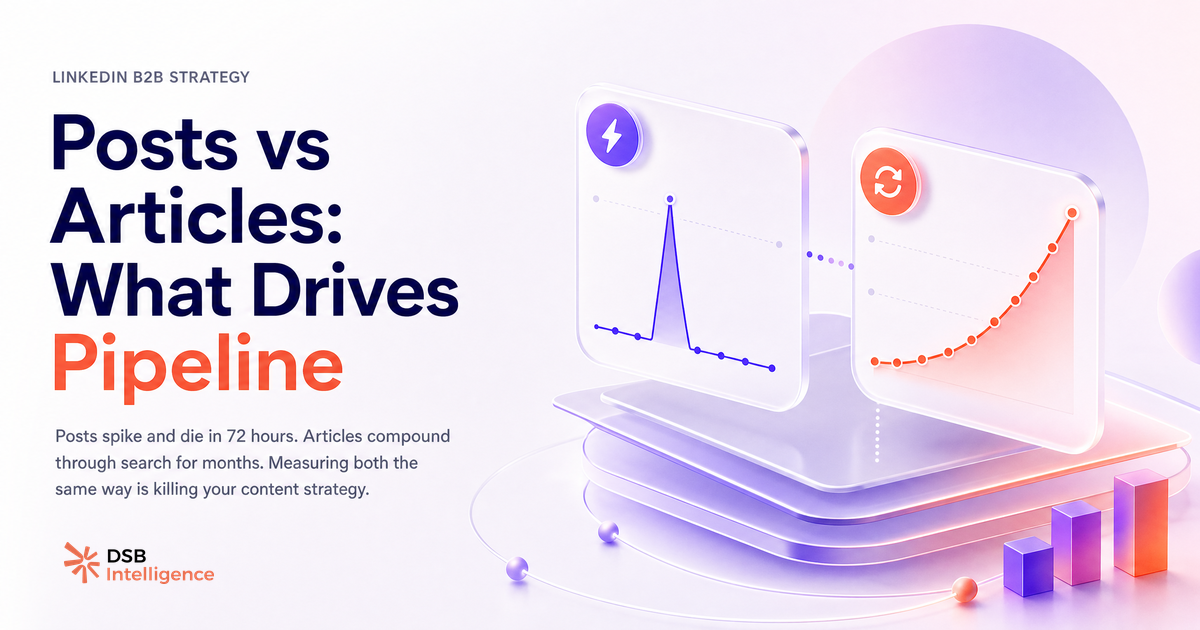
Most B2B teams treat LinkedIn like a single-format channel. They post, they measure likes, they post again. Articles sit in the background, used occasionally, measured poorly, and quietly abandoned.
That's the wrong mental model — and it's costing pipeline.
Do articles and posts actually compete for the same audience on LinkedIn?
No. That's the format gap most B2B teams get wrong.
Posts and articles don't compete for the same distribution slot. They operate on entirely different mechanics. A post enters the feed and gets evaluated by LinkedIn's algorithm within hours based on early engagement signals: reactions, comments, shares, and the time people spend reading it. If those signals are strong, reach compounds. If they're weak, the post dies by end of day.
An article doesn't work that way. When you publish an article, LinkedIn sends a single feed notification to a fraction of your network. That's it for push distribution. What happens next is pull: the article sits in LinkedIn search, gets indexed by Google, and accumulates views from people who are actively looking for that topic.
These are two completely different buyer moments. The person scrolling the feed is in discovery mode. The person searching "how to build a B2B outbound sequence on LinkedIn" is in research mode, probably three weeks from a buying decision. Serving them the same format is like running a billboard campaign to close a deal.
For a deeper look at how articles specifically fit into a long-term content strategy, LinkedIn Articles in 2026: Dead Format or Hidden Asset? breaks down the format's trajectory in detail.
What does the reach data actually look like for posts vs. articles?
Posts dominate feed reach. Articles live in search. That's the short version.
A typical LinkedIn post from a personal profile with an engaged network will generate the bulk of its impressions in the first 24 to 72 hours. The distribution curve is steep and fast. After that, impressions drop sharply unless the post gets reshared or picked up by a second wave of engagement.
Articles follow a flatter, longer curve. Initial impressions are low because there's no algorithmic feed push. But search-driven views accumulate over weeks and months. An article on a specific B2B topic can still generate profile visits six months after publication — something a post almost never does.
The implication for B2B teams is concrete: if your content goal is brand awareness or conversation, posts win on volume. If your goal is to be found by a buyer who is actively researching a problem you solve, articles are the only format on LinkedIn that gives you that surface area.
This also explains why measuring articles with post-level metrics (likes, comments, impressions in the first week) consistently makes them look like failures. They're not failing — they're being measured wrong.
The same logic applies to video. Posting Video to LinkedIn: What Determines Reach covers how video fits into this distribution picture and what signals actually drive its performance.
How do you read format-level performance signals across your content mix?
Most LinkedIn analytics tools give you a flat view: impressions, clicks, engagement rate per post. That's useful for individual post performance. It's not useful for understanding how your format mix is working as a system.
The question you actually need to answer is: which formats are driving the buyer behaviors that matter — profile visits, connection requests from target accounts, inbound messages that reference a specific piece of content?
This is where DSB Intelligence's Insight Narrator is useful. Rather than surfacing raw per-post metrics, it reads patterns across your content mix and flags where format-level signals diverge from what you'd expect: an article generating sustained profile visits weeks after publication, a post format that consistently underperforms your average despite strong topics, a newsletter issue that drove a spike in connection requests from a specific industry segment.
That kind of cross-format reading is what turns a content calendar into a pipeline signal.
When should you write an article, when should you post, and when is neither the right call?
The decision comes down to three variables: the buyer's mode, the topic's searchability, and your distribution asset.
Write an article when the topic has search intent behind it. If a buyer would type a phrase into LinkedIn or Google to find an answer, and you can write the definitive answer to that phrase, an article earns its place. This works especially well for niche B2B topics where the search volume is low but the buyer intent is high.
Post when you want reach, reaction, or to test a message. Posts are also the right format for time-sensitive content: a take on an industry event, a reaction to a product announcement, a question to your network. The feed is built for the present tense. Use it that way.
Neither format is right when the content is genuinely better served by a newsletter. A LinkedIn newsletter has push distribution (subscribers get a notification) combined with long-form depth. It's a distinct third format, not a variation of articles. LinkedIn Newsletter Is Not Email Marketing explains exactly where newsletters fit in a B2B content strategy and why conflating them with articles is a common mistake.
One more scenario where neither works: when the content is really a company page play, not a personal profile play. How to Set Up a LinkedIn Company Page That Doesn't Flatline covers the format logic specific to company pages, which follows different rules than personal profiles.
Are LinkedIn articles still worth it in 2025?
Yes, for a specific type of content and a specific type of buyer.
Articles are worth writing when three conditions are true: the topic has genuine search intent, the buyer researches before buying, and you can write something more useful than what already ranks. In B2B SaaS, enterprise software, professional services, and consulting, those three conditions are often met. The buyer does research. The topics are specific. The competition for good long-form content is lower than it looks.
Articles are not worth writing as a vanity publishing exercise. If you're writing a 1,200-word piece on "why company culture matters" because it feels like thought leadership, you're producing content that has no search surface, no feed reach, and no buyer intent behind it. That's not a format problem — it's a strategy problem.
The honest 2025 answer: articles are a durable asset when used correctly. They're a time sink when used as a substitute for having something specific to say. The format doesn't save weak content. But for B2B teams with real expertise on searchable topics, articles remain one of the few LinkedIn formats that compound over time rather than decay.
For a related angle on how LinkedIn's direct outreach formats fit into the same pipeline picture, What Is an InMail on LinkedIn? A B2B Practitioner's Guide is worth reading alongside this.
Now what?
- Audit your last 10 pieces of LinkedIn content. Separate them by format: post, article, newsletter. For each article, check profile visits and search impressions — not likes. If you've been measuring articles with post metrics, you've been making format decisions on bad data.
- Pick one topic from your pipeline where buyers actively research before buying. Write an article on it. Optimise the title for the phrase a buyer would actually search. Publish and wait three weeks before judging performance.
- Stop treating your content calendar as a single-format plan. Map each piece to a buyer mode: discovery (post), research (article), opted-in nurture (newsletter). Different formats, different jobs.
- If you want to see how your format mix is actually performing across all three dimensions, start a free trial of DSB Intelligence and let the Insight Narrator read the patterns you're currently missing.