

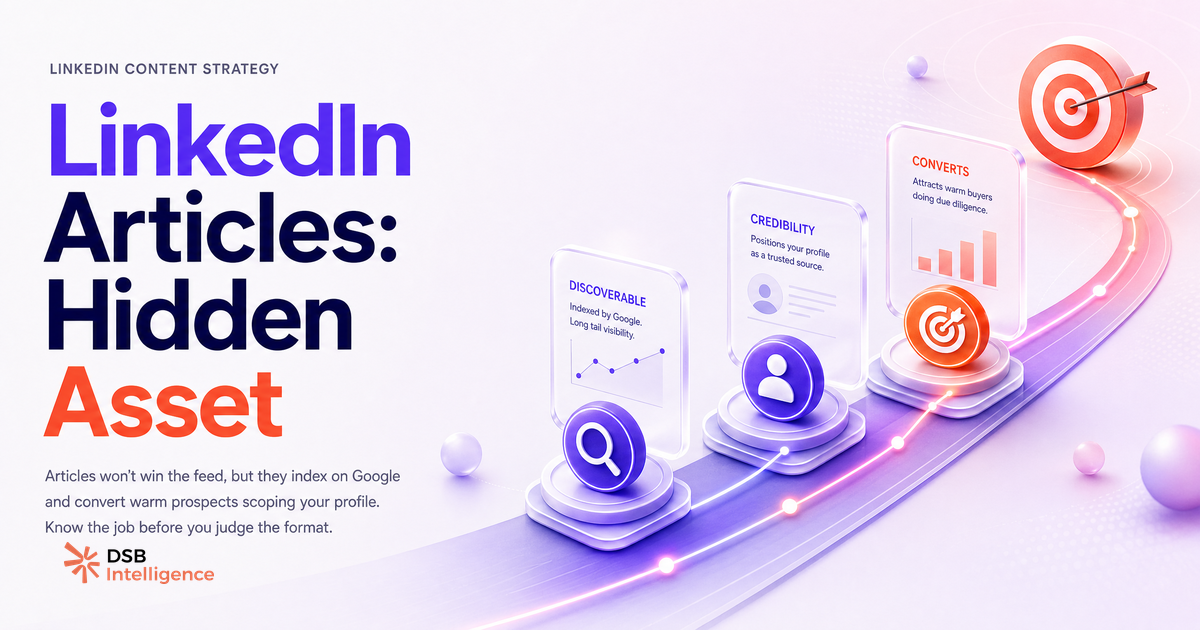
Les articles LinkedIn sont le format que tout le monde a essayé une fois, puis abandonné après avoir vu les vues. Ce serait une erreur de s'arrêter là.
Les articles LinkedIn sont-ils encore pertinents ? La réponse honnête : ça dépend de ce que tu mesures
La réponse courte : oui, mais pas pour les raisons que tu crois.
La plupart des créateurs comparent les articles LinkedIn à leurs posts en regardant le compteur de vues. C'est la mauvaise métrique. Un post texte bien construit peut atteindre plusieurs milliers d'impressions en 48 heures. Un article publié le même jour en génère dix fois moins dans le feed. Si tu mesures ça, l'article perd à chaque fois.
Mais un article LinkedIn fait quelque chose qu'un post ne fait pas : il reste. Il est indexé par Google. Il apparaît dans la section "Articles" de ton profil. Il est consulté par un prospect qui t'évalue avant un appel commercial, pas par quelqu'un qui scrolle distraitement.
Ce sont deux audiences différentes, avec deux niveaux d'intention différents. Le post capte l'attention passive. L'article capte l'intention active.
La vraie question n'est pas "est-ce que les articles LinkedIn fonctionnent ?" mais "est-ce que tu optimises pour le volume ou pour la qualité du signal ?"
Pourquoi les articles LinkedIn ont-ils moins de reach dans le feed que les posts ?
L'algorithme LinkedIn priorise les contenus qui retiennent l'utilisateur dans l'application. C'est une logique commune à toutes les plateformes sociales : plus tu gardes quelqu'un dans le feed, plus tu génères de la donnée et de l'inventaire publicitaire.
Un article LinkedIn renvoie vers une page séparée. Le lecteur quitte le feed pour lire. Ce comportement est, du point de vue de l'algorithme, une sortie. LinkedIn le pénalise en distribution, pas de façon punitive, mais par simple mécanique de priorisation.
Les posts texte natifs, les carrousels PDF et les vidéos uploadées directement restent dans l'environnement LinkedIn. Ils génèrent du dwell time sans redirection. C'est pourquoi ils sont favorisés.
Ce n'est pas une théorie : c'est le comportement observé de façon cohérente par les praticiens du contenu B2B depuis plusieurs années, et il est cohérent avec la logique de toutes les plateformes qui monétisent l'attention. Pour aller plus loin sur les formats qui maximisent la rétention, consulte LinkedIn Video Size 2026 : les specs qui arrêtent le scroll et How to Upload a Video to LinkedIn (And Make It Reach).
Quels patterns de contenu génèrent vraiment du pipeline via les articles LinkedIn ?
La majorité des articles LinkedIn publiés sont des synthèses génériques. "5 tendances du marketing B2B en 2026." "Ce que j'ai appris en 10 ans de sales." Ces formats ne génèrent pas de pipeline, parce qu'ils ne créent pas de différenciation.
Les articles qui convertissent ont trois caractéristiques communes.
Premièrement, une prise de position tranchée. Pas "voici les avantages et inconvénients de X", mais "X est surestimé, et voici pourquoi nous avons arrêté de l'utiliser". Une position assumée crée de la mémorabilité. Un prospect qui lit un article de synthèse ne se souvient pas de l'auteur. Un prospect qui lit un désaccord argumenté, si.
Deuxièmement, un cas concret documenté. Un article qui décrit une situation réelle, avec un contexte précis et un résultat observable, est plus crédible qu'un article théorique. Pas besoin de chiffres spectaculaires : la précision du contexte suffit à signaler l'expérience.
Troisièmement, une distribution complémentaire. Un article publié sans post de teaser associé ne sera pas lu. La mécanique optimale : publier l'article, puis publier un post dans les 24 heures qui extrait l'argument central et renvoie vers l'article en commentaire. Le post fait le reach, l'article fait la profondeur.
Comment l'Insight Narrator de DSB Intelligence lit-il la performance d'un article différemment d'un post ?
Les métriques natives de LinkedIn pour les articles sont limitées : vues, clics, réactions. Elles ne disent pas qui a lu, depuis quel contexte, ni ce qui s'est passé ensuite.
C'est là que la lecture change. L'Insight Narrator de DSB Intelligence ne traite pas un article comme un post avec moins de vues. Il lit les signaux comportementaux autour de l'article : est-ce que la publication de l'article a coïncidé avec une augmentation des visites de profil ? Est-ce que les lecteurs qui ont interagi sont dans la cible ICP ? Est-ce que le pattern de lecture (pic immédiat vs. trafic long tail) indique une distribution organique ou une recherche Google ?
Un article avec peu de vues mais un profil de lecteurs à forte intention vaut plus qu'un post viral consulté par des profils hors-cible. L'Insight Narrator rend cette distinction lisible, sans que tu aies à croiser manuellement les données.
Pour comprendre comment les plateformes d'automatisation traitent (ou mal-traitent) ces signaux, voir LinkedIn Automation Platforms in 2026: Claims vs Reality.
Quand publier un article, quand poster, et quand choisir la Newsletter LinkedIn ?
Ce sont trois mécaniques de distribution distinctes. Les confondre, c'est gaspiller de l'effort.
Publie un post quand tu veux maximiser la distribution immédiate. Le post texte natif reste le format le plus efficace pour atteindre une audience large rapidement. Il est éphémère par nature : sa durée de vie utile est de 48 à 72 heures dans le feed.
Publie un article LinkedIn quand tu veux créer un actif durable. L'article est fait pour être trouvé, pas pour être poussé. Il vit sur ton profil, il est indexé par Google, il est consulté par des prospects en phase d'évaluation. C'est un format de fond, pas de flux.
Publie une Newsletter LinkedIn quand tu as une audience abonnée à activer. La Newsletter envoie une notification à chaque abonné à chaque publication : c'est une mécanique de push, pas de pull. Elle est plus proche de l'emailing que de l'article. Pour comprendre la différence de logique entre Newsletter et pipeline B2B, consulte LinkedIn Newsletter : pipeline, pas emailing.
La règle simple : si tu veux être trouvé par quelqu'un qui cherche, écris un article. Si tu veux atteindre quelqu'un qui ne te cherche pas encore, poste. Si tu veux activer une audience qui t'a déjà choisi, envoie une Newsletter.
Pour aller plus loin sur la mécanique de distribution et les formats complémentaires, voir aussi InMail Credits LinkedIn : combien par mois, vraiment ? sur la logique de contact direct en complément du contenu organique.
Et maintenant ?
- Audite tes trois derniers articles LinkedIn : regarde qui les a lus, pas combien. Si tu n'as pas accès à ce niveau de granularité, c'est le premier problème à résoudre.
- Identifie un sujet sur lequel tu as une position tranchée et documentée. Pas une synthèse, une prise de position. Écris l'article autour de ça.
- Prépare un post de teaser à publier dans les 24 heures suivant l'article. Le post fait le reach, l'article fait la profondeur. Les deux ensemble.
- Teste la lecture de performance avec DSB Intelligence : l'Insight Narrator distingue les articles qui construisent de la crédibilité de ceux qui ne font que consommer du temps.