
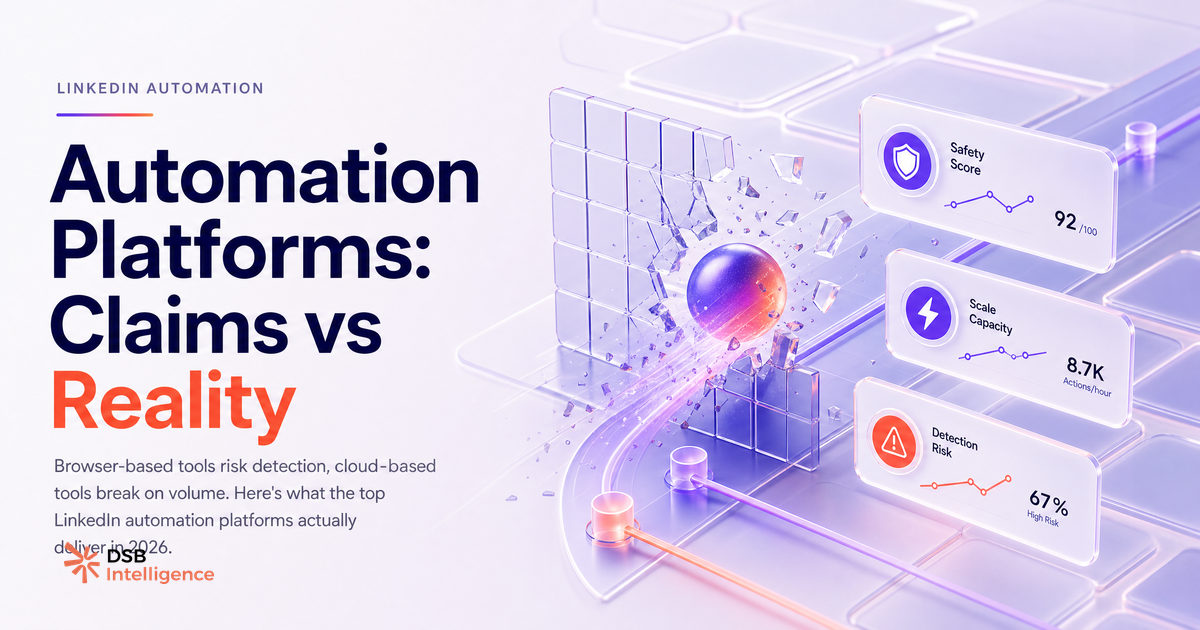
Most vendors selling a LinkedIn automation platform in 2026 lead with the same promise: scale your outreach, save time, stay safe. Two of those three are sometimes true.
What does "LinkedIn automation platform" actually mean in 2026, and what do vendors quietly skip?
A LinkedIn automation platform automates actions your SDR or founder would otherwise do manually: sending connection requests, triggering message sequences, visiting profiles, and sometimes scheduling posts. That's the honest definition.
What vendors skip in their marketing copy is the architecture distinction that actually determines your risk profile.
Browser-based tools inject automation into your active LinkedIn session. They look like a human using the browser, but LinkedIn's behavioral fingerprinting has grown more sophisticated. Unusual click cadence, inhuman response times between actions, and session patterns that don't match normal usage all feed into detection models.
Cloud-based tools run on a dedicated IP assigned to your account, separate from your browser. The behavioral pattern is cleaner. But LinkedIn can still flag accounts when action volumes exceed what a single human could plausibly do in a day, regardless of where the request originates.
Every vendor in this space claims compliance. LinkedIn's Terms of Service, section 8.2, explicitly prohibit "scraping or copying profiles and information through manual or automated means" and "using bots or other automated methods to access the Services." There is no carve-out for "safe" automation. The compliance claim is a marketing position, not a legal one.
For a broader framework on evaluating these tools before you buy, see Best LinkedIn Automation Tools: a Buyer's Framework.
What are the three failure modes that kill accounts at scale?
The failure modes are predictable. They are also rarely disclosed upfront by vendors.
Rate limit breaches are the most common. LinkedIn enforces soft and hard limits on connection requests, messages, and profile views per day and per week. These limits are not published officially, and they shift. Accounts with older tenure and higher SSI scores tolerate more volume before triggering a warning. New accounts or accounts with thin activity histories hit restrictions faster. A tool that works fine for a 5-year-old account with 3,000 connections will get a 6-month-old account restricted within days at the same settings.
Behavioral detection patterns are subtler. LinkedIn's systems look at the ratio of actions to organic activity, the timing distribution of those actions, and the gap between sent messages and profile engagement. An account that sends 80 connection requests between 8:00 and 9:00 AM with zero other activity looks nothing like a human. The pattern is the signal, not the volume alone.
Reply quality collapse is the failure mode nobody talks about. As outreach volume increases, message personalization decreases. Generic templates generate lower reply rates. Lower reply rates push SDRs to increase volume to hit the same number of responses. That cycle accelerates until the campaign is generating noise, not pipeline. The tool didn't fail technically. The strategy failed.
For a detailed breakdown of where automation gets accounts banned, LinkedIn Outreach Automation in 2026: What Works, What Gets You Banned covers the restriction patterns in depth.
How can you flag automation-driven reach decay before your account gets flagged?
The leading indicator is not a restriction notice. It's a quieter signal: your connection acceptance rate drops, your message reply rate drops, and your organic post reach starts compressing, all within the same 2-4 week window.
Most teams notice the restriction after it happens. The pattern is visible earlier if you're tracking the right metrics together rather than in isolation.
This is where DSB Intelligence's Recommendations Engine is relevant: it surfaces this type of correlated signal decay across outreach and content metrics, flagging the pattern early enough to adjust volume or pause sequences before LinkedIn's systems escalate from soft warning to hard restriction.
The key behavioral shift to watch for: a rising ratio of sent actions to received engagement. When that ratio deteriorates consistently over 10 or more days, it's a leading indicator that your account's behavioral profile is drifting into flagged territory, not a lagging confirmation that you've already been caught.
Content reach is not isolated from outreach behavior on the same account. If you're running aggressive automation and expecting your organic posts to distribute normally, that assumption deserves scrutiny. For context on how LinkedIn's feed distribution actually works for content, Posting Video to LinkedIn: What Determines Reach is worth reading alongside your outreach data.
How do Expandi, Meet Alfred, and Salesflow each break?
Each of the three main platforms has a specific breaking point. Knowing it in advance changes how you configure (or avoid) them.
Expandi is cloud-based and genuinely better than most browser extensions on detection risk. Its breaking point is volume ambition. Teams that push connection requests toward the upper range of what Expandi allows, combined with aggressive follow-up sequences, consistently report account warnings within 30 to 60 days. The tool's safety settings are conservative by default. The problem is that most users override them immediately.
Meet Alfred positions itself on multi-channel sequences: LinkedIn message, then email, then Twitter DM. The concept is sound. The execution has a documented sync problem: when a prospect replies to the LinkedIn step, the email step fires anyway if the reply detection window is too short or the CRM webhook is slow. Recipients get a follow-up email seconds after they've already responded on LinkedIn. That's not a minor UX issue. It's a trust-destroying sequence that signals automation immediately.
Salesflow is built for teams and emphasizes CRM integration. Its breaking point is timing lag. The CRM sync introduces a delay between when a prospect takes an action (accepts a connection, visits your profile) and when Salesflow triggers the next step. For high-intent signals, that lag matters. A prospect who accepts your connection and visits your profile in the same session is showing intent. A follow-up message that arrives 18 hours later, because the sync ran on a batch schedule, misses the window.
None of these are disqualifying on their own. They are known constraints. The problem is that vendor documentation doesn't surface them prominently.
For a comparison of InMail as an alternative outreach channel, InMail Credits on LinkedIn: What You Actually Get is a useful reference before committing to a pure automation-only strategy.
When is automation the wrong tool entirely?
Automation works for one specific job: following up at scale with people who have already shown some signal of interest. Inbound leads who downloaded a resource, attendees of a webinar you hosted, people who commented on a post. The signal exists. The automation adds speed and consistency to the follow-up.
Automation is the wrong tool when:
- Your ICP is VP-level and above. Senior buyers recognize templated outreach instantly. One generic sequence can close a door that would have opened with a thoughtful, manual first message.
- Your deal cycle is long and trust-dependent. Enterprise SaaS deals, professional services, and partnerships require relationship-building that a message sequence cannot replicate. Automation compresses the timeline in a way that works against you.
- Your message requires genuine context. If the right first message requires reading the prospect's last three posts, understanding their company's recent news, and referencing something specific, a template will not do that job. The personalization tokens ({first_name}, {company}) are not personalization. They are mail merge.
LinkedIn is not an email list. The norms around cold outreach are stricter, the tolerance for generic messages is lower, and the cost of a bad first impression is higher because the platform is visible and social. LinkedIn Newsletter Is Not Email Marketing makes the same point from the content side: the channel has different rules, and importing email-era tactics directly tends to underperform.
The honest position on LinkedIn automation software in 2026 is this: it's a legitimate tool for a narrow use case, operated conservatively, with close monitoring of the metrics that predict restriction before it happens.
Now what?
- Audit your current automation settings against your account's actual tenure and connection volume. If you're pushing near the upper limits your tool allows, pull back by at least 30% and monitor acceptance and reply rates for two weeks.
- Separate your outreach metrics from your content metrics in your tracking. If both are declining simultaneously, the cause is likely behavioral, not content quality.
- Before adding a new automation platform, map its specific breaking point (volume cap, sync lag, multi-channel sequencing) against your actual use case. Most mismatches are visible before you sign up.
- If your ICP is senior or your deal cycle is long, test a manual-first sequence on 20 prospects before automating anything. The reply rate difference will tell you whether automation is appropriate for that segment.
Ready to track the signals that predict account risk before LinkedIn acts on them? Start a free trial of DSB Intelligence and connect your LinkedIn analytics in under five minutes.