

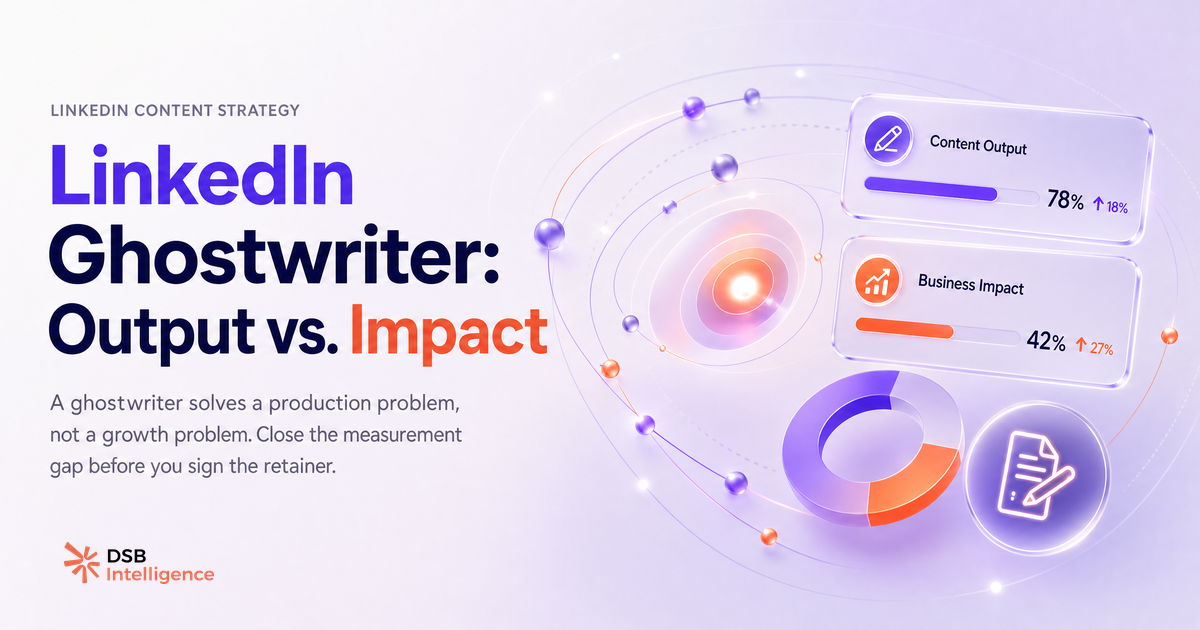
Most executives who hire a LinkedIn ghostwriter are solving the wrong problem first. They fix the content production bottleneck before they know what success looks like. Six months later, the posts are consistent, the voice sounds right, and nobody can tell you whether the engagement moved the business.
That is the structural problem with the ghostwriting market. This article maps it clearly so you can avoid it.
What does a LinkedIn ghostwriter actually do (and what can't they do for you)?
A LinkedIn ghostwriter turns your ideas, opinions, and professional experience into publishable content. That is the core job. They interview you, extract your point of view, and write posts that sound like you wrote them at your best, on a good day, with an hour to spare.
Good ghostwriters also bring a content calendar, a positioning framework, and an editorial rhythm. They know which formats hold attention on LinkedIn in a given quarter. They will push back when your brief is too generic. They will rewrite a post that reads like a press release.
What they cannot do is override the platform's distribution logic. A ghostwriter controls the input, not the output. If your account has low historical engagement, a new posting cadence will not instantly fix that. Growth on LinkedIn is cumulative and slow, regardless of content quality.
They also cannot manufacture your opinions. Ghostwriting for executives on LinkedIn works best when the writer has direct access to the executive's real convictions, not just a brand brief and a LinkedIn profile to reverse-engineer. The posts that generate genuine conversation are the ones where the executive's actual position is on the line. A ghostwriter can sharpen that position. They cannot invent it.
One more limit worth naming: most ghostwriters do not manage your LinkedIn analytics. They produce content. What that content does to your account's reach, follower trajectory, or inbound volume is typically outside their scope unless you negotiate it explicitly.
What does the market charge, and what drives pricing up?
LinkedIn ghostwriting cost is all over the map. A freelancer on the lower end of the market charges per post, often between $150 and $500 per piece depending on research depth and format. A monthly retainer covering four to eight posts sits between $1,000 and $4,000 for most mid-market freelancers.
Full-service LinkedIn content strategy agencies, where ghostwriting is bundled with positioning work, editorial planning, and some form of reporting, typically start at $4,000 to $8,000 per month. At the top end, agencies working with C-suite executives at large companies charge significantly more.
The main cost driver is not word count. It is strategy depth. A ghostwriter who simply executes your brief is cheaper than one who challenges your positioning, maps your content to a buyer journey, and adjusts the editorial plan based on what is actually performing. The second profile is rarer and more expensive for good reason.
Format complexity also moves the price. A text post costs less than a carousel. A long-form article with original research costs more than both. If you are investing in LinkedIn Video Aspect Ratio in 2026: What Gets Watched, expect video scripting to add a separate line item.
Be cautious of retainers priced purely on post volume. A contract that promises "12 posts per month" with no mention of strategy review or performance check-in is a content factory agreement, not a growth partnership.
Why do most ghostwriting engagements have no proof of impact?
The measurement gap is structural, not accidental. Ghostwriters are incentivised to produce content. Their deliverable is posts, not performance reports. Unless measurement is explicitly scoped and priced into the contract, it does not happen.
The result: most clients end the engagement without a single documented before/after comparison. They cannot tell you whether follower growth accelerated, whether profile views increased, or whether inbound connection requests changed in quality or volume. They know the posts went out. That is all.
This is not a ghostwriter problem specifically. It is a content services problem. The same gap exists in blog writing, newsletter production, and social media management. Output is easy to count. Impact is hard to attribute.
The baseline issue compounds it. To measure impact, you need a snapshot of your account metrics on day one of the engagement. Most clients do not have that. Neither does the ghostwriter. So even if you wanted to run a retrospective analysis at month six, the reference point is missing.
Linking ghostwritten content to account-level performance requires a separate analytics layer. That layer is not standard in a ghostwriting retainer. It needs to be negotiated, or sourced independently.
The Recommendations Engine in DSB Intelligence is built for exactly this gap: it tracks account-level signals across your posting history and flags when a content change correlates with a shift in reach or engagement pattern, so you can tell whether the new voice is actually landing. It does not replace the ghostwriter. It gives you the evidence layer the retainer is missing.
For context on what a compliant analytics setup looks like before you start tracking anything, LinkedIn Automation Tools in 2026: What the SERP Won't Tell You is worth reading first.
What should you ask before signing a ghostwriting retainer?
The questions below are not a checklist for eliminating bad vendors. They are a checklist for surfacing scope gaps before you sign, not after month three.
On voice capture: How do you extract my point of view? Is there an onboarding interview, an ongoing briefing process, or do you work from written inputs only? How often does that process repeat?
On strategy: Do you set the editorial calendar, or do I? What happens when a topic I want to cover does not fit the positioning you have defined?
On metrics: What baseline do you capture on day one? Which metrics do you track across the engagement? Who has access to the analytics, and how often do you share a report?
On performance: What does a 90-day success report look like? What triggers a strategy adjustment? What is the exit criteria if the account is not moving?
On compliance: How do you handle LinkedIn's terms of service around third-party posting access? If you are scheduling posts on my behalf, what tool are you using and how is my account credential managed?
That last point matters more than most clients realise. Granting login access to a ghostwriting agency without understanding the tooling creates compliance exposure. The LinkedIn Automation Tools in 2026: What the SERP Won't Tell You article covers the risk landscape in detail.
If a ghostwriter cannot answer the metrics questions clearly, measurement is not in their scope. That is not a disqualifier on its own, but it means you need to own the analytics layer yourself.
For executives building a company presence alongside a personal brand, the setup questions extend to the page level too. How to Create a LinkedIn Company Page (And What Comes Next) covers what actually matters once the page exists.
Now what?
- Before contacting any ghostwriter, pull your current LinkedIn baseline: average impressions per post over the last 30 days, follower count, and profile views. Screenshot it. You will need it at month three.
- Add a measurement clause to any retainer you negotiate. Specify who captures the baseline, which metrics are tracked, and how often you receive a performance report. If the agency does not offer this, price it separately.
- Audit your LinkedIn Hashtags in 2026: Do They Still Work? usage before the ghostwriter takes over. Small distribution levers that are already broken will not be fixed by better writing.
- If you want an independent analytics layer that tracks what your ghostwritten content actually does to your account, try DSB Intelligence free and connect your profile before the engagement starts. That way, the baseline is already captured.