

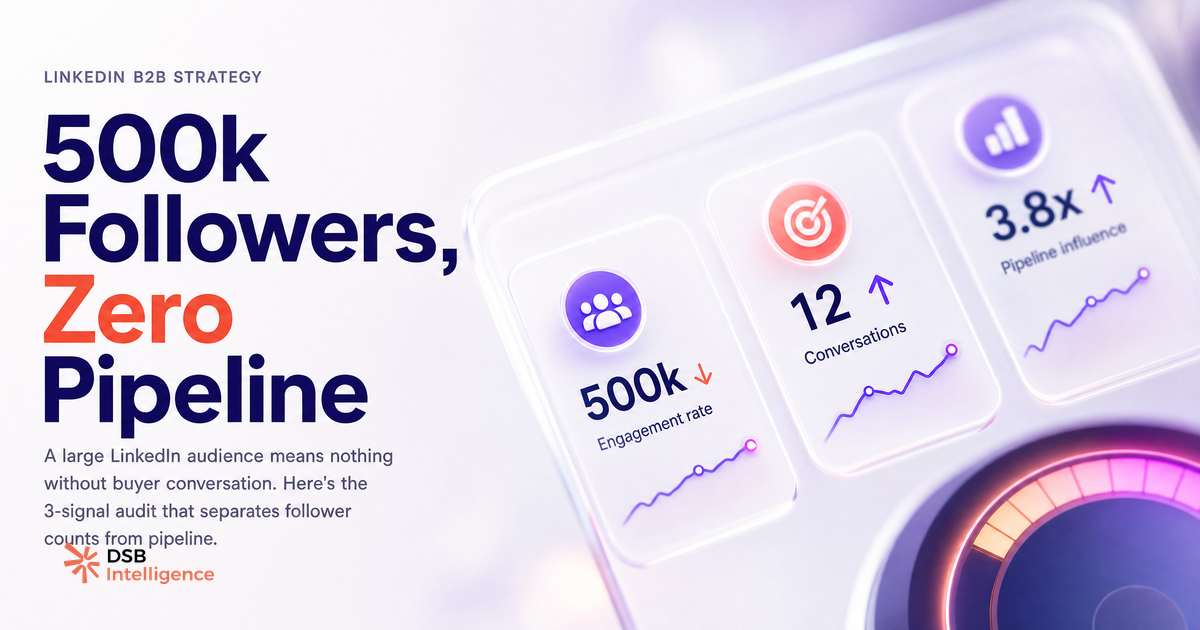
A 500,000-follower LinkedIn page that generates almost no buyer conversation is not a success story. It is a warning.
Rockwell Automation is one of the most recognized names in industrial automation globally. Its LinkedIn presence reflects exactly that: enormous brand equity, consistently low organic traction. The pattern is worth dissecting because it repeats across nearly every large manufacturing company on the platform.
What does Rockwell Automation's LinkedIn page actually show?
The page has the structural markers of a well-resourced corporate presence: consistent posting cadence, professional visuals, event coverage, product launches, and award announcements. Follower count sits above 500,000, which places it among the top-tier industrial company pages on the platform.
What is missing is conversation. Scroll through the comments on any given post and you find a predictable mix: congratulatory reactions from employees, a handful of generic "great work" responses, and almost no questions from buyers, integrators, or plant managers trying to solve a real problem.
This is not a Rockwell-specific failure. It is the default output of a corporate content process optimized for brand safety rather than buyer relevance. The content passes legal review. It does not start a commercial conversation.
If you are building or auditing a company page from scratch, How to Create a LinkedIn Company Page (And What Comes Next) covers the structural decisions that shape this outcome before the first post goes live.
Why do industrial giants get impressions but not pipeline from LinkedIn?
The core issue is a mismatch between what large industrial brands post and what their buyers are actually doing on LinkedIn.
Industrial buyers — plant engineers, procurement leads, operations directors — use LinkedIn primarily as a validation layer. They look up a vendor after a referral, after a trade show conversation, or after a Google search. They are not scrolling the feed looking for their next automation partner.
When they land on a company page and find product announcements and award posts, they confirm the company exists and is active. That is the ceiling of the interaction. Nothing in the content gives them a reason to engage, ask a question, or click through to a conversation.
The underlying dynamic is structural. Large industrial companies manage LinkedIn through corporate communications teams whose KPIs are impressions and follower growth. Neither metric is connected to pipeline. The team optimizes for what it measures, and what it measures has no commercial signal in it.
There is also a content approval problem. Any post that names a specific customer pain point, challenges a common industry practice, or takes a position on a procurement decision is a post that will spend three weeks in legal review. The content that survives is the content that offends no one, which is also the content that interests no one.
What are the 3 content signals that separate industrial brands generating leads from those generating likes?
The industrial brands that do generate commercial traction on LinkedIn share three observable content patterns. None of them require a large budget. All of them require a decision to prioritize buyer relevance over brand safety.
Signal 1: Named use case, not generic capability. "We help manufacturers improve OEE" is a capability statement. "How a mid-size automotive stamping plant cut unplanned downtime by restructuring its predictive maintenance triggers" is a use case. The second version attracts the plant engineer who has the same problem. The first attracts no one in particular.
Signal 2: Addressed to a named persona. Content that opens with "if you're a maintenance manager responsible for a multi-site operation" filters the audience immediately. It signals to the right reader that this post is for them. It signals to everyone else that they can scroll past. That filtering is not a loss — it is the mechanism that generates qualified engagement.
Signal 3: A concrete next step beyond "learn more." The weakest CTA in industrial B2B content is a link to a product page. The strongest is a specific, low-friction action: a checklist, a diagnostic question, a request to share a similar experience in the comments. Buyers do not want to be sold to. They will engage with content that helps them think through a problem they already have.
DSB Intelligence's Recommendations Engine is built to flag exactly this kind of content gap: when a brand's post mix drifts toward capability statements and away from use-case content, it surfaces the pattern early so you can correct before the engagement drop compounds.
How do you benchmark your manufacturing brand against this pattern?
Benchmarking your LinkedIn presence against the Rockwell pattern does not require access to their internal analytics. It requires a structured read of your own data.
Start with a 90-day audit of your post mix. Categorize each post into one of three buckets: product/capability announcement, use-case or problem-solving content, and social proof (awards, events, partnerships). Most industrial company pages skew heavily toward the first and third buckets. The second bucket is where commercial conversations start.
Next, audit comment quality rather than comment volume. A post with 40 generic reactions and zero questions is underperforming relative to a post with 12 reactions and three buyer questions. The ratio of substantive comments to total engagements is a more honest signal of content relevance than any aggregate engagement rate.
Finally, track the follower-to-engagement ratio over time, not as a vanity metric but as a drift indicator. If your follower count grows while your engagement rate falls, your content is attracting passive brand recognizers, not active buyers. That is the Rockwell pattern. Recognizing it early is the first step to correcting it.
Personal Branding on LinkedIn: Be the Obvious Choice covers the individual-level version of this same dynamic — worth reading alongside the company page analysis, since industrial B2B pipeline often flows through people, not pages.
For teams managing page access and content workflows across multiple contributors, How to Add an Admin to a LinkedIn Page (Right Role, First Time) is a practical starting point before scaling content operations.
When does this analysis not apply?
The Rockwell pattern describes large industrial conglomerates with broad product portfolios and heterogeneous buyer audiences. It does not describe every manufacturing company on LinkedIn.
Niche industrial verticals with tight, identifiable buyer communities behave differently. A specialty robotics integrator serving a single vertical — say, food and beverage packaging — operates in a community where buyers know each other, follow each other, and notice when a vendor posts something genuinely useful. The audience is smaller, more homogeneous, and more likely to engage substantively.
In these verticals, a company page with 8,000 followers and consistent use-case content can generate more pipeline than a 500,000-follower page optimized for brand safety. The mechanism is the same: buyer relevance. The scale is just different.
The implication for niche industrial brands is that the Rockwell benchmark is the wrong benchmark. Comparing your engagement rate to a global automation conglomerate will either demoralize you or give you false confidence, depending on which direction the gap runs. The right benchmark is a comparable company in your specific vertical, with a comparable buyer audience.
If outbound LinkedIn activity is part of your pipeline strategy alongside content, How to Send a LinkedIn InMail (And Why Most Fail) covers the targeting and messaging decisions that determine whether outreach complements your content or undermines it.
Now what?
- Run a 90-day post audit on your company page. Categorize every post: product announcement, use-case content, or social proof. If use-case content is under a third of your mix, that is your first fix.
- Read your last 10 posts' comments. Count substantive buyer questions vs. generic reactions. If the ratio is near zero, your content is not reaching active buyers.
- Pick one buyer persona your team knows well. Write one post addressed explicitly to that persona, naming their specific problem. Measure comment quality against your baseline.
- If you want a structured view of how your content mix and engagement patterns compare over time, start a free trial of DSB Intelligence and run the audit on your actual data.