

Most B2B marketing teams discover the LinkedIn Thought Leadership Ad format, get excited about the "personal brand + paid reach" pitch, and immediately boost their last post. Three weeks later, the CPL is ugly and the pipeline report is empty.
The format is not the problem. The selection process is.
What is a Thought Leadership Ad, and why is it not a boosted post?
A LinkedIn Thought Leadership Ad sponsors content published from an individual's personal profile, not from a company page. That single structural difference changes everything about how the ad is received.
When a prospect scrolls past a company-page sponsored post, they know it is an ad. When they see a post from a named person in their industry, the cognitive frame shifts. The content reads as a recommendation from a peer, not a pitch from a vendor. LinkedIn's own feed mechanics treat personal-profile content differently from company-page content, which is why organic reach from individuals has historically outpaced page posts on a per-follower basis.
A boosted post, by contrast, amplifies a company page post with limited targeting control and no access to Campaign Manager's full audience stack. A Thought Leadership Ad runs through Campaign Manager. You get matched audiences, retargeting lists, job-title filters, company-size exclusions, and conversion tracking. The creative just happens to look organic.
The author must explicitly grant your ad account permission to sponsor their posts. LinkedIn sends them a request; they accept it. They can see which posts are being amplified. There is no workaround, and there should not be: the format's credibility depends on the author's genuine ownership of the content.
For context on how personal brand strategy intersects with paid amplification, LinkedIn Rockwell Automation: What Industrial B2B Can Learn is worth reading before you build your first campaign.
What is the content signal problem, and why do most teams amplify the wrong posts?
Most teams pick posts to amplify based on impressions or likes. Both metrics are unreliable proxies for the thing that actually predicts paid performance: resonance with the right audience.
Impressions measure distribution. A post can rack up 20,000 impressions because it triggered the algorithm's initial distribution window, not because 20,000 relevant buyers found it compelling. Likes are even noisier: they skew toward the author's existing network, which may have zero overlap with your target ICP.
The signals that actually predict whether a post will convert under paid amplification are different. Dwell time (how long people pause on the post before scrolling) indicates that the content stopped someone mid-scroll. Save rate indicates that the reader found the content worth returning to. Comment quality, specifically whether comments come from job titles and company sizes that match your ICP, tells you whether the post reached the right people organically before you spend a dollar.
None of these signals are visible in LinkedIn's native analytics at the post level without additional tooling. That gap is where most teams fly blind.
A related issue is format selection. Not every format that performs organically translates to paid. LinkedIn Video Aspect Ratio: Ranked by Pipeline Impact covers which video formats hold attention long enough to matter in a paid context, which is directly relevant if your shortlisted posts include video.
How does the Recommendations Engine identify which organic posts are worth putting budget behind?
The core problem is that the decision to amplify is usually made too early, based on 48-hour performance data, and on the wrong metrics.
DSB Intelligence's Recommendations Engine monitors the full resonance curve of a post across its organic lifespan, not just the first-day spike. It flags posts where the engagement-to-impression ratio holds above the author's baseline for an extended period, and where the commenter profile matches a defined ICP. When those two conditions align, the engine surfaces the post as a candidate for paid amplification, with a plain-language explanation of why.
The output is not a score. It is a prioritized shortlist with the reasoning attached, so the marketing team can make the final call with context rather than gut feel.
This matters because the decision to put budget behind a post is a media buying decision, not a content decision. Treating it as one requires the same rigor you would apply to any paid channel: a hypothesis, a signal threshold, and a defined audience before you spend.
What is the setup playbook, from organic signal to paid amplification in four steps?
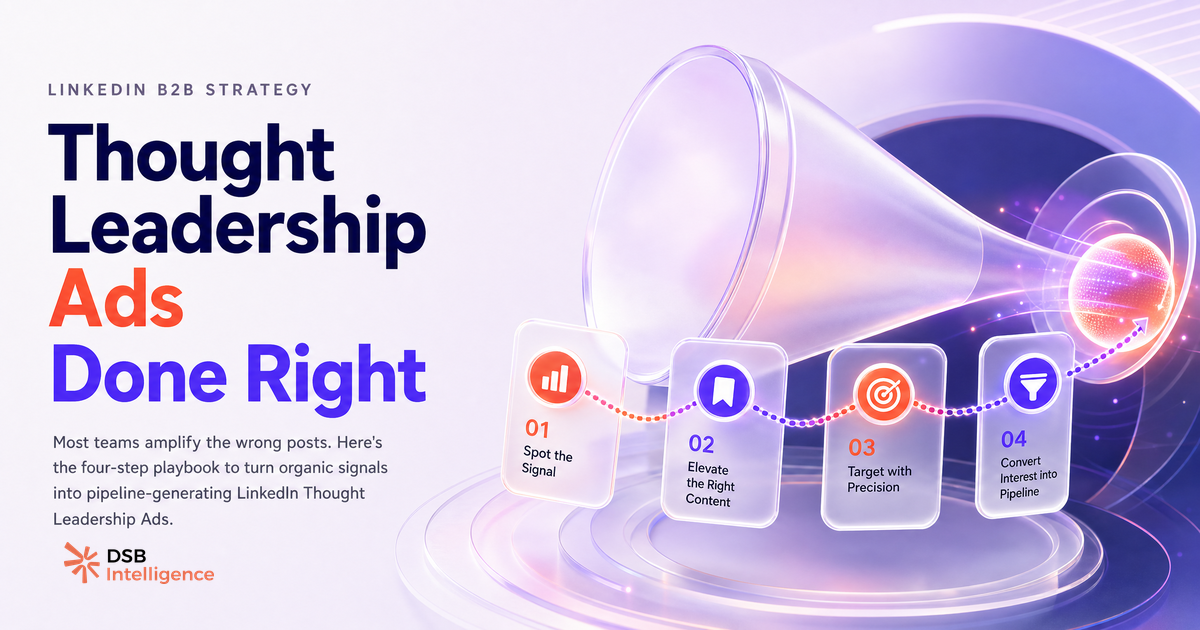
Getting from "this post is resonating" to a live Thought Leadership Ad takes four concrete steps.
Step 1: Track organic signals for at least two weeks. One week of data is not enough to distinguish a genuine resonance pattern from an algorithm spike. Two weeks gives you a stable baseline for the author's typical performance and lets you identify posts that are still pulling engagement past the initial distribution window.
Step 2: Shortlist posts with above-average resonance on the right signals. Filter for posts where dwell time, save rate, and ICP-aligned comments all exceed the author's median. Discard posts that performed on impressions alone. You are looking for posts that already worked with the right people, not posts that worked with everyone.
Step 3: Build a matched audience in Campaign Manager before you touch the creative. Define your ICP by job title, seniority, company size, and industry. Layer in a retargeting list of website visitors or existing contacts if you have one. Set a frequency cap: seeing the same post more than three times in a week turns a credible thought leadership piece into wallpaper. Check your conversion events are firing correctly before the campaign goes live. Attribution set up after launch is not attribution.
Step 4: Set a clear next step in the post or in the ad's destination. A Thought Leadership Ad that ends with "thoughts?" is a brand awareness play, not a pipeline play. The post should lead somewhere: a specific resource, a demo request, a short-form assessment. If the organic version of the post did not have a next step, add one in the sponsored version's comment or link destination.
For hashtag strategy on the organic posts you are considering for amplification, How to Add Hashtags to a LinkedIn Post in 2026 covers current best practice. And if you are evaluating which LinkedIn subscription tier makes sense alongside your paid strategy, LinkedIn Sales Navigator vs Premium: B2B Verdict is a useful reference.
When do Thought Leadership Ads not generate pipeline?
The format fails in predictable ways. Knowing them in advance saves budget.
The post lacks a next step. A post that performs well organically because it sparked a conversation does not automatically convert under paid amplification. Organic engagement is often driven by the author's existing network, who already know and trust them. A cold paid audience needs a clearer reason to act. If the post's call to action is implicit, the ad will generate impressions and maybe clicks, but the journey ends there.
The audience definition is too broad. Thought Leadership Ads are not awareness plays for general audiences. They work when the content is specific enough to resonate with a defined segment, and the targeting is tight enough to reach that segment. A post about supply chain risk management sponsored to "all LinkedIn members in North America" is money leaving the building.
Attribution is not configured. This is the most common silent killer. The campaign runs, the budget is spent, and no one can connect the ad exposure to pipeline because the conversion event was never set up, or the CRM integration was not in place. The result is that the format gets blamed for poor ROI when the measurement infrastructure was simply absent.
The author's profile does not support the content. Prospects who see a compelling post from an individual will click through to their profile before they click the CTA. If the profile is sparse, inconsistent with the post's topic, or has not been updated in two years, the credibility the ad format was supposed to generate evaporates on the profile page. The ad creative and the author's profile are one unit.
A note on competitive tooling: platforms like Taplio position themselves as content scheduling and analytics tools, but their paid amplification guidance tends to stop at the "boost your best post" level. Taplio LinkedIn Video Downloader: What B2B Teams Miss covers where that approach leaves gaps in a B2B pipeline context.
Now what?
Four actions you can take today:
- Pull the last 30 days of organic post data for your top two or three executive authors. Filter for posts where comments came from ICP-matching job titles, regardless of total impression count. That shortlist is your amplification candidates.
- Check that LinkedIn Insight Tag is firing correctly on your key conversion pages and that your Campaign Manager conversion events are mapped to actual pipeline stages, not just page views.
- Request author permissions in Campaign Manager for each executive whose posts you plan to sponsor. Do this before you need it: the approval step takes time and blocks launch if left to the last minute.
- For each candidate post, write a one-sentence "next step" that can be added as the first comment or embedded in the destination URL. If you cannot write it, the post is not ready to be amplified.
Ready to stop guessing which posts deserve budget? Start your free trial of DSB Intelligence and let the Recommendations Engine surface your next amplification candidates from real resonance data.