

The job listing is a strategy document in disguise. When a B2B company posts a LinkedIn video editor role, it tells you exactly what content bet they've already made — and how far behind their production capacity is.
B2B teams are hiring video editors at scale: what do the job listings actually say?
The pattern in LinkedIn video editor jobs posted across 2024 and into 2025 is consistent. Employers are not asking for broadcast experience or agency reels. They want someone who can turn a 45-minute webinar into three 60-second clips, add captions in under an hour, and ship content the same week it was recorded.
The skills that appear most often: short-form editing (under 2 minutes), subtitle and caption workflows, basic motion graphics for text overlays, and familiarity with LinkedIn's native video player behavior. Adobe Premiere and CapCut appear in roughly equal measure across listings — a signal that "professional" and "fast" are weighted equally.
What's absent is telling too. Almost no B2B listings ask for color grading expertise, broadcast camera operation, or long-form documentary editing. The production bar has moved down. The distribution bar has moved up.
This is a direct consequence of LinkedIn's platform shift toward video in the feed. Teams that were publishing three text posts a week now want three video clips a week, and they don't have the internal capacity to produce them. The hire is reactive, not strategic — which is exactly the problem.
Which content formats are driving that demand, and which ones generate pipeline vs. vanity metrics?
Not all video formats perform equally on LinkedIn, and the ones that look best in a portfolio are rarely the ones that move pipeline.
Talking-head clips with a direct, specific point of view consistently outperform polished brand videos in engagement depth. A founder or practitioner speaking directly to a named pain point holds attention longer than a 90-second animated explainer with a voiceover. The mechanism is straightforward: LinkedIn's professional audience responds to credibility signals, and a real face with a real opinion is a stronger credibility signal than motion graphics.
Product demos under 90 seconds are the second highest-performing format for pipeline attribution, particularly when they show a specific workflow rather than a feature overview. "Here is how we reduced our reporting time" outperforms "here is our dashboard" every time.
Event recap clips — 30 to 60 seconds cut from a conference, panel, or internal all-hands — perform well for reach but rarely drive direct pipeline. They build brand familiarity. That's valuable, but it's not what you hire a video editor to optimize for if your goal is qualified leads.
The format that consistently underperforms its production cost: the cinematic brand film. High budget, high view count, low save rate, near-zero click-through. It looks good in a board deck. It doesn't fill a pipeline.
For a deeper look at how video format interacts with paid distribution, LinkedIn Advertising Video: What Actually Drives Pipeline breaks down the organic-to-paid handoff. And if you're still calibrating your technical setup, LinkedIn Video Size 2026: The Specs That Stop the Scroll covers the format constraints that affect how your content renders in the feed.
How do you read your own video performance data before you hire anyone?
Hiring before auditing is the most common sequencing mistake in B2B content. You bring in a video editor, they produce content that looks like what worked for someone else, and three months later you have a polished library and no pipeline signal.
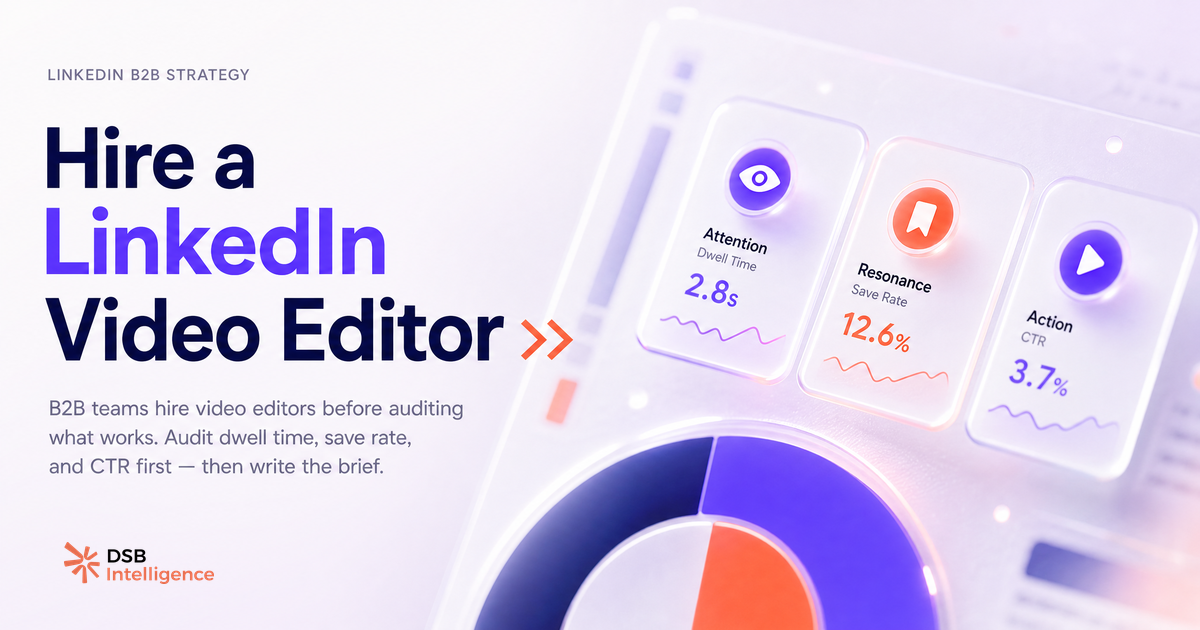
The audit takes less time than writing a job description. Pull the last 60 days of video posts. For each one, look at three metrics: dwell time (how long people actually watched), save rate (did anyone bookmark it for later), and click-through rate (did anyone take the next step). View count is the least useful number in this analysis — it measures distribution, not intent.
A video with high views and low saves is an awareness asset. That's fine, but it's not a pipeline driver. A video with moderate views, a high save rate, and a meaningful click-through rate is the template you want to replicate. That's the brief you hand to a new hire.
DSB Intelligence's Insight Narrator is built for exactly this kind of read: it surfaces the engagement pattern behind your video posts and flags which content signals genuine audience intent versus passive scroll-through, so you're not making hiring decisions based on vanity metrics.
If you haven't yet established a clear view of how different post formats perform for your audience, LinkedIn Articles vs Posts: What Actually Drives Pipeline and Can You Post Video on LinkedIn? Format Changes Everything give you the comparative baseline.
What's the playbook for commissioning video content that converts, not just content that looks good?
The brief is the strategy. Most B2B teams hand a video editor a recording and a deadline. The best teams hand them a distribution goal, an audience segment, and a desired action.
Start with the question: who is this for, and what do we want them to do after watching? If the answer is "decision-makers at mid-market SaaS companies, and we want them to book a demo," the edit looks different than if the answer is "practitioners who follow us for tactical content, and we want them to save this for later."
From there, the format follows the goal. A demo-booking video needs a clear verbal CTA in the first 15 seconds and again at the end. A save-for-later video needs a hook that signals "this is useful, not promotional" within the first three seconds. These are editing decisions, not just creative ones — which is why the brief has to come before the creative concept.
Three things to do before your next video hire:
- Run a 60-day audit of your existing video posts using dwell time, save rate, and click-through as your primary signals. Discard view count as a decision variable.
- Write one sample brief using the format: audience segment + desired action + format constraint + distribution channel. Use it as a hiring filter — ask candidates to respond to it.
- Start with a freelance engagement tied to a single content experiment (one format, one audience, four weeks) before committing to a full-time role. The experiment gives you data. The data justifies the hire.
For teams also running outbound alongside content, What Is an InMail on LinkedIn? A B2B Practitioner's Guide covers how video content and direct outreach can reinforce each other in the same pipeline motion.
If you want to track which video formats are actually moving the needle for your LinkedIn presence, start a free trial of DSB Intelligence and run the audit in minutes, not spreadsheets.