

Most B2B teams create a Showcase Page, post to it twice, then forget it exists. The sub-page sits there, follower count frozen in the low double digits, quietly telling every prospect who finds it that nobody's home.
Why do most B2B companies use Showcase Pages wrong?
The default mistake is treating Showcase Pages as a content routing problem. A team has two products, so they create two pages and split the editorial calendar down the middle. The logic feels clean. The outcome is not.
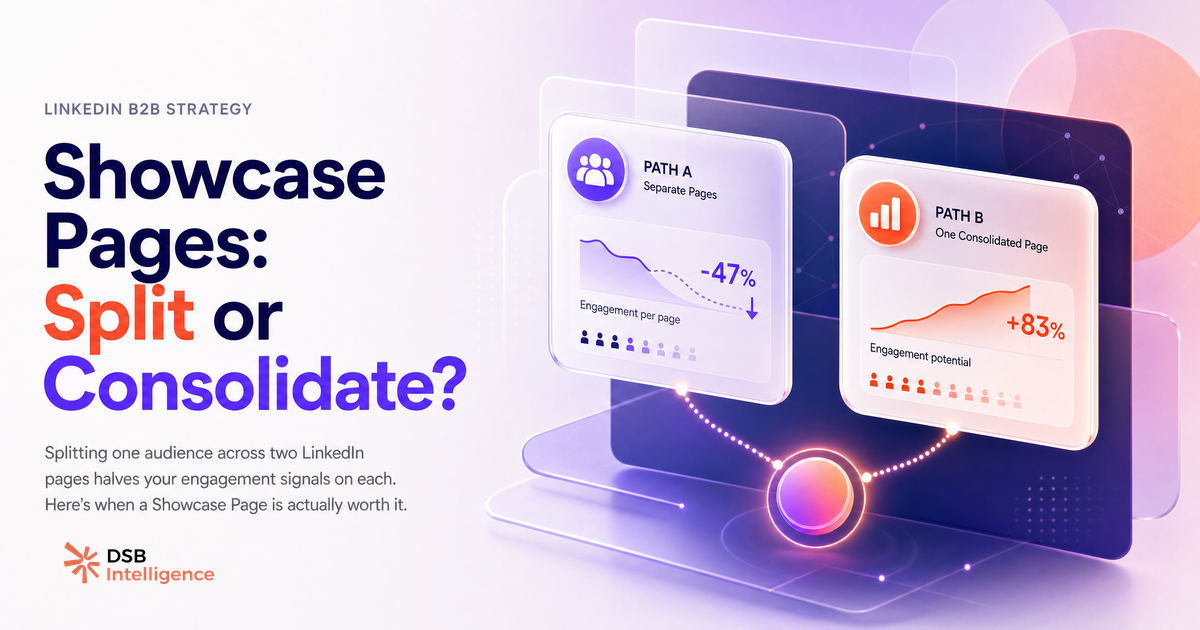
Organic reach on LinkedIn is driven by engagement velocity: how quickly a post accumulates reactions, comments, and dwell time in the first hours after publishing. That velocity is a function of your follower base size and quality. When you split one audience into two pages, you don't double your reach. You halve the signal density on each page, and the algorithm responds accordingly.
The parent Company Page also carries signals that a Showcase Page simply does not inherit. Employee connections, brand search volume, and the gravity that comes from years of follower accumulation stay anchored to the parent. A new Showcase Page starts from zero on all of those dimensions, regardless of how established the parent is.
This is the structural trap: teams expect the Showcase Page to perform like a focused version of the parent. Instead, it performs like a brand-new account with no history.
For a deeper look at how the parent Company Page distributes content organically, LinkedIn Company Page: Fix Your Organic Reach Strategy covers the mechanics in detail.
What do Showcase Pages actually do, and what does the parent page still control?
A Showcase Page gives a product line or business unit its own LinkedIn presence: a dedicated feed, a separate follower count, and standalone analytics. Followers can subscribe to the Showcase Page without following the parent. That's the feature's core value proposition.
What it does not give you: any of the parent page's authority signals. The parent retains employee count display, the "People also viewed" placement, the follower gravity, and the credibility that comes from a mature page with consistent posting history. None of that transfers.
The practical implication is that a Showcase Page must earn its audience from scratch, in parallel with the parent, with no algorithmic head start. It is a cold start problem, every time.
This matters operationally. A Showcase Page is not a lighter version of a Company Page. It requires the same editorial discipline: a content owner, a posting cadence, a defined audience, and a reason for that audience to follow this page instead of the parent. Without those four elements in place before launch, the page will underperform and stay that way.
When does a Showcase Page earn its own feed, and when doesn't it?
The architecture decision comes down to one question: would your target segment actively disengage from the parent page's content if they saw it?
If a company sells developer tooling to CTOs and also sells HR software to CHROs, those two audiences have almost no content overlap. A CTO following the parent page to see product release notes and engineering deep-dives does not want CHRO-targeted content about workforce planning in their feed. That mismatch is the exact scenario Showcase Pages were built for.
If, on the other hand, a company sells two SaaS products to the same buyer persona (say, two tools both targeting growth marketers at mid-market SaaS companies), the audience overlap is high enough that a single page with a segmented content calendar outperforms the split. The follower base stays unified, engagement signals stay concentrated, and the editorial team isn't stretched across two feeds.
A useful heuristic: if you can describe the Showcase Page's target audience in a way that explicitly excludes the parent page's core followers, the split may be justified. If the description sounds like a subset of the same audience, it isn't.
LinkedIn Content Strategy B2B: Stop Planning in the Dark walks through how to build a segmented content calendar on a single page before you consider splitting into multiple ones.
How do you track whether your Showcase Page is pulling its weight or cannibalizing your main page?
The two metrics that matter most are follower growth rate and engagement rate per post, tracked in parallel across both pages over a minimum of 90 days.
If the Showcase Page follower growth rate is flat or declining while the parent page continues to grow, the split is not generating net-new audience. It is redistributing attention from a stronger signal to a weaker one. That redistribution has a cost: the parent page's engagement velocity drops because some of the team's content and editorial energy is being spent on a page that isn't compounding.
Engagement rate per post is the second signal. A Showcase Page targeting a genuinely distinct audience should, over time, show higher engagement rates than the parent page on the content relevant to that segment. If the Showcase Page engagement rate is consistently lower than the parent's, the audience is either not there yet or not distinct enough to justify the split.
The Insight Narrator in DSB Intelligence surfaces exactly this pattern: it reads the engagement distribution across both pages and flags when a Showcase Page is drawing down the parent's signal without building its own. That's the kind of early warning that prevents teams from running a failed split for six months before noticing.
For content types that tend to generate stronger dwell time signals on LinkedIn, Posting Video to LinkedIn: What Determines Reach and LinkedIn Video Ads vs Organic Video: What Drives Pipeline are worth reading alongside your Showcase Page content planning.
What is the one scenario where Showcase Pages are worth the operational overhead?
A multi-product B2B company with one product line sold to a buyer persona that is categorically different from the others. Not slightly different. Categorically different: different job titles, different content consumption habits, different vocabulary, different pain points.
The clearest real-world pattern is a company that has one technical product (sold to engineers or IT) and one business product (sold to finance, HR, or operations). The content that converts a VP of Engineering is not the content that converts a CFO. Mixing them on a single page creates noise for both audiences and reduces the relevance signal for each.
In that scenario, a Showcase Page with a dedicated content owner, a defined posting cadence, and a follower acquisition strategy (paid promotion to seed the initial audience, employee advocacy to sustain it) can build a genuinely distinct channel that outperforms what the parent page could do alone for that segment.
Outside that scenario, the overhead is rarely justified. Creating and maintaining a Showcase Page requires the same editorial infrastructure as a Company Page. If the team can't staff it, the page will stall. An abandoned Showcase Page is worse than no Showcase Page: it signals to every visitor that the company started something and gave up.
Download LinkedIn Video: What It Reveals About B2B Teams covers a related operational signal worth tracking when you're auditing how your team manages multi-channel LinkedIn content.
Now what?
- Audit your existing Showcase Pages (or your plan to create one): write down the target audience in one sentence. If that sentence describes a subset of your parent page's audience rather than a categorically different buyer, close the Showcase Page or don't create it.
- If you proceed with a Showcase Page, assign a dedicated content owner before launch. No owner, no page.
- Set a 90-day review gate: track follower growth rate and engagement rate per post on both pages. If the Showcase Page isn't growing its own follower base by day 90, consolidate back to the parent.
- Use the parent page's analytics as your baseline. Any content that performs well on the parent page should be tested on the Showcase Page only if it's genuinely relevant to the distinct audience, not just repurposed for volume.
If you want to track both pages in one place and catch the cannibalization signal before it costs you six months of reach, start a free trial of DSB Intelligence.