

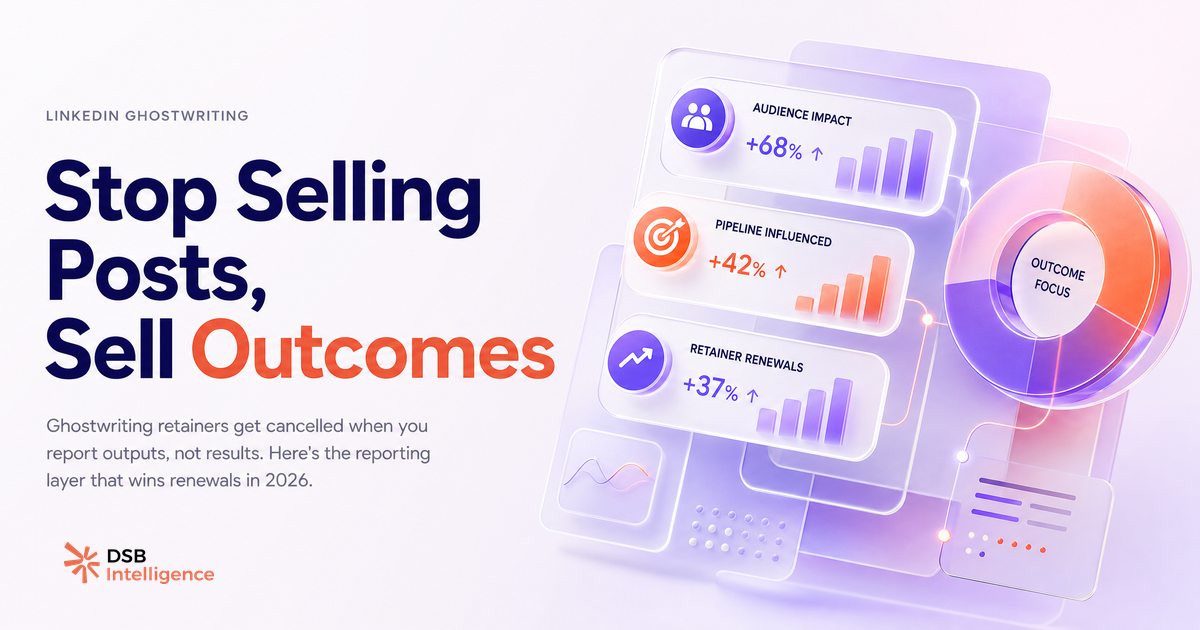
Most LinkedIn ghostwriting retainers get cancelled not because the writing was bad, but because nobody could prove it worked.
That's the real problem in this market — and it's entirely fixable.
What does a LinkedIn ghostwriter actually deliver?
The deliverable is not a post. It's a consistent editorial presence that a busy executive or founder could never maintain alone.
A ghostwriter takes the client's raw material — interviews, voice notes, opinions, past talks — and converts it into a publishing cadence. Three to five posts per week, a coherent point of view, a tone that sounds like the person and not like a content mill. That last part is where most of the craft lives: matching voice is harder than writing well.
The best ghostwriters also make editorial decisions. They kill the post that's too safe. They push the client toward a contrarian take when the obvious angle is crowded. They notice that a particular topic consistently outperforms and double down on it before the client asks.
That's strategy work, not copywriting. And it's why the better agencies bill it differently.
For context on what a strong LinkedIn content strategy looks like at the company level, LinkedIn Rockwell Automation: What Industrial B2B Can Learn is a useful reference — the same principles of editorial consistency apply to personal profiles.
How much do LinkedIn ghostwriters charge, and what justifies the price gap?
Rates span a wide range, and the gap is not arbitrary.
At the low end, you find per-post pricing or thin monthly packages: a writer who takes a brief, produces copy, and delivers a Google Doc. No interviews, no strategy, no reporting. These services exist, they're not worthless, but they produce generic content that sounds like every other ghostwritten profile.
Mid-tier retainers typically include a monthly strategy call, 8-12 posts, and some form of performance review. The writer invests time understanding the client's market, their competitors' positioning, and the conversations happening in their niche. That research time is what you're paying for — not the hours spent typing.
High-end engagements add a full analytics layer. The agency tracks profile visits, follower growth, post reach, inbound connection requests from target personas, and — where the client has CRM discipline — pipeline sourced from LinkedIn. They present this monthly in a format the client can share internally.
The price gap between a low-end and high-end retainer often reflects one variable: can the agency answer "what did this produce?" at the end of the month? If yes, the retainer is defensible. If not, it's a cost centre waiting to be cut.
Setting up the right infrastructure matters here too. LinkedIn Company Page Setup: What Most Teams Get Wrong covers the baseline configuration errors that silently cap organic reach — worth auditing before any ghostwriting engagement starts.
Why do most ghostwriting engagements die at renewal?
The answer is almost always the same: the agency reported on outputs, not outcomes.
"We published 14 posts this month" is an output. It tells the client you did the work. It tells them nothing about whether the work mattered.
Outcomes look like: profile visits from decision-makers in the target ICP, a measurable increase in organic reach over the quarter, inbound messages from prospects who mentioned a specific post. These are the numbers that survive a budget review.
The structural problem is that most ghostwriting agencies are not instrumented to capture outcomes. They write, they publish, they move on. At renewal, they send a deck with screenshots of posts and a vague claim that "engagement is up." The client, who has been half-paying attention, can't tell if that's true or meaningful.
Organic reach on LinkedIn follows a pattern familiar to anyone who has looked at the distribution carefully: a small number of posts drive a disproportionate share of total impressions. The ghostwriter's analytical job is to identify which posts hit that threshold and why — then replicate the conditions. Without that analysis, the engagement is essentially running blind.
This is exactly the gap that DSB Intelligence's Insight Narrator is built to close. It reads the performance pattern across a client's post history and surfaces the signal in plain language: which topics, formats, and posting rhythms are actually driving reach, and which are filling the calendar without moving the needle. That output goes directly into the monthly client brief.
What does a defensible ghostwriting retainer look like in 2026?
Three components, non-negotiable.
First: a documented editorial strategy. Not a content calendar. A written thesis about what the client stands for, which audiences they're trying to reach, and what a successful post looks like for this specific person. This document is what you update quarterly and what you point to when the client asks "why are we writing about this?"
Second: a production process with clear inputs. The ghostwriter needs raw material. The best retainers include a 30-minute monthly interview, access to the client's existing talks or newsletters, and a standing brief for the client to flag topics they care about. Without inputs, the writer invents a persona — and invented personas sound hollow.
Third: a monthly analytics brief the client can share with their CFO. This is the retention mechanism. It doesn't need to be a 20-slide deck. A one-page summary covering reach trend, top-performing posts, profile visit trajectory, and one forward-looking recommendation is enough. The goal is to make the value legible to someone who wasn't in the room.
Video content is increasingly part of the ghostwriting scope in 2026 — clients want short-form clips alongside written posts. Taplio LinkedIn Video Downloader: What B2B Teams Miss and LinkedIn Video Ad Specs: What Actually Drives Results are worth reading before adding video to a retainer scope. And if you're thinking about building an in-house content team rather than outsourcing, LinkedIn Video Editor Jobs: What B2B Hiring Reveals shows what the market actually looks like right now.
The agencies winning ghostwriting renewals in 2026 are not the ones with the best writers. They're the ones who built a reporting layer that makes the value of good writing visible to a non-practitioner. That's the product. The posts are just the evidence.
Now what?
- Audit your current ghostwriting retainer (or pitch): can you answer "what did this produce last month?" with a number? If not, fix the reporting before the next renewal conversation.
- Map your top five posts from the last 90 days by reach. Find the pattern — topic, format, day, hook structure. That pattern is your editorial strategy, whether you've written it down or not.
- Build a one-page monthly brief template: reach trend, top post, profile visit change, one recommendation. Send it before the client asks.
- If you're instrumenting a ghostwriting engagement at scale, try DSB Intelligence free — the Insight Narrator turns raw LinkedIn analytics into the client-readable brief you need to survive renewal.