

Most executives who hire a personal branding agency expect one thing: to become known. What they get, more often than not, is a content calendar and a monthly PDF showing their impressions went up.
That gap is not accidental. It is structural.
What does a personal branding agency actually do (beyond content calendars and headshots)?
A personal branding agency builds the infrastructure of a professional's public identity. At its best, that means three things: positioning, production, and distribution strategy.
Positioning is the hard part. It means deciding what the executive stands for, which audience they are speaking to, and what angle makes them distinct from the other 50 founders posting about AI or leadership. Good agencies spend real time here. Most skip it and go straight to content.
Production is what most clients actually pay for. Ghostwritten posts, LinkedIn carousels, newsletters, short-form video scripts. The agency interviews the executive, extracts ideas, and turns them into publishable content. This is legitimate work. It takes skill to capture someone's voice at scale.
Distribution strategy is where most agencies underdeliver. Knowing when to post, how to engage in comments, which conversations to enter, which profiles to collaborate with — this requires ongoing data, not a one-time setup. Most agencies treat it as a checkbox, not a discipline.
What agencies rarely own: the measurement of business outcomes. That accountability gap is where clients lose money.
If you want to understand what you are actually buying when you hire a ghostwriter specifically, LinkedIn Ghostwriter: What You're Buying and What You're Not breaks down the economics and the limits of that engagement model.
Why do the metrics most agencies report tell you almost nothing?
Because they are easy to pull and hard to challenge.
Impressions, follower growth, engagement rate — these numbers go up over time for almost any account that posts consistently. They are a function of activity, not influence. An executive with 12,000 followers and a 4% engagement rate from other marketers is not building pipeline. They are building an audience of peers.
The core problem is attribution. LinkedIn does not expose who read your post and then booked a demo three weeks later. That invisibility lets agencies report on what they can measure, not on what matters.
Engagement rate is the most abused metric in this space. A post that gets 200 likes from other founders in your industry feels good. But if your buyers are CFOs at mid-market SaaS companies, those 200 likes are noise. The question is not "did people engage?" It is "did the right people see it?"
Most agencies do not ask that question because answering it requires audience-level analytics they do not have access to, or do not prioritize building.
What does measurable output actually look like: pipeline influence, share of voice, inbound quality?
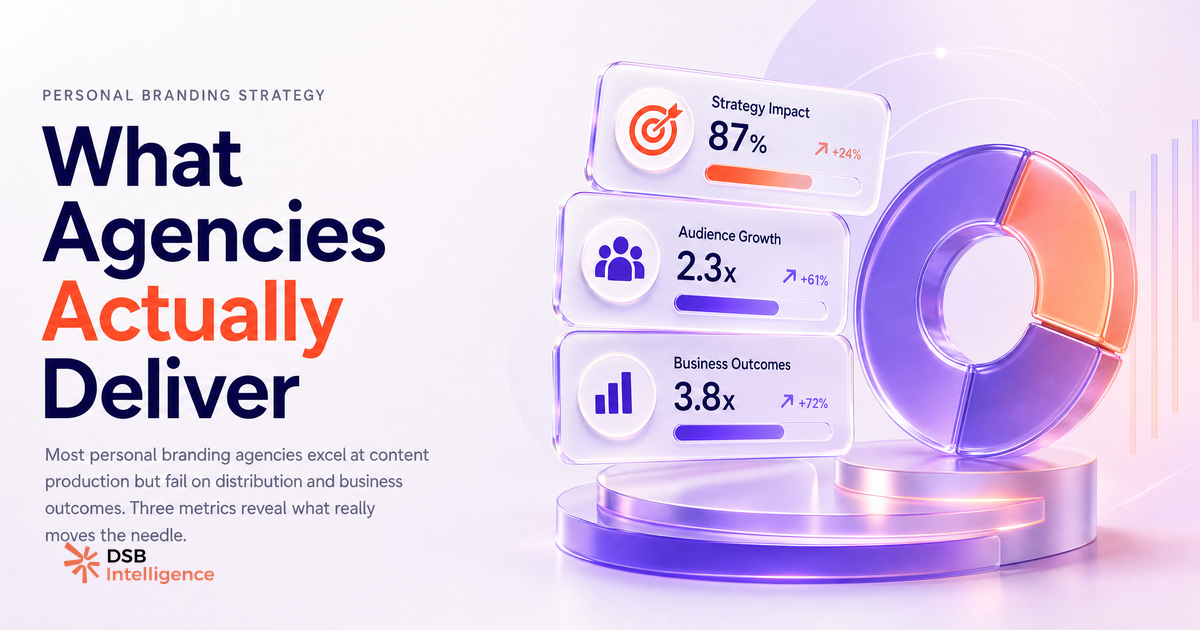
Three metrics are worth tracking. Each requires more effort than a screenshot of LinkedIn analytics, but each connects to business outcomes.
Share of voice measures how often your name or content surfaces in conversations around a defined topic, relative to peers and competitors. If you are a B2B cybersecurity founder and your posts consistently appear in discussions about zero-trust architecture, you are building topical authority. If your posts are about "lessons from my morning run," you are not. Share of voice is directional, not precise, but it tells you whether you are owning a niche or just occupying a feed.
Inbound conversation quality is a leading indicator most executives track informally but rarely systematize. The signal is not "I got a DM." The signal is "I got a DM from a VP of Engineering at a 500-person company who referenced a specific post." That specificity tells you the content is reaching the right audience and triggering the right response. Track the job title and company size of every inbound conversation for 90 days. The pattern will tell you more than any agency report.
Decision-maker reach is the hardest to measure but the most valuable. What percentage of your post's audience holds a title like Director, VP, or C-level at companies in your ICP? LinkedIn's native analytics give you a rough cut. Dedicated tools go deeper, surfacing the actual company distribution of your followers and post viewers.
For context on how LinkedIn visibility connects to pipeline more broadly, Personal Branding on LinkedIn: Be the Obvious Choice maps the full funnel from content to commercial outcome.
How does DSB Intelligence track personal brand performance for agency clients?
The gap between "we posted 12 times this month" and "here is what moved" is a data problem.
DSB Intelligence's Insight Narrator is built for exactly this: it reads the distribution of your content's reach by seniority, company size, and topic cluster, then surfaces whether your audience composition is drifting toward or away from your ICP. Instead of a monthly PDF showing impressions, you get a structured read of whether the right people are actually in the room.
For agencies managing multiple executive profiles, this matters operationally. You can see which content formats are pulling decision-maker attention, which topics are generating the right inbound signals, and where a profile's share of voice is growing or stalling. That is the layer of accountability most agency-client relationships are missing.
It also changes the conversation with the client. Instead of defending a follower count, you are discussing audience quality and content-to-conversation conversion. That is a harder conversation, and a more honest one.
When does hiring a personal branding agency make sense — and when does it not?
Hiring a personal branding agency makes sense in one specific scenario: the executive has a clear, differentiated point of view, genuine expertise worth amplifying, and no time or writing capacity to produce content consistently. The agency's job is execution, not invention.
It does not make sense when the positioning is still undefined. Agencies amplify a signal. If the signal is weak or generic ("I help companies grow"), amplifying it faster just produces more noise. The positioning work has to come first, and most executives underestimate how long it takes to get it right.
It also does not make sense as a substitute for actual engagement. A ghostwritten post can start a conversation. Only the executive can finish it. Agencies that promise to manage your comments and DMs are managing your relationships, which is a different kind of risk.
A few questions worth asking before signing a contract:
- What is the agency's measurement framework, and which metrics are tied to business outcomes (not just platform metrics)?
- Who owns the positioning work, and how long does it take before content production starts?
- How does the agency handle topics where the executive has no genuine expertise or opinion?
If the answers are vague, the deliverable will be too.
For executives thinking about LinkedIn outreach alongside content, How to Send a LinkedIn InMail (And Why Most Fail) covers the targeting and messaging side that most agencies ignore entirely.
On the compliance side, if your agency is using any automation to manage posting or engagement, LinkedIn Automation Tools in 2026: What the SERP Won't Tell You is worth reading before you sign off on their tech stack.
And if you are building a company presence alongside the executive profile, How to Create a LinkedIn Company Page (And What Comes Next) covers what actually matters after the setup.
Now what?
- Pull your last 90 days of inbound LinkedIn conversations. Log the job title and company size of each person who reached out. That is your baseline for audience quality, independent of what any agency reports.
- Define your ICP in one sentence: title, company size, industry. Then ask your agency to show you what percentage of your post audience matches it. If they cannot answer, that is your answer.
- Pick one topic you want to own in your niche. Track how often your posts appear in comments and conversations around that topic over the next 60 days. That is your share of voice proxy.
- If you want a structured measurement layer across all three dimensions, start a free trial of DSB Intelligence and connect your LinkedIn profile. The Insight Narrator will show you who is actually in your audience, not just how many of them there are.